UNITED STATES
SECURITIES AND EXCHANGE COMMISSION
WASHINGTON, D.C. 20549
SCHEDULE 14A
PROXY STATEMENT PURSUANT TO SECTION 14(a)
OF THE SECURITIES EXCHANGE ACT OF 1934
Filed by the Registrant [X]
Filed by a party other than the Registrant [ ]
Check the appropriate box:
| [ ] | Preliminary Proxy Statement | ||||
| [ ] | Confidential, for Use of the Commission Only (as permitted by Rule 14a-6(e)(2)) | ||||
| [X ] | Definitive Proxy Statement | ||||
| [ ] | Definitive Additional Materials | ||||
| [ ] | Soliciting Material under §240.14a-12 | ||||
(Name of Registrant as Specified In Its Charter)
(Name of Person(s) Filing Proxy Statement, if other than the Registrant)
Payment of Filing Fee (Check all boxes that apply):
| [X ] | No fee required | ||||
| [ ] | Fee paid previously with preliminary materials. | ||||
| [ ] | Fee computed on table in exhibit required by Item 25(b) per Exchange Act Rules 14a-6(i)(1) and 0-11. | ||||

IMAX Corporation 902 Broadway, 20th Floor New York, New York, U.S.A. 10010 | |||||
| April 24, 2026 | |||||
Dear Fellow Shareholders:
IMAX delivered the strongest performance in our history in 2025, cementing our position as a premier global platform for awe‑inspiring experiences. We achieved record global box office, market share, and revenue; further expanded our footprint across key markets; and drove strong profitability and cash flow — resulting in share price growth of 44% during the calendar year.
From the outset, we saw opportunity in a robust slate and seized upon it with strong execution — exceeding our ambitious targets by strengthening our global content portfolio and making IMAX even more indispensable to so many of the world’s greatest filmmakers and most passionate moviegoers.
From China’s “Ne Zha 2” and Japan’s “Demon Slayer: Infinity Castle” to Filmed For IMAX® Hollywood hits including “F1: The Movie” and “Mission: Impossible – The Final Reckoning,” IMAX continues to prove invaluable in launching the biggest blockbusters. We’re also expanding into new events and experiences – from live events to music, gaming, and sports – that help drive utilization of our network throughout the year.
Building on our box office momentum, we signed agreements for 166 new and upgraded IMAX theater systems with both longstanding and new exhibitor partners, including a massive agreement for 80 new and upgraded locations with AMC. We also completed 160 system installations – the high end of our projections for the year.
2026 boasts our biggest lineup of Filmed For IMAX releases ever – films shot with IMAX cameras specifically to be experienced on our screens. The slate is headlined by “The Mandalorian & Grogu,” “Narnia,” “Dune: Part Three,” and Christopher Nolan’s “The Odyssey,” the first feature shot entirely with IMAX film cameras. Hotly anticipated Hollywood films, including “Toy Story 5,” “Moana” and “Minions & Monsters,” also lie ahead alongside a robust lineup of international films.
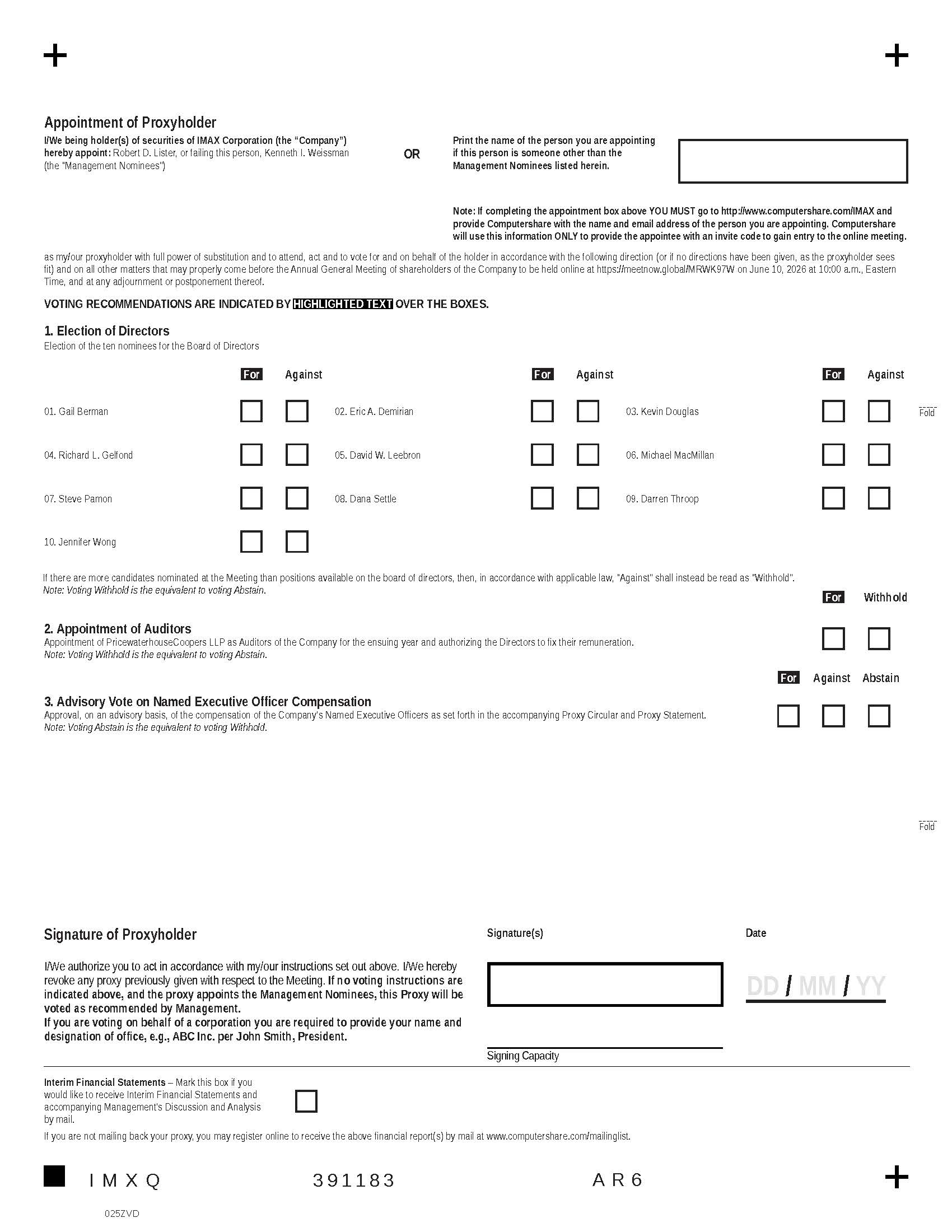
I invite you to attend our 2026 Annual General Meeting of Shareholders, scheduled to be on June 10, 2026 via live audio webcast. Shareholders will be asked to vote on several proposals, details of which are set forth in the accompanying Notice of Annual General Meeting and Proxy Circular and Proxy Statement. Your vote is important, and we encourage you to ensure your shares are represented. You may vote by completing and returning the accompanying Form of Proxy. You may also vote online, by phone, or at the meeting. Please refer to the Proxy Circular and Proxy Statement for instructions and additional details.
We are energized by our historic success, but even more excited about the opportunity ahead to grow and deliver strong returns for our shareholders. I look forward to sharing our progress with all of you.
Sincerely,
| /s/ Richard L. Gelfond | ||
| Richard Gelfond | ||
| CEO, IMAX Corporation | ||
IMAX Corporation 902 Broadway, 20th Floor New York, New York, U.S.A. 10010 | April 24, 2026 | ||||
NOTICE of ANNUAL GENERAL MEETING of SHAREHOLDERS
to be held on
Wednesday, June 10, 2026
NOTICE IS HEREBY GIVEN that the Annual General Meeting of Shareholders of IMAX Corporation (the “Company”) will be conducted as a virtual meeting via live audio webcast at: meetnow.global/MRWK97W on Wednesday, June 10, 2026 at 10:00 a.m. (Eastern Time) (the “Meeting”), for the following purposes:
(1)to receive the consolidated financial statements for the fiscal year ended December 31, 2025, together with the auditors’ report thereon;
(2)to elect the ten individuals nominated to serve as directors until the close of the next annual general meeting of shareholders or until their successors are elected or appointed;
(3)to appoint auditors and authorize the directors to fix the auditors’ remuneration;
(4)to conduct an advisory vote on the compensation of the Company’s Named Executive Officers; and
(5)to transact such other business as may properly be brought before the Meeting or any adjournments thereof.
The foregoing items of business are more fully described in the Proxy Circular and Proxy Statement accompanying this Notice of Annual General Meeting of Shareholders.
Only shareholders of record as of the close of business on April 13, 2026 are entitled to notice of and to vote at the Meeting.
By Order of the Board of Directors,
/s/ Kenneth I. Weissman
KENNETH I. WEISSMAN
Deputy General Counsel & Corporate Secretary
Registered shareholders and duly appointed proxyholders will be able to attend the Meeting, ask questions and vote, all in real time, by going to meetnow.global/MRWK97W, provided they are connected to the Internet and comply with all of the requirements set out in the Proxy Circular and Proxy Statement accompanying this Notice of Annual General Meeting of Shareholders. Responses to questions received during the Meeting will be provided in a format that is accessible by all meeting attendees. Beneficial shareholders who have not duly appointed themselves as a proxyholder will be able to attend the Meeting as guests provided they are connected to the Internet. Guests will be able to listen to the meeting, but will not be able to vote or submit questions at the Meeting.
Shareholders who wish to appoint a person other than the management nominees identified in the accompanying form of proxy (the “Form of Proxy”) or Voting Instruction Form as their proxy (including beneficial shareholders who wish to appoint themselves to attend) must carefully follow the instructions in the accompanying Proxy Circular and Proxy Statement and on their Form of Proxy or Voting Instruction Form. These instructions include the additional step of registering such proxyholder with our transfer agent, Computershare Investor Services Inc., after submitting their Form of Proxy or Voting Instruction Form. Failure to register the proxyholder with our transfer agent will result in the proxyholder not receiving an invite code to participate and vote at the Meeting and only being able to attend as a guest.
1
YOUR VOTE IS IMPORTANT.
Shareholders who are unable to attend the Meeting online are requested to complete and return the accompanying Form of Proxy in the envelope provided for that purpose. Proxies must be received by Computershare Investor Services Inc., c/o Proxy Unit, 100 University Avenue, 8th Floor, Toronto, Ontario, Canada, M5J 2Y1 or at the Company’s address noted above on or before 10:00 a.m. (Eastern Time) on Monday, June 8, 2026. Shareholders may also vote in advance of the Meeting on or before 10:00 a.m. (Eastern Time) on Monday, June 8, 2026 by following the instructions for voting by telephone or over the Internet in the accompanying Proxy Circular and Proxy Statement.
2
PROXY CIRCULAR
AND
PROXY STATEMENT
IMAX CORPORATION
902 Broadway, 20th Floor, New York, New York, U.S.A. 10010
tel: 212-821-0100
www.imax.com
Contents
(i)
Cautionary Note Regarding Forward-Looking Statements
This Proxy Circular and Proxy Statement (this “Circular”) contains “forward-looking statements” within the meaning of the U.S. Private Securities Litigation Reform Act of 1995 or “forward-looking information” within the meaning of Canadian securities laws. Words such as “aim,” “anticipate,” “believe,” “can,” “contemplate,” “continue,” “could,” “designed,” “encourage,” “estimate,” “expect,” “forthcoming,” “future,” “goal,” “intend,” “likely,” “may,” “objective,” “plan,” “potential,” “projection,” “propose,” “recommend,” “scheduled,” “seek,” “shall,” “should,” “strategy,” “will,” “wish,” “would,” or the negative thereof, and similar expressions identify forward-looking statements and forward-looking information.
These forward-looking statements and forward-looking information include, but are not limited to statements regarding: anticipated growth and trends in our businesses and markets, industry outlooks, market share, technology transitions, strategies and financial performance; our development of new products and releases, technologies and capabilities; the Company’s governance, compensation, and human capital policies and the risks and benefits thereof; and other statements that are not historical fact, and actual results could differ materially. These forward-looking statements are based on certain assumptions and analyses made by the Company in light of its experience and its perception of historical trends, current conditions and expected future developments, as well as other factors it believes are appropriate in the circumstances. Risk factors that could cause actual results to differ are set forth in the “Risk Factors” section of, and elsewhere in, our annual report for the fiscal year ended December 31, 2025 on Form 10-K and other filings with the United States Securities and Exchange Commission (the “SEC”). Consequently, all of the forward-looking statements made in this Circular are qualified by these cautionary statements, and actual results or anticipated developments by the Company may not be realized, and even if substantially realized, may not have the expected consequences to, or effects on, the Company. The forward-looking statements herein are made only as of the date hereof and the Company undertakes no obligation to update publicly or otherwise revise any forward-looking statements, whether as a result of new information, future events or otherwise.
Incorporation by Reference
References to websites, reports, awards, datasets, publications, or other materials prepared or maintained by third parties, IMAX’s website address and additional Company reports or information contained on the website throughout this Circular are for information purposes or to satisfy requirements of the New York Stock Exchange or the SEC and are intended to provide inactive, textual references only. The information prepared or maintained by third parties or on IMAX’s website, including the information contained in those reports, is not part of this Circular and is not incorporated by reference into this Circular.
(ii)
IMAX Corporation
902 Broadway, 20th Floor
New York, New York, U.S.A. 10010
GENERAL INFORMATION
This Proxy Circular and Proxy Statement (the “Circular”) is furnished in connection with the solicitation by the management of IMAX Corporation (the “Company,” “we” or “us”) of proxies to be used at our Annual General Meeting of Shareholders, which will be conducted as a virtual meeting to be held via live audio webcast online at: meetnow.global/MRWK97W on Wednesday, June 10, 2026 at 10:00 a.m. (Eastern Time) (the “Meeting”), or at any continuation, postponement or adjournment thereof.
The Notice of Annual General Meeting of Shareholders, the Circular, and the form of proxy (the “Form of Proxy”) are intended to be released on or about April 24, 2026 to holders of our common shares, no par value (the “Common Shares”).
Registered shareholders and duly appointed proxyholders who participate in the Meeting online will be able to listen to the Meeting, ask questions and vote, all in real time, provided they are connected to the Internet and comply with all the requirements set out below under “Voting at the Meeting.” Beneficial holders who have not duly appointed themselves as proxyholders may still attend the Meeting as guests, provided they are connected to the Internet. Guests will be able to listen to the Meeting but will not be able to vote or submit questions at the Meeting.
Important Notice Regarding the Availability of Proxy Materials for the Annual General Meeting to be held on June 10, 2026
Pursuant to the United States Securities and Exchange Commission (the “SEC”) rules, we have elected to provide access to our proxy materials by sending you this full set of proxy materials, including a Form of Proxy or Voting Instruction Form. You are encouraged to access and review all of the important information contained in the proxy materials before submitting a proxy or voting at the Meeting.
The definitive proxy materials will also be available on the Internet at http://www.imax.com/Proxy.
Regardless of the number of Common Shares you hold, your role as a shareholder is very important, and the Board of Directors (the “Board” or the “Board of Directors”) strongly encourages you to exercise your right to vote.
(1)
INFORMATION ON VOTING
Who Can Vote?
The Board of Directors has fixed April 13, 2026 as the record date for the Meeting. As of April 13, 2026, we had 55,015,891 Common Shares issued and outstanding. You are entitled to vote at the Meeting if you were a holder of record of Common Shares as of the close of business on April 13, 2026. You are entitled to one vote on each proposal for each Common Share you held on the record date. The holders of record of Common Shares are entitled to receive notice of and to attend all annual and special meetings of the shareholders of the Company.
None of our shareholders has any dissenters’ or appraisal rights with respect to the matters to be voted on at the Meeting.
Difference Between a Shareholder of Record and a Beneficial Holder
If your Common Shares are registered directly in your name on a share certificate or a direct registration system statement, you are considered the shareholder of record with respect to those Common Shares. If you are a shareholder of record, you will receive a Form of Proxy for this Meeting.
If your Common Shares are held in a stock brokerage account or by a bank, trust or other nominee, then the broker, bank, trust, or other nominee is considered to be the shareholder of record with respect to those Common Shares. However, you are still considered the beneficial owner of those Common Shares, and your Common Shares are said to be held in “street name.” Beneficial holders generally cannot submit a proxy or vote their Common Shares directly and must instead instruct the broker, bank, trust, or other nominee on how to vote their Common Shares using the methods described below in “Voting by Beneficial Holders” on page 4.
VOTING IN ADVANCE OF THE MEETING
SHAREHOLDERS OF RECORD
The following instructions for voting before the Meeting are for shareholders of record only. If you are a beneficial holder (meaning that your Common Shares are held in “street name”), please follow your broker’s instructions on how to vote your Common Shares. See the description in “Voting by Beneficial Holders” on page 4.
Voting by Proxy
If you are a shareholder of record but do not plan to attend the Meeting, you may vote by proxy. There are three ways to vote by proxy.
Mail – You may vote by completing, dating, and signing the enclosed Form of Proxy and promptly returning it, in the pre-addressed envelope provided to you, to Computershare Investor Services Inc. (“Computershare”), for receipt no later than 10:00 a.m. (Eastern Time) on Monday, June 8, 2026, or on the second to last business day prior to any postponed or adjourned meeting.
Telephone – You may vote by telephone from within the United States or Canada by calling the toll-free number shown on the Form of Proxy no later than 10:00 a.m. (Eastern Time) Monday, June 8, 2026, or on the second to last business day prior to any postponed or adjourned meeting. Please refer to the holder account number and 15-digit control number provided on the Form of Proxy.
Internet – You may vote over the Internet by following the login and voting procedures described on the Form of Proxy. Please refer to the holder account number and 15-digit control number provided on the Form of Proxy. Detailed voting instructions will then be provided via the Internet to those who have completed the login procedure. You may vote (and revoke a previous vote) over the Internet at any time until 10:00 a.m. (Eastern Time) on Monday, June 8, 2026, or on the second to last business day prior to any postponed or adjourned meeting.
The Internet voting procedure is designed to authenticate shareholders’ identities, to allow shareholders to vote their Common Shares, and to confirm that shareholders’ votes have been recorded properly. Shareholders who submit a proxy through the Internet should be aware that they may incur costs to access the Internet, such as usage charges from Internet service providers, and that these costs must be borne by the shareholder. Also, please be aware that we are not involved in the operation of the Internet voting procedure and cannot take responsibility for any access or Internet service interruptions that may occur or any inaccuracies or erroneous or incomplete information that may appear.
(2)
If you are using a 15-digit control number to login to the Meeting and you accept the terms and conditions, you will be provided the opportunity to vote by online ballot on the matters put forth at the Meeting. Your previously submitted proxies will be revoked if you vote at the Meeting. If you do not wish to revoke all previously submitted proxies, do not vote at the Meeting.
What is a Proxy?
A proxy is a document that authorizes another person to attend the Meeting and cast votes on behalf of a shareholder of record at the Meeting. If you are a shareholder of record, you can use the accompanying Form of Proxy. You may also use any other legal form of proxy.
How do you Appoint a Proxyholder?
Your proxyholder is the person you appoint to cast your votes for you at the Meeting. The persons named in the enclosed Form of Proxy are directors and officers of the Company. You have the right to appoint one of the persons designated as proxyholders in the accompanying Form of Proxy. In the alternative, you have the right to appoint any other person, who need not be a shareholder of the Company, to attend and act on your behalf at the Meeting, and such right may be exercised by inserting such person’s name in the blank space provided in the enclosed Form of Proxy or by completing another proper form of proxy. The additional registration step outlined below under “Voting at the Meeting” must also be followed.
Your proxy authorizes the proxyholder to vote and otherwise act for you at the Meeting, including any continuation of the Meeting if it is adjourned.
How will a Proxyholder Vote?
If you mark on the proxy how you want to vote on a particular issue (by checking FOR, AGAINST, WITHHOLD, or ABSTAIN, as applicable for any voting item), your proxyholder must cast your votes as instructed. If you vote “WITHHOLD” on the proxy for a particular voting item, it is the equivalent to voting “ABSTAIN,” and you will be abstaining from voting, though you will be treated as present for the purposes of determining a quorum.
The person appointed as proxyholder has discretionary authority and may vote the Common Shares represented thereby as such person considers best with respect to amendments or variations to matters identified in the Notice of Annual General Meeting, and with respect to any other matter that may properly come before the Meeting. As of the date of this Circular, we are not aware of any such amendment, variation, or other matter proposed or likely to come before the Meeting. If any amendments are proposed to these matters, or if any other matters properly arise at the Meeting, your proxyholder can generally vote your Common Shares as the proxyholder sees fit.
If you do not mark on the proxy how you intend to vote on a particular matter, your proxyholder is entitled to vote your Common Shares as the proxyholder sees fit. If your proxy does not specify how you intend to vote on any particular matter, and if you have authorized a director or officer of the Company to act as your proxyholder, your Common Shares will be voted at the Meeting as follows:
•FOR the election of the ten nominees for the Board of Directors named in this Circular as directors;
•FOR the appointment of PricewaterhouseCoopers LLP as our independent auditors and authorizing the directors to fix the auditors’ remuneration; and
•FOR the approval, on an advisory basis, of the compensation of our Named Executive Officers.
For more information about these matters, please see “Item No. 1 - Election of The Ten Nominees for the Board of Directors” on page 9, “Item No. 2 - Appointment of PricewaterhouseCoopers LLP as the Company's Independent Auditors” on page 15, and “Item No. 3 – Advisory Vote on Named Executive Officer Compensation ("Say-on-Pay")” on page 17.
How do you Revoke your Proxy?
Any proxy given pursuant to this solicitation may be revoked by the person giving it at any time before the Meeting by depositing an instrument in writing (including another proxy) executed by the shareholder or the shareholder’s attorney authorized in writing: (i) at IMAX Corporation at 2525 Speakman Drive, Mississauga, Ontario, Canada L5K 1B1, Attention: Corporate Secretary, so that it is received at any time up to and including 10:00 a.m. (Eastern Time) on the last business day prior to the date of the Meeting or any adjournment or postponement thereof; or (ii) in any other manner permitted by law. If you revoke your proxy and do not replace it with another form of proxy that has been properly deposited, you may still vote Common Shares registered in your name at the Meeting.
(3)
If you are using a 15-digit control number to login to the Meeting and you accept the terms and conditions, you will be provided the opportunity to vote by online ballot on the matters put forth at the Meeting. Your previously submitted proxies will be revoked if you vote at the Meeting. If you do not wish to revoke all previously submitted proxies, do not vote at the Meeting.
Confidentiality of Voting
Computershare counts and tabulates proxies in a manner that preserves the confidentiality of your votes. Proxies will not be submitted to management unless:
•there is a proxy contest;
•the proxy contains comments clearly intended for management; or
•it is necessary to determine a proxy’s validity or to enable management and/or the Board to meet their legal obligations to shareholders or to discharge their legal duties to the Company.
Solicitation of Proxies
While we intend to solicit most proxies by mail, some proxies may be solicited by telephone or other personal contact by our directors, officers, or employees. Directors, officers, and employees will not receive any additional compensation for such activity. We will, upon request, pay brokers and certain other persons who hold our Common Shares for others their reasonable expenses for sending proxy materials to the beneficial owners of our Common Shares. The cost of solicitation will be borne by us. While we have chosen not to engage the services of a proxy solicitor to aid in the solicitation of proxies and verify records relating to the solicitation at this time, should we decide to do so, we will bear all costs of such solicitation.
VOTING BY BENEFICIAL HOLDERS
For beneficial holders of our Common Shares, copies of this solicitation have been distributed to your broker, bank, or other intermediary who are required to deliver them to, and seek voting instructions from, beneficial holders (meaning shareholders who hold Common Shares in “street name”). Intermediaries often use a service company such as Broadridge Investor Communications (“Broadridge”) to forward meeting materials to beneficial holders. If you are a beneficial holder, you can vote your Common Shares at the Meeting through your intermediary by following the instructions your intermediary provides to you. As a beneficial holder, while you are invited to attend the Meeting, you will not be entitled to vote at the Meeting unless you make the necessary arrangements with your intermediary to do so, in addition, if applicable, to following the procedures set out below under “Voting at the Meeting” on page 5.
For the purposes of Canadian securities laws, beneficial holders fall into two categories – those who object to their identity being made known to the issuers of securities which they own (“OBOs”) and those who do not object to their identity being made known to the issuers of the securities they own (“NOBOs”). Subject to the provisions of Canadian National Instrument 54-101 – Communication with Beneficial Owners of Securities of a Reporting Issuer, issuers may request and obtain a list of their NOBOs from intermediaries and may use the NOBO list in connection with any matters relating to the affairs of the issuer, including the distribution of proxy-related materials directly to NOBOs. We are not sending Meeting materials directly to NOBOs; instead, we use and pay intermediaries and agents to send the Meeting materials.
Voting Through an Intermediary
As a beneficial holder, you will be given a Voting Instruction Form by your intermediary, which must be submitted in accordance with the instructions provided by the intermediary. You must follow the intermediary’s instructions (which allow the completion of the Voting Instruction Form by mail, telephone, or Internet). Occasionally, as a beneficial holder you may be given a form of proxy that has been signed by the intermediary and which is restricted to the number of Common Shares owned by you as the beneficial holder but that is otherwise not completed. This form of proxy does not need to be signed by you. In this case, you can complete the form of proxy and vote by following the instructions provided by the intermediary.
Mail – You may vote by completing, dating, and signing the Voting Instruction Form and promptly returning it in the pre-addressed envelope provided to you for receipt by no later than 10:00 a.m. (Eastern Time) on Friday, June 5, 2026, or on the third to last business day prior to any postponed or adjourned meeting.
Telephone – You may vote by telephone from within the United States or Canada by calling the toll-free number shown on the Voting Instruction Form no later than 10:00 a.m. (Eastern Time) on Friday, June 5, 2026, or on the third to last business day prior to any postponed or adjourned meeting. Please refer to the 16-digit control number provided on the Voting Instruction Form.
(4)
Internet – If your intermediary is registered with Broadridge, you may vote over the Internet by following the login and voting instructions on your Voting Instruction Form no later than 10:00 a.m. (Eastern Time) on Friday, June 5, 2026, or on the third to last business day prior to any postponed or adjourned meeting. Please refer to the 16-digit control number provided on the Voting Instruction Form.
U.S. Householding
Some brokers, banks, or other intermediaries may participate in the practice of “householding” proxy circulars and annual reports. This means that only one copy of the Circular and the annual report may have been sent to multiple shareholders in the same household. Each shareholder will continue to receive a separate Voting Instruction Form. We will promptly deliver a separate copy of the Circular or the annual report to you if you request one by writing or calling as follows: IMAX Corporation, 902 Broadway, Floor 20, New York, New York, USA 10010, Attention: Investor Relations, 212-821-0154. If you would like to receive separate copies of the proxy circular and proxy statement and the annual report in the future, or if you are receiving multiple copies and want to receive only one copy for your household, you should contact your intermediary.
Information for U.S. Beneficial Holders
If you are a United States (“U.S.”) beneficial holder with an intermediary, you must instruct your U.S. intermediary how to vote your Common Shares. If you do not provide voting instructions, your Common Shares will not be voted on any proposal on which the U.S. intermediary does not have discretionary authority to vote. This is called a “broker non-vote.” In these cases, the broker can register your Common Shares as being present at the Meeting for purposes of determining the presence of a quorum but will not be able to vote on those matters for which specific authorization is required.
If you do not mark on the Voting Instruction Form how you intend to vote on a particular matter, your broker is entitled to vote your Common Shares as the broker sees fit with respect to “routine” matters such as the ratification of the appointment of PricewaterhouseCoopers LLP as our independent auditors. However, your intermediary does not have discretionary authority to vote on the election of the nominees for the Board named in this Circular as directors, on the advisory vote on Named Executive Officer compensation, or with respect to other matters which may properly be brought before the Meeting, if your proxy does not specify how you intend to vote on those particular matters. Accordingly, if you are a U.S. beneficial holder, it is particularly important that you instruct your U.S. intermediary how you wish to vote your Common Shares on each matter.
VOTING AT THE MEETING
General
Shareholders of record may vote at the Meeting by completing a ballot online during the Meeting, as further described below under “How Do I Attend and Participate at the Meeting?” on page 6.
Beneficial holders who have not duly appointed themselves as proxyholder and do not have a 15-digit control number or an invite code will not be able to vote or submit questions at the Meeting but will be able to listen to the Meeting. This is because the Company and Computershare do not have a record of the beneficial holders, and, as a result, will have no knowledge of your shareholdings or entitlement to vote unless you appoint yourself as proxyholder.
If you are a beneficial holder and wish to vote at the Meeting, please follow the instructions set forth in “Appointment of a Beneficial Holder or a Third Party as Proxy” and “How Do I Attend and Participate at the Meeting?” below.
Appointment of a Beneficial Holder or a Third Party as Proxy
The following applies to shareholders who wish to appoint someone as their proxyholder other than the management nominees named in the Form of Proxy or Voting Instruction Form. This includes beneficial holders who wish to appoint themselves as proxyholder to attend, participate or vote at the Meeting.
Shareholders who wish to appoint someone other than the management nominees as their proxyholder to attend and participate at the Meeting as their proxy and vote their Common Shares MUST submit their Form of Proxy or Voting Instruction Form, as applicable, appointing that person as proxyholder prior to registering their proxyholder, as described below. Registering your proxyholder is an additional step to be completed AFTER you have submitted your Form of Proxy or Voting Instruction Form. Failure to register a duly appointed proxyholder will result in the proxyholder not receiving an invite code to participate in the Meeting and only being able to attend as a guest.
(5)
Step 1: Submit your Form of Proxy or Voting Instruction Form
To appoint someone other than the management nominees as proxyholder, insert that person’s name in the blank space provided in the Form of Proxy or Voting Instruction Form (if permitted) and follow the instructions for submitting such Form of Proxy or Voting Instruction Form. This must be completed before registering such proxyholder, which is an additional step to be completed once you have submitted your Form of Proxy or Voting Instruction Form.
If you are a beneficial holder and wish to vote at the Meeting, you have to insert your own name in the space provided on the Voting Instruction Form sent to you by your intermediary, follow all of the applicable instructions provided by your intermediary AND register yourself as your proxyholder, as described below in “Step 2: Register your proxyholder.” By doing so, you are instructing your intermediary to appoint you as proxyholder. It is important that you comply with the signature and return instructions provided by your intermediary. Please also see further instructions below under the heading “How Do I Attend and Participate at the Meeting?”.
If you are a U.S. beneficial holder, to attend and vote at the Meeting, you must first obtain a valid legal proxy from your broker, bank, or other agent and then register in advance to attend the Meeting. Follow the instructions from your broker or bank included with these proxy materials, or contact your broker or bank to request a legal proxy form.
Step 2: Register your proxyholder
To register a third party proxyholder, shareholders must visit http://www.computershare.com/IMAX by 10:00 a.m. (Eastern Time) on Friday, June 5, 2026 and provide Computershare with the required proxyholder contact information so that Computershare may provide the proxyholder with an invite code via email to participate in the Meeting. Without an invite code, proxyholders will not be able to vote at the Meeting and will only be able to attend as a guest.
If you are a U.S. beneficial holder, after first obtaining a valid legal proxy from your broker, bank, or other agent, you must submit a copy of your legal proxy to Computershare in order to register to attend the meeting. Requests for registration should be directed by mail to the attention of Computershare at 100 University Avenue, 8th Floor, Toronto, Ontario, M5J 2Y1 or by email at USLegalProxy@computershare.com. Requests for registration must be labeled as “Legal Proxy” and be received no later than Friday, June 5, 2026 by 10:00 a.m. (Eastern Time). You will receive a confirmation of your registration by email after Computershare receives your registration materials. In addition, you are required to register your appointment at https://www.computershare.com/IMAX by 10:00 a.m. (Eastern Time) on Friday, June 5, 2026 and provide Computershare with the required proxyholder contact information so that Computershare may provide the proxyholder with an invite code via email to participate in the Meeting. Without an invite code, proxyholders will not be able to vote at the Meeting and will only be able to attend as a guest.
How Do I Attend and Participate at the Meeting?
The Company is holding the Meeting in a virtual-only format, which will be conducted via live audio webcast. Shareholders will not be able to attend the Meeting in person.
Attending the Meeting online enables shareholders of record and duly appointed proxyholders, including beneficial holders who have duly appointed themselves as proxyholder, to vote at the Meeting and ask questions at the appropriate times during the Meeting, all in real time. In order to participate online, shareholders must have a valid 15-digit control number and duly appointed proxyholders must have received an email from Computershare containing an invite code. A shareholder of record or a duly appointed proxyholder will appear on a list of proxyholders prepared by Computershare, who is appointed to review and tabulate proxies for this Meeting. To be able to vote their shares at the Meeting, each shareholder of record or duly appointed proxyholder will be required to enter their 15-digit control number or invite code provided by Computershare at meetnow.global/MRWK97W prior to the start of the Meeting.
Log in online at: meetnow.global/MRWK97W on your smartphone, tablet, or computer. You will need the latest version of Chrome, Safari, Edge, or Firefox (note: Internet Explorer is not a supported browser). We recommend that you log in at least 15 minutes before the Meeting starts.
If you are a shareholder of record, click “Shareholder” and then enter your 15-digit control number, which is the control number located on your Form of Proxy or in the email notification you received from Computershare.
OR
(6)
If you are a duly appointed proxyholder click “Invitation” and then enter the invite code that was provided to you by Computershare. In order to be a duly appointed proxyholder, the proxyholder must be registered as described in “Appointment of a Beneficial Holder or a Third Party as Proxy” above.
If you are a beneficial holder and have not appointed yourself as a proxyholder (as described above), click “Guest” and then complete the online form. Guests can listen to the Meeting but are not able to vote or submit questions.
If you attend the Meeting, it is important that you are connected to the Internet at all times during the Meeting in order to vote when balloting commences. It is your responsibility to ensure connectivity for the duration of the Meeting. You should allow ample time to check into the Meeting online and complete the related procedures outlined above.
If you are using a 15-digit control number to login to the Meeting and you accept the terms and conditions, you will be provided the opportunity to vote by online ballot on the matters put forth at the Meeting. Your previously submitted proxies will be revoked if you vote at the Meeting. If you do not wish to revoke all previously submitted proxies, do not vote at the Meeting. Responses to questions received during the Meeting will be provided in a format that is accessible by all Meeting attendees.
VOTING REQUIREMENTS TO APPROVE MATTERS TO BE DISCUSSED AT THE 2026 ANNUAL GENERAL MEETING
| Item No. | Vote Required | Broker Discretionary Voting Allowed | ||||||
1.Election of the Ten Nominees for the Board of Directors | Majority of Votes Cast at the Meeting | No | ||||||
2.Appointment of PricewaterhouseCoopers LLP as the Company’s Independent Auditors | Majority of Votes Cast at the Meeting | Yes | ||||||
3.Advisory Vote on Named Executive Officer Compensation | Majority of Votes Cast at the Meeting | No | ||||||
Withheld/Abstentions or broker non-votes are counted for purposes of establishing a quorum, but they are not counted as votes cast for or against a proposal and have no impact on the outcome.
Quorum
The Meeting requires a quorum, which for the purposes of the Meeting means:
•at least two persons present or connected by means of a telephonic, electronic, or other communication facility that permits all participants to communicate adequately with each other during the Meeting, each being a shareholder entitled to vote at the Meeting or a duly appointed proxyholder for a shareholder; and
•together owning or representing by proxy not less than 33⅓% of the outstanding Common Shares entitled to vote at the Meeting.
As of April 13, 2026, we had 55,015,891 Common Shares issued and outstanding, each carrying the right to one vote at all meetings of our shareholders.
PROCEDURE FOR CONSIDERING SHAREHOLDER PROPOSALS AND DIRECTOR NOMINATIONS FOR OUR
2027 ANNUAL GENERAL MEETING
2027 ANNUAL GENERAL MEETING
IMAX is subject to both the Securities Exchange Act of 1934, as amended (the “Exchange Act"), and the Canada Business Corporations Act (“CBCA”) with respect to shareholder proposals. As clearly indicated under the CBCA and the rules of the SEC promulgated under the Exchange Act, simply submitting a shareholder proposal does not guarantee its inclusion in the proxy materials.
Shareholders who, in accordance with Rule 14a-8 of the Exchange Act, wish to present proposals for inclusion in the proxy materials to be distributed by us in connection with our 2027 Annual General Meeting of Shareholders must submit their proposals to the Corporate Secretary of the Company by December 25, 2026, and must otherwise comply with the requirements of Rule 14a-8. Under the CBCA, shareholders who wish to present proposals for inclusion in the proxy materials to be distributed by the Company, including to have the Governance Committee consider the nomination of any person for director, in connection with our 2027 Annual General Meeting, must submit their proposals between January 11, 2027 and March 11, 2027, and must otherwise comply with the requirements of the CBCA. Shareholders who wish to present proposals before our 2027 Annual General Meeting of Shareholders but who do not intend to have their proposals included in our proxy statement must submit a timely notice to the Company by March 10, 2027.
(7)
A shareholder wishing to nominate an individual to be a director, other than pursuant to a shareholder proposal, is required to comply with the advance notice procedures set forth in the Second Amended and Restated By-Law No. 1 of the Company (the “By-Laws”), a copy of which is available under the Company’s profile at www.sedarplus.ca or www.sec.gov. Pursuant to the By-Laws, we may require that the nominating shareholder and/or any proposed nominee furnish additional information as may be reasonably required to determine the eligibility of such proposed nominee to serve as an independent director of the Company or that could be material to a reasonable shareholder’s understanding of the independence, or lack thereof, of such proposed nominee. Additionally, shareholders who wish to solicit proxies in support of director nominees other than the Board’s nominees must not only comply with the Company’s advance notice provisions, but must also comply with requirements of Rule 14a-19 under the Exchange Act, including providing written notice and information required by Rule 14a-19 to the Company no later than April 11, 2027. If the nominating shareholder fails to comply with the By-Laws or Rule 14a-19, then the Company shall disregard any proxies or votes solicited for the shareholder’s director nominees.
Proposals and notices should be submitted in writing to IMAX Corporation, 2525 Speakman Drive, Mississauga, Ontario, Canada L5K 1B1, Attention: Corporate Secretary.
SHAREHOLDER COMMUNICATION
Shareholders or other interested parties wishing to communicate with the Board, or any individual director, may do so by sending a written communication to IMAX Corporation, 902 Broadway, Floor 20, New York, New York, USA 10010, addressed to the Board or any individual director, Attention: Corporate Secretary.
Upon receipt of any such communication, the Secretary will conduct an initial review of the communication and forward all appropriate communications to the intended recipient(s). The Secretary has discretion to exclude from transmittal any communications deemed inappropriate, including commercial advertisements or other forms of solicitation, patently offensive or obscene material, and other matters the Secretary deems to be of a commercial or frivolous nature or otherwise inappropriate for the Board’s or its committees’ consideration.
FINANCIAL STATEMENTS AND AUDITORS’ REPORT
The Board will submit to the shareholders at the Meeting the consolidated financial statements for the fiscal year ended December 31, 2025 and the auditors’ report thereon. A copy of these financial statements and the auditors’ report are included in our Annual Report on Form 10-K for the fiscal year ended December 31, 2025 (the “2025 Form 10-K”), which is being mailed to our shareholders together with this Circular.
MATTERS TO BE CONSIDERED AT THE 2026 ANNUAL GENERAL MEETING
BOARD OF DIRECTORS’ RECOMMENDATIONS FOR YOUR VOTE
The following is a summary of matters to be considered at the Meeting together with the Board of Directors’ unanimous recommendations for your votes:
Item No. | Board Recommendation | ||||
1.Election of the Ten Nominees for the Board of Directors | FOR | ||||
2.Appointment of PricewaterhouseCoopers LLP as the Company’s Independent Auditors | FOR | ||||
3.Advisory Vote on Named Executive Officer Compensation (“Say-on-Pay”) | FOR | ||||
(8)
Item No. 1 - ELECTION OF THE TEN NOMINEES FOR THE BOARD OF DIRECTORS | ||
Our Corporate Governance Guidelines provide that the Board of Directors may comprise a minimum of one and a maximum of 15 directors, with the actual number determined from time to time by resolution of the Board of Directors. As of the date of this Circular, the size of the Board of Directors has been set at ten directors.
The Board of Directors is currently composed of Gail Berman, Eric A. Demirian, Kevin Douglas, Richard L. Gelfond, David W. Leebron, Michael MacMillan, Steve Pamon, Dana Settle, Darren Throop, and Jennifer Wong. The term of each director will expire at the close of the Meeting. Upon the recommendation of the Governance Committee, our Board of Directors has nominated the ten individuals identified on the following pages 10-14 for election at the Meeting. All of the nominees are currently serving as our directors. Shareholders are not permitted to vote for more than ten nominees.
As previously announced, Mr. Gelfond is currently on a temporary medical leave of absence. Mr. Gelfond has reaffirmed his agreement to be named in this Circular and to serve on the Board of Directors, if elected, and the Governance Committee has determined that Mr. Gelfond continues to meet the criteria required for service on the Board of Directors. Management does not contemplate that Mr. Gelfond or any of the other proposed nominees will be unable to serve as a director. Please see “Corporate Governance—Board & Management Succession Planning” on page 66 for information on the Company’s succession planning.
Nominees for Election
At the Meeting, shareholders will be asked to approve the election of directors by ordinary resolution, which requires that a majority of the votes cast at the Meeting be in favor of the resolution. Shareholders will be allowed to vote “for” or “against” each nominee for the Board of Directors and, each nominee will be elected only if the number of votes cast in their favor represents a majority of the votes cast for and against them at the Meeting. The CBCA provides for a transitional period for any incumbent director who is not re-elected at the Meeting as a result of not receiving a majority of the votes in his or her favor, which permits such director to continue in office until the earlier of: (a) the 90th day after the day of the election; and (b) the day on which a successor is appointed or elected.
In the absence of any instruction on the accompanying Form of Proxy, it is the intention of the persons named by management in the Form of Proxy to vote the Common Shares represented by the proxy in favor of the resolution. If any of the nominees is for any reason unable to serve as a director, proxies in favor of management will be voted for another nominee in their discretion.
The Board of Directors recommends a vote FOR the election of each of these nominees as directors.
The nominees for election as directors have indicated to us that they will serve if elected. Each director elected will hold office until the earlier of the close of the 2027 Annual General Meeting of Shareholders, until his or her successor is elected or appointed, or until the date of his or her resignation or termination.
(9)
The following section lists certain information concerning the persons to be nominated for election to our Board of Directors.
Nominees for Election as Directors for the Term Expiring in 2027
 RICHARD L. GELFOND Director (since March 1994) and Chief Executive Officer Age: 70 New York, New York, U.S.A. | Richard Gelfond has been sole Chief Executive Officer of the Company since 2009. Mr. Gelfond served as Co-Chairman of the Company from 1999 to 2009 and served as Co-Chief Executive Officer from 1996 to 2009. From 1994 to 1999, Mr. Gelfond served as Vice Chairman of the Company. Mr. Gelfond has also been the Chairman and Non-Executive Director of the Company’s subsidiary, IMAX China Holding, Inc. (“IMAX China”), since 2015, and has been a director of IMAX China since 2010. Mr. Gelfond serves as chairman of the board of trustees of the Stony Brook Foundation, Inc., which is affiliated with Stony Brook University. He is also a member of the Academy of Motion Picture Arts and Sciences. Mr. Gelfond serves on the International Advisory Board of the Turkana Basin Institute, a non-profit initiative focusing on field research in the Lake Turkana Basin of Kenya. Mr. Gelfond served as the chairman of the Columbia Shuttle Memorial Trust Steering Committee, which was established in co-operation with NASA to support the families of the seven crew members of the STS-107 mission of the Space Shuttle Columbia, which came to a tragic end on February 1, 2003. | ||||
Key Skills and Experience: Mr. Gelfond’s long service as Chief Executive Officer of the Company, as well as his marketing, financial, legal, and capital markets expertise, combined with his extensive knowledge of the business, operations, and domestic and international markets of the Company and his formidable relationships with studios, exhibitors, directors, talent, and other partners and stakeholders of the Company, are valuable assets to the Board. | |||||
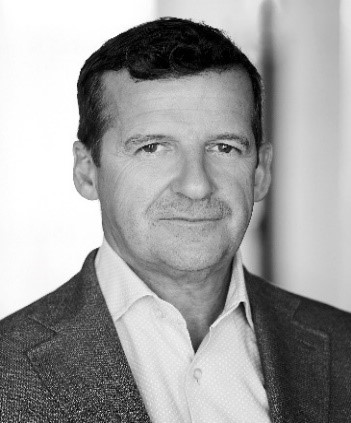 DARREN THROOP Chairman of the Board (since June 2021) and Director (since June 2015) Age: 61 Toronto, Ontario, Canada | Darren Throop is a Canadian entrepreneur whose leadership has reshaped the global entertainment industry. He began his career in 1991 by founding Urban Sound Exchange and later expanded into music distribution through strategic acquisitions. In 2001, he became CEO of ROW Entertainment, taking the company public in 2003 and rebranding it as Entertainment One (eOne). Under Mr. Throop’s leadership, eOne grew into a powerhouse in film, television, and music, fueled by key acquisitions and partnerships. In 2007, he orchestrated the company’s listing on London’s Alternative Investment Market, securing funding for further expansion. In 2019, he led the $4 billion sale of eOne to Hasbro, remaining as CEO until 2022. Today, he directs a global music rights investment fund, continuing his commitment to content ownership. Mr. Throop is a dedicated philanthropist and has received numerous accolades, including induction into the Canadian Music Industry Hall of Fame (2015) and appointment as a Member of the Order of Canada (2019). He has served on the IMAX Corporation Board since 2015, becoming Chairman in 2021, and is a member of both the Academy of Motion Picture Arts and Sciences and The Television Academy. | ||||
Key Skills and Experience: Mr. Throop’s experience in the growth of an entrepreneurial and international entertainment and content brand company engaged in television, film and music production, distribution, merchandising, and licensing further strengthens the Board’s expertise in these areas. | |||||
(10)
 GAIL BERMAN Director (since March 2023) Age: 69 Pacific Palisades, California, U.S.A. Committee Memberships: Compensation Committee | Gail Berman founded The Jackal Group, a content production studio creating scripted and unscripted television, feature films, and commercial theatre, in 2014 and has been the chairman and the chief executive officer of The Jackal Group from 2014 to 2018 and from 2020 to present. From 2019 to 2020, Ms. Berman served as the chairperson and chief executive officer of Sidecar Content Accelerator, an in-house production studio for Fox Entertainment. Ms. Berman also co-founded BermanBraun, a media company, in 2007. Her previous positions include President of Paramount Pictures (2005-2007), Entertainment President of Fox Broadcasting (2000-2005), and President of Regency Television (1998-2000). Ms. Berman serves on the board of the Center Theatre Group, a Los Angeles non-profit theatre company, and has served as President of the Producers Guild of America. She is a member of the Academy of Motion Picture Arts and Sciences and the Television Academy. | ||||
Key Skills and Experience: Ms. Berman’s extensive experience in the entertainment industry and the operation of an entrepreneurial content production company further strengthens the Board’s expertise in these areas and brings a valuable perspective to the Company’s curation of alternative content and live experiences. | |||||
 ERIC A. DEMIRIAN Director (since September 2010) Age: 67 Toronto, Ontario, Canada Committee Memberships: Audit Committee (Chair) | Eric Demirian has been the president of Parklea Capital Inc., a boutique financial advisory and strategy firm, and has been the president of Demicap Inc., a private investment firm, since 2003. Prior to Mr. Demirian’s position at Parklea Capital, he held the position of an executive vice president of Group Telecom, Inc. from 2000 to 2003. Mr. Demirian’s previous positions include partner and head of Information and Communication Practice at PricewaterhouseCoopers LLP (1983 - 2000). Mr. Demirian serves as the non-executive chair of the board of Descartes Systems Group and a director of Calian Group Ltd. He has previously served on the boards of numerous public (Enghouse Systems Ltd. from 2004 to March 2025) and private companies, as a member of the Advisory Council for the School of Accounting & Finance at Ted Rogers School of Management at Ryerson University (renamed Toronto Metropolitan University in 2022), advisor to the Accounting Standards Board of CPA (Canada), and as the director and treasurer for the Parkinson Foundation of Canada. He is a chartered professional accountant, certified general accountant, and a chartered accountant. He holds a bachelor of business management from Toronto Metropolitan University. | ||||
Key Skills and Experience: Mr. Demirian’s accounting experience combined with his substantial business and transactional experience makes him well suited to assist the Board in its assessment of financial and accounting matters. With his strong financial background, Mr. Demirian meets the SEC definition of an audit committee financial expert. | |||||
(11)
 KEVIN DOUGLAS Director (since October 2016) Age: 63 Greenbrae, California, U.S.A. Committee Memberships: Compensation Committee (Chair) | Kevin Douglas has been the chairman and founder of Douglas Telecommunications, a family investment office through which Mr. Douglas manages the Douglas family investment portfolio, since 1995. Prior to Douglas Telecommunications, he was the chairman of the board at Rural Cellular Management Corporation. Mr. Douglas has served on the board of Quantum Fuel Systems, LLC since 2018. Mr. Douglas served on the board of KSR International Co. from 1985 to 2025 and was formerly on the board of Stamps.com from 2003 to 2009. Mr. Douglas is IMAX Corporation’s largest individual investor and has been a shareholder since 2007. In 2014, the Company partnered with Mr. Douglas and his spouse, Michelle Douglas, to donate an IMAX® theatre to the University of Southern California’s School of Cinematic Arts. The Michelle and Kevin Douglas IMAX Theatre and Immersive Media Lab serves as a research and teaching facility for students to learn IMAX filmmaking as well as other immersive entertainment experiences. | ||||
Key Skills and Experience: Mr. Douglas’ long association with the Company has given him a broad understanding of the Company’s business, its products, and the markets in which it operates. Mr. Douglas’ investment and business experience with technology and other companies, together with his expertise in identifying new opportunities for investment and growth, are valuable resources for the Board. | |||||
 DAVID W. LEEBRON Director (since September 2003) Age: 71 Houston, Texas, U.S.A. Committee Memberships: Governance Committee (Chair) Audit Committee | David Leebron has served as University Professor and President Emeritus at Rice University since 2022. Previous to that, he served as President of Rice University from 2004 to 2022. In the fall of 2022, he was a visiting professor at Columbia Law School and Harvard Law School. In 2024, Mr. Leebron was named the president and chief executive officer of Texas 2036, a non-partisan non-profit policy organization. Prior to 2004, Mr. Leebron held the position of Dean of Columbia Law School from 1996 to 2004 and Professor of Law from 1989 to 1996, teaching international economic law, international human rights, corporate finance and torts. Mr. Leebron is on the Council on Foreign Relations and is a member of the American Academy of Arts and Sciences. He served as the chair of the Association of American Universities (AAU) from 2016 to 2017. He currently serves on the boards of the Universities Research Association and the Higher Education Advisory Board for Anthropic. | ||||
Key Skills and Experience: Mr. Leebron brings his broad legal experience, leadership, strategic, and management skills as former President of Rice University and former Dean of Columbia Law School to the Board, which make him well suited to assess legal risks and other challenges faced by the Company, as well as to apply his experience to governance issues faced by the Company and the Board. | |||||
(12)
 MICHAEL MACMILLAN Director (since June 2013) Age: 69 Toronto, Ontario, Canada Committee Memberships: Audit Committee Governance Committee | Michael MacMillan is the chief executive officer of Blue Ant Media, a Canadian-based media company, which he co-founded in 2011. Blue Ant is a producer, distributor, and broadcaster with active operations in Toronto, Los Angeles, London, and elsewhere internationally. Mr. MacMillan was the chairman and/or the chief executive officer of Alliance Atlantis Communications from 1998 to 2007. Mr. MacMillan co-founded Atlantis Films Limited in 1978, which acquired Alliance Communications in a reverse takeover in 1998 and subsequently became Alliance Atlantis Communications. Mr. MacMillan retired from Alliance Atlantis Communications in 2007 after selling the company to Canwest Communications and Goldman Sachs. In 2007, he co-founded Samara, a charity that works to strengthen political engagement in Canada through innovative research and educational programs, and serves as Chair Emeritus. Mr. MacMillan is the co-founder and co-owner of Closson Chase, a vineyard and winery in Prince Edward County, Ontario, Canada. A member of the Order of Canada, Mr. MacMillan has volunteered with numerous community and industry organizations over many years. | ||||
Key Skills and Experience: Mr. MacMillan’s extensive experience in the entertainment industry as well as his ownership interests in various private companies and involvement with charitable organizations gives him a broad expertise in film and television production, digital publishing and other media, thus bringing additional expertise to the Board in these areas. | |||||
 STEVE R. PAMON Director (since June 2021) Age: 55 South Orange, New Jersey, U.S.A. Committee Memberships: Compensation Committee Governance Committee | Steve Pamon is the president of VERZUZ, a digital media production company co-founded by GRAMMY® award-winning producers Swizz Beatz and Timbaland. His leadership spans talent, programming, production, finance, business affairs, and strategic partnerships. Prior to his role at VERZUZ, Mr. Pamon served as the president and the chief operating officer of Parkwood Entertainment, global entertainer Beyoncé's multifaceted enterprise, encompassing oversight of music, touring, artist management, business ventures, and TV/film production. During his time leading Parkwood Entertainment, the team achieved a historic level of critical and commercial success, as evident in the Super Bowl 50 Halftime Show, “Lemonade” visual album, the “Formation World Tour,” “Homecoming”/Coachella Music Festival performance, “On the Run II” world tour, “Everything is Love” album, Global Citizen Africa festival, Adidas/Ivy Park products, and Disney's “Black Is King” movie, among many others. In addition, his team managed the careers of Grammy nominated musicians/actresses Chloe x Halle. Prior to Mr. Pamon’s position at Parkwood Entertainment, he served as Head of Sports and Entertainment Marketing for JPMorgan Chase from 2011 to 2015 and was the vice president of strategy and new Business development for the National Football League from 2008 to 2011. Mr. Pamon’s career journey also includes executive leadership and operating roles with HBO and Time Warner from 2001 to 2008 and McKinsey & Company from 1995 to 2000. In addition to his executive roles, Mr. Pamon holds positions on the board of Herschend Family Entertainment (home to Dollywood® Parks & Resorts, Silver Dollar City® Attractions, Adventure Aquarium®, and the Harlem Globetrotters), and New York Road Runners (organizers of The New York City Marathon). His past board service included a seat on the board of World Wrestling Entertainment (“WWE”) from 2020 through 2024; his tenure culminated in a historic $21 billion merger with UFC/Endeavor, becoming one of the largest transactions in sports history. | ||||
Key Skills and Experience: Mr. Pamon’s deep relationships with the creative community, as well as his broad experience as a senior executive within some of the leading players in media and entertainment, provides a valuable perspective to the Board as it evaluates new product and service opportunities. He also has experience in management consulting and investment banking, which further strengthens the Board in the areas of corporate strategy and financial matters. | |||||
(13)
 DANA SETTLE Director (since July 2015) Age: 53 Los Angeles, California, U.S.A. Committee Memberships: Compensation Committee Governance Committee | Dana Settle is a co-founder and managing partner at Greycroft, a venture capital firm, a position she has held since 2006. As a member of Greycroft’s management committee, she is responsible for the firm’s operations, investment strategy, and vision. Ms. Settle is on the investment committee for all Greycroft funds and has been involved in all phases of Greycroft’s growth. Ms. Settle’s active investments include Acorns, Anine Bing, Avaline, Citizen, Goop, HamsaPay, Happiest Baby, Mayk.it, Merit Beauty, Rembrand, Seed Health, Stability.ai, Thrive Market, and Versed. Her notable exits include Bumble (IPO), Maker Studios (acquired by Disney), Pulse (acquired by LinkedIn), The RealReal (IPO), Trunk Club (acquired by Nordstrom), and WideOrbit (interest sold to company management). Ms. Settle is on the boards of directors of National Venture Capital Association and MNTN, Inc. She is a founding member of the non-profit Baby2Baby and the female mentorship collective All Raise. Prior to Greycroft, Ms. Settle spent several years as a venture capitalist and advisor to startups in the Bay Area, including six years at Mayfield, and in investment banking at Lehman Brothers. Ms. Settle holds a bachelor of arts in Finance and International Studies from the University of Washington and a master of business administration (“M.B.A.”) from Harvard Business School. | ||||
Key Skills and Experience: Ms. Settle’s extensive experience in the private equity markets, as well as her board positions and ownership interests in various digital and other start-up companies, gives her a broad expertise in emerging technology and media markets which is beneficial to the Board, particularly as it examines new growth opportunities. Ms. Settle also has experience in business development and investment banking, which is relevant to the Board’s oversight of the Company’s financial matters. | |||||
 JENNIFER WONG Director (since March 2023) Age: 51 New York, New York, U.S.A. Committee Memberships: Audit Committee | Jennifer Wong has served as the chief operating officer of Reddit, Inc., a social news aggregation, content rating, and forum social network, since 2018. Prior to 2018, Ms. Wong was the president of Digital and chief operating officer of Time Inc. from 2016 to 2018. She was the chief business officer of POPSUGAR from 2011 to 2015. Ms. Wong currently serves on the boards of Capital One Financial Corp and Marfeel. She has a bachelor of science in Applied Mathematics from Yale University, M.B.A from Harvard Business School, and master of science in Engineering Economic Systems and Operations Research from Stanford University. | ||||
Key Skills and Experience: Ms. Wong’s extensive experience in digital media, technology, building global businesses, and marketing, as well as her role as chief operating executive in various companies, brings valuable perspective to the Board as the Company evaluates its short-term and long-term operations and explores new business initiatives, particularly in the digital sphere. | |||||
(14)
Item No. 2 - APPOINTMENT OF PRICEWATERHOUSECOOPERS LLP AS THE COMPANY'S INDEPENDENT AUDITORS | ||
At the Meeting, shareholders will be asked to approve the appointment of PricewaterhouseCoopers LLP, Chartered Accountants (“PwC”), as our independent auditors, until the close of the next annual general meeting of shareholders at a remuneration rate to be fixed by the Board of Directors.
Shareholders will be asked to approve the appointment by ordinary resolution, which requires that a majority of the votes cast at the Meeting be in favor of the resolution. In the absence of any instruction on the accompanying Form of Proxy, it is the intention of the persons named by management in the Form of Proxy to vote the Common Shares represented by the Form of Proxy in favor of the resolution. Voting “WITHHOLD” is the equivalent to voting “ABSTAIN.”
Representatives of PwC are expected to participate in the Meeting online and to be available to respond to appropriate questions and to make a statement if they desire to do so.
PwC are our principal independent accountants. PwC have been our auditors for more than five years. The following table presents fees for professional services rendered by PwC for the audits of our annual financial statements for the years ended December 31, 2025 and December 31, 2024, and fees billed for other services rendered by PwC during those periods.
| 2025 | 2024 | ||||||||||
Type of Fees | ($) | ($) | Description of Fees | ||||||||
| Audit Fees | 2,508,546 | 2,132,683 | For professional services rendered in connection with the audit of our financial statements included in our Annual Report on Form 10-K and of our internal control over financial reporting, the review of our financial statements included in our Quarterly Reports on Form 10-Q, the audit of IMAX China, various statutory audits, and for services that are normally provided by the independent registered public accounting firm in connection with statutory and regulatory filings or engagements for those fiscal years. | ||||||||
| Audit-Related Fees | 243,750 | 90,254 | For professional services rendered in connection with assurance and related services that are reasonably related to the performance of the audit or review of financial statements and which include discussions concerning financial accounting and reporting standards and review of regulatory matters. In 2025, audit-related fees principally consisted of comfort letter fees associated with the issuance of convertible notes and, to a much lesser extent, fees for the audits of the Company’s pension plans, the reimbursement of Canadian Public Accountability Board fees, and various other smaller matters. In 2024, audit-related fees consisted primarily of fees for the audits of the Company’s pension plans, the reimbursement of Canadian Public Accountability Board fees, and various other smaller matters. | ||||||||
| Tax Fees | 236,963 | 359,980 | For professional services rendered in connection with tax services. In 2025 and 2024, tax fees comprised two areas: (i) tax compliance, such as corporate and indirect tax compliance; and (ii) other tax services, such as tax advice related to transfer pricing, including bilateral advance pricing arrangement support, corporate tax consulting in multiple jurisdictions, and audit defense. Tax compliance related fees represented approximately $33,000 and $88,000 of the total tax fees in 2025 and 2024, respectively, while other tax services represented approximately $203,000 and $272,000 of the total tax fees in 2025 and 2024, respectively. | ||||||||
| All Other Fees | 28,451 | 22,279 | For professional services rendered related to reporting in 2025 and 2024 required pursuant to the Hong Kong Stock Exchange’s Environmental, Social and Governance Code and Corporate Governance Code, and access to PwC reporting tools. | ||||||||
| Total | 3,017,710 | 2,605,196 | |||||||||
Audit Committee’s Pre-Approval Policies and Procedures
All audit-related services and all other permissible non-audit services provided by PwC were pre-approved by the Audit Committee, and the fees for each category are budgeted. The Audit Committee requires PwC and management to report actual fees versus the budget to the extent that actual fees exceed budgeted and approved fees. The Audit Committee reviews all actual fees at year-end. During the year, circumstances may arise when it may become necessary to engage PwC for additional services not contemplated in the original pre-approval categories. In those instances, the Audit Committee requires specific pre-approval before engagement of PwC. The Audit Committee may delegate pre-approval authority to one or more of its members. The member(s) to whom such authority is delegated must report, for informational purposes only, any pre-approval decisions to the Audit Committee at its next scheduled meeting.
(15)
REPORT OF THE AUDIT COMMITTEE
The following is the report of the Audit Committee with respect to our audited financial statements for the fiscal year ended December 31, 2025.
The Audit Committee has reviewed and discussed the Company’s audited financial statements for the fiscal year ended December 31, 2025 with senior management. The Audit Committee meets privately with PwC on a periodic basis and PwC has unrestricted access to the Audit Committee. The Audit Committee has discussed with PwC the matters required to be discussed by Statement on Auditing Standards No. 61, as amended (AICPA, Professional Standards, Vol. 1, AU section 380), as adopted by the Public Company Accounting Oversight Board Rule 3200T, which include, among other items, matters related to the conduct of the audit of the Company’s financial statements. The Audit Committee has also received written disclosures and the letter from PwC required by applicable requirements of the Public Company Accounting Oversight Board (which relate to the accountant’s independence from the Company and related entities) and has discussed with PwC the independence of PwC from the Company. As part of its responsibilities for oversight of the Company’s enterprise risk management process, the Audit Committee has reviewed and discussed the Company’s policies with respect to risk assessment and risk management, including discussions of individual risk areas as well as an annual summary of the overall process.
Based on the review and discussions referred to above, the Audit Committee recommended to the Company’s Board of Directors that the Company’s audited financial statements be included in the Company’s Annual Report on Form 10-K for the fiscal year ended December 31, 2025 for filing with the SEC and the Company’s Annual Information Form for the fiscal year ended December 31, 2025.
The information contained in this report shall not be deemed to be “soliciting material” or to be “filed” with the SEC, nor shall such information be incorporated by reference into any future filing under the Securities Act of 1933, as amended or the Exchange Act, except to the extent that the Company specifically incorporates it by reference in such filing.
| April 24, 2026 | Respectfully submitted, | |||||||||||||
| Eric A. Demirian (Chair) | ||||||||||||||
| David W. Leebron | ||||||||||||||
| Michael MacMillan | ||||||||||||||
| Jennifer Wong | ||||||||||||||
(16)
Item No. 3 - ADVISORY VOTE ON NAMED EXECUTIVE OFFICER COMPENSATION (“SAY-ON-PAY”) | ||
In accordance with the Dodd-Frank Wall Street Reform and Consumer Protection Act of 2010 and Section 14A of the Exchange Act, we are asking shareholders to vote to approve, on an advisory (nonbinding) basis (“Say-on-Pay”), the compensation program for our Named Executive Officers (“NEOs”) as disclosed in this Circular. Supporting information is described in the “Compensation Discussion and Analysis” section, and the tabular disclosures regarding such compensation that follow, which we encourage you to review closely.
Although the vote is advisory and non-binding in nature, the Board of Directors and the Compensation Committee review the voting results and consider shareholder views in connection with our executive compensation program and their decision making.
To support our ongoing evaluation of our corporate and compensation practices, the Company has conducted annual governance-related shareholder outreach (with the exception of 2020) since 2019. This outreach is designed to solicit direct feedback on our executive compensation program and allow shareholders to speak to members of our Board of Directors, including members of our Compensation Committee, as well as senior management.
During our March – April 2025 shareholder outreach, we contacted the holders of approximately 67% of our outstanding shares and engaged in active discussions with investors who accepted meetings, representing approximately 32% of our outstanding shares. All shareholders who engaged were generally supportive of our executive compensation program. Those investors that did not accept the meetings did not express any concerns regarding our executive compensation program. Where suggestions were provided, they related to specific performance metric preferences for our incentive compensation elements and were not reflective of any systemic issues with respect to our overall executive compensation. For example, EPS and EBIT were suggested as additional performance metrics. In response, we incorporated Adjusted EPS as a quantitative performance metric in the executive bonus scorecard. This positive feedback was reinforced at our 2025 Annual General Meeting of Shareholders, where 95% of shares cast voted in favor of the say-on-pay advisory vote on executive compensation. We also conducted a round of shareholder outreach in March – April 2026, where shareholders continued to express broad support for the structure of our program, and will report on that round of engagement in next year’s proxy statement. For additional discussion of our shareholder outreach efforts, please read the section titled “Compensation Discussion and Analysis — Shareholder Engagement” on page 29.
As discussed in this Circular, the objectives of our executive compensation program are to:
•Provide competitive and market‑aligned total compensation that includes both short‑term cash incentives and long‑term equity‑based awards designed to motivate performance, support executive retention, and promote the creation of sustainable, long‑term shareholder value;
•Reward executives based on individual performance and contributions, recognizing the scope of their responsibilities, leadership, and impact on the Company’s results;
•Align executive compensation with the Company’s long‑term strategic objectives, reinforcing accountability for the execution of our strategic priorities; and
•Align the interests of executives with those of shareholders through a meaningful equity ownership framework that fosters a shared commitment to long‑term value creation and an appropriate level of shared risk.
Consistent with these objectives, our executive compensation program is structured to include annual short‑term cash incentive opportunities and long‑term equity awards that are designed to motivate strong performance, reward the achievement of strategic and financial goals, and support executive retention. The program is intended to attract and retain highly talented leaders in the highly competitive entertainment and technology landscapes, where executive expertise is critical to the successful execution of the Company’s strategic plan—particularly as that plan continues to evolve alongside the rapid transformation of the digital entertainment ecosystem.
Shareholders will be asked to indicate their support for the compensation program for our NEOs as discussed in this Circular by ordinary resolution, which requires that a majority of the votes cast at the Meeting be in favor of the resolution. In the absence of any instruction on the accompanying Form of Proxy, it is the intention of the persons named by management in the Form of Proxy to vote the Common Shares represented by the Form of Proxy in favor of the resolution.
At the Company’s 2023 annual general meeting of shareholders, our shareholders indicated their preference to hold the non-binding shareholder vote to approve the compensation of our NEOs each year. Accordingly, the Company currently intends to hold
(17)
such votes annually. The next vote to approve the frequency of advisory votes to approve compensation of our NEOs is expected to be held at the Company’s 2029 annual general meeting of shareholders.
The Board of Directors asks its shareholders to vote FOR the following resolution at the Meeting:
RESOLVED that the shareholders approve the compensation of the Company’s Named Executive Officers, as disclosed in the “Compensation Discussion and Analysis” section, the compensation tables and the related narrative disclosure set forth in the Circular dated April 24, 2026.
(18)
EXECUTIVE OFFICERS
The following table sets forth certain information regarding our executive officers as of April 24, 2026. As Mr. Gelfond also serves as director of the Company, his biographical information is presented above under the heading “Item No. 1 — Election of Directors.”
| Name | Age | Position | ||||||
EXECUTIVE OFFICERS: | ||||||||
Richard L. Gelfond(1) | 70 | Chief Executive Officer (“CEO”) and Director | ||||||
Natasha Fernandes | 45 | Chief Financial Officer (“CFO”) and Executive Vice President | ||||||
Anne Globe | 63 | Chief Marketing Officer | ||||||
Robert D. Lister(2) | 57 | Chief Legal Officer and Senior Executive Vice President | ||||||
Mark Welton | 62 | President, IMAX Global Theatres | ||||||
Pablo Calamera | 63 | Chief Technology Officer and Executive Vice President | ||||||
Giovanni M. Dolci | 41 | Chief Commercial Officer and Executive Vice President | ||||||
Jonathan Fischer | 51 | Chief Content Officer and Executive Vice President | ||||||
Michele Golden | 58 | Global Chief People Officer and Executive Vice President | ||||||
Daniel Manwaring | 42 | Chief Executive Officer, IMAX China | ||||||
Kenneth I. Weissman | 54 | Deputy General Counsel and Corporate Secretary | ||||||
| Jose Zlatar | 39 | Senior Vice President, Finance and Controller | ||||||
(1) Currently on a temporary medical leave of absence.
(2) Serving as the Company’s interim principal executive officer (“PEO”) until May 1, 2026 in connection with Mr. Gelfond’s temporary medical leave of absence.
 NATASHA FERNANDES Chief Financial Officer and Executive Vice President | Natasha Fernandes joined the Company in September 2007 as Manager, Financial Reporting and has served as the Company's Chief Financial Officer since May 2022. Ms. Fernandes’ position as CFO is the culmination of a decades-long career with the Company, during which she has held a broad range of senior leadership roles across the finance organization. Most recently, she led the Company’s successful $250 million convertible debt offering and the renewal and expansion of the Company’s credit facility in 2025. Prior to becoming CFO, Ms. Fernandes served as the Company’s Deputy Chief Financial Officer beginning in 2021 and as Vice President, Finance & Corporate Treasurer from 2018 to 2021. In these roles, she played a key part in shaping the Company’s financial strategy and capital structure. Earlier in her tenure, Ms. Fernandes held progressively senior positions including Vice President, Finance & Assistant Controller; Senior Director, Finance; Director, Financial Reporting; and other leadership roles within the finance function. Prior to joining the Company, Ms. Fernandes was a manager at Deloitte Touche Tohmatsu Limited. Previous to that, Ms. Fernandes was an associate accountant at Hilborn Ellis Grant, LLP. Ms. Fernandes serves on the boards of directors of IMAX China and IMAX Theatres International Limited, wholly-owned subsidiaries of IMAX Corporation. Additionally, she serves on the board of Oasis Youth Care, a community-based nonprofit organization that provides transitional housing and culturally responsive wrap-around supports, including life skills training, mentoring, and access to education and employment resources to youth experiencing or at risk of homelessness, with a focus on building self-sufficiency and long-term stability. Ms. Fernandes is a member of Chartered Professional Accountants Canada and holds a bachelor of business administration, honours with co-operative option from the School of Business and Economics of Wilfrid Laurier University. | ||||
(19)
 ANNE GLOBE Chief Marketing Officer | Anne Globe joined the Company in January 2024 as Chief Marketing Officer. In this role, she leads the Company's global marketing efforts and is responsible for the IMAX brand across 91 countries and territories. From 2015 to 2020, Ms. Globe served as the chief marketing officer at Skydance Media, where she was behind the marketing and distribution strategies for Skydance's major intellectual property, including “Mission: Impossible,” “Terminator,” and “Jack Reacher.” From 1996 to 2013, Ms. Globe held several executive positions at DreamWorks, including chief marketing officer, where she oversaw marketing, distribution, and licensing for iconic franchises such as “Kung Fu Panda,” “How to Train Your Dragon,” “Shrek,” and “Madagascar.” Ms. Globe has served as an adjunct professor for the University of Southern California's Business of Cinematic Arts program since 2018. She is also a member of the Academy of Motion Picture Arts and Sciences and the American Film Institute. | ||||
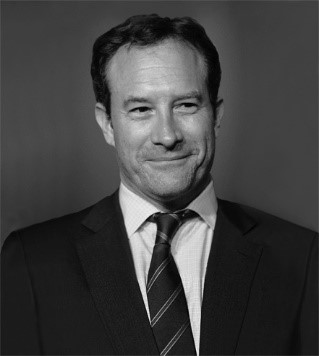 ROBERT D. LISTER Chief Legal Officer and Senior Executive Vice President | Robert Lister joined the Company in May 1999 as Senior Vice President, Legal Affairs and General Counsel and currently serves as Chief Legal Officer and Senior Executive Vice President. Mr. Lister is also serving as the Company’s interim PEO from April 16, 2026 until May 1, 2026, following which Mr. Gelfond will resume the role of PEO. Mr. Lister has held numerous positions at the Company, including Chief Legal Officer and Chief Business Development Officer, Senior Executive Vice President and General Counsel and Executive Vice President, Business & Legal Affairs, Corporate Communications and General Counsel. Prior to joining the Company, Mr. Lister was Vice President, General Counsel and Secretary of Clearview Cinemas, a film exhibitor, from March 1998 until his employment with the Company. From 1996 to 1998, Mr. Lister served as an associate general counsel of Merit Behavioral Care Corporation, a behavioral healthcare company. Mr. Lister serves on the board of directors of IMAX China. Mr. Lister is a member of the New York State Bar Association. | ||||
 MARK WELTON President, IMAX Global Theatres | Mark Welton joined the Company in July 1997 as Director, Business Affairs and was appointed President, IMAX Global Theatres in October 2011. Previous to that, Mr. Welton held the position of Executive Vice President, Corporate and Digital Development & Theatre Operation since April 2007. Mr. Welton has held various other positions within the Company including: Senior Vice President, Business Affairs; Senior Vice President, Theatre Operations; and Executive Vice President, Theatre Operations & General Manager, Digital. Prior to joining the Company, Mr. Welton was an associate lawyer at the law firm Stikeman Elliott LLP from 1994 until his employment with the Company. Prior to that, Mr. Welton was an associate accountant at Ernst & Young. Mr. Welton serves on the board of directors of IMAX Theatres International Limited. Mr. Welton is a member of the Ontario Bar Association and the Chartered Professional Accountants Canada. | ||||
(20)
 PABLO CALAMERA Chief Technology Officer and Executive Vice President | Pablo Calamera joined the Company in February 2020 as Chief Technology Officer and Executive Vice President. Prior to joining the Company, Mr. Calamera was the chief technology officer for several pioneering start-ups and public companies, including JW Player from 2017 to 2019, where he oversaw all aspects of technology development and technical operations supporting small businesses to large global enterprises with the best video technology and monetization capabilities on web, mobile and embedded devices. Previous to that, Mr. Calamera served as the chief technology officer at Vonage from 2014 to 2017 and at iHeartRadio from 2011 to 2014, where he led technology vision, architecture, R&D, and technical operations. Mr. Calamera also held technology leadership roles such as a director at Apple Inc. from 2006 to 2010 and a senior director at Danger Inc. from 2001 to 2006. | ||||
 GIOVANNI M. DOLCI Chief Commercial Officer and Executive Vice President | Giovanni Dolci joined the Company in October 2012 as Vice President, Theatre Development and was appointed Chief Commercial Officer and Executive Vice President in 2025. Previous to that, Mr. Dolci held the position of Chief Sales Officer (2021-2025); Head of Global Sales (2020-2021); Senior Vice President (2018-2020); and Vice President, Theatre Development and Managing Director, Europe and Africa (2017-2018). Prior to joining the Company, he was the director of business development and commercial operations at Arts Alliance Media. Before his time at Arts Alliance Media, Mr. Dolci worked in film financing focusing on several projects in New Zealand, Italy, and the UK. Mr. Dolci also serves on the board of directors of IMAX Theatres International Limited. Mr. Dolci has a degree in Economics and Management from Bocconi University in Milan and a master of science in Management from Cass Business School in London. He is a former Junior Fellow of the Aspen Institute, Italy. | ||||
 JONATHAN FISCHER Chief Content Officer and Executive Vice President | Jonathan Fischer joined the Company in October 2024 as Chief Content Officer and Executive Vice President. Mr. Fischer oversees the Company’s content strategy across Hollywood and international films, documentaries, and live events, as well as experiences including music, gaming, sports, and more. Prior to joining the Company, he served as the vice president of Content Strategy & Analysis, Global Films for Netflix from December 2019 to February 2023. Prior to Netflix, Mr. Fischer served as the chief operating officer at Illumination Entertainment (2018-2019) and New Regency Entertainment (2012-2017). Mr. Fischer also served as the president of Groundswell Productions (2008-2012), chief financial officer of independent production company, Intrepid Pictures, LLC (2005-2008), and held roles in business development and strategic planning at Universal Pictures and The Walt Disney Company. Additionally, he is a board member of The Meg Foundation, non-profit focused on empowering families to manage pain and medical anxiety. Mr. Fischer is based in Los Angeles and has a bachelor’s degree (A.B.) in Economics from Stanford University. | ||||
(21)
 MICHELE GOLDEN Global Chief People Officer and Executive Vice President | Michele Golden serves as the Global Chief People Officer and Executive Vice President for IMAX. In this role, she leads all Human Resources functions for the Company. Ms. Golden joined the Company in September 2022. Ms. Golden has over 20 years of Human Resources experience at media and entertainment companies, launching and scaling some of the industry's most recognizable brands. Prior to joining the Company, Ms. Golden served as the chief human resources officer for HBO Max, WarnerMedia's global streaming platform from September 2020 to August 2022. From September 2019 to September 2020, Ms. Golden was the chief people officer for AT&T's former adtech unit, Xandr, leading its integration into WarnerMedia. Before joining Xandr, and before its acquisition by AT&T, she served as the senior vice president of Human Resources for WarnerMedia since 2013. She also led the Human Resources functions for many well-known media and entertainment brands including Turner Sports, TBS, TNT, Cartoon Network, and Bleacher Report, as well as three professional sports teams, the Atlanta Braves, the Atlanta Hawks, and the Atlanta Thrashers. Ms. Golden graduated from the University of Texas with a bachelor of science in Communication and from Vanderbilt University with an M.B.A. | ||||
 DANIEL MANWARING Chief Executive Officer IMAX China | Daniel Manwaring joined the Company in January 2023 as Chief Executive Officer of IMAX China. Prior to joining the Company, Mr. Manwaring spent nearly 10 years with Creative Artists Agency, a well-known talent agency, in various roles, including as Head of Media Finance (Asia) from January 2020 to December 2022, Head of Motion Pictures China from January 2018 to December 2020, and as an agent from January 2013 to December 2018. Mr. Manwaring was also a senior financial analyst of China Hydroelectric Corporation (NYSE: CHC) from October 2008 to October 2011 and a financial analyst of Friedland Capital Inc. from May 2007 to October 2008. Mr. Manwaring graduated from the University of Florida, with a bachelor of science in Finance and a bachelor of arts in Chinese Language and Culture, in May 2008. Mr. Manwaring has been based in China since 2006 and is fluent in Mandarin. | ||||
(22)
 KENNETH I. WEISSMAN Deputy General Counsel and Corporate Secretary | Kenneth Weissman joined the Company in October 2011 as Vice President, Legal Affairs, and he has held the position of Deputy General Counsel and Corporate Secretary since July 2022. Mr. Weissman became Senior Vice President, Legal Affairs in 2015, and in December 2017, Mr. Weissman was appointed Corporate Secretary and Chief Compliance Officer. Prior to joining the Company, Mr. Weissman was Senior Corporate Counsel at Sony Corporation of America, where he held various positions from 2004 through 2011. Before that, Mr. Weissman was an associate lawyer at Skadden, Arps, Slate, Meagher & Flom in New York and Testa, Hurwitz & Thibeault in Boston. He also served as a law clerk to the Hon. Judith S. Kaye, Chief Judge of the State of New York. Mr. Weissman serves on the board of directors of IMAX Theatres International Limited and is a member of the American Bar Association and the Association of Corporate Counsel. | ||||
 JOSE ZLATAR Senior Vice President, Finance and Controller | Jose Zlatar joined the Company in February 2025 as Senior Vice President, Finance and Controller. In this role he leads the Company’s global controllership, accounting, and reporting functions. Prior to joining the Company, from 2023 to 2025, Mr. Zlatar served as Associate Vice President, Accounting, for Canadian National Railway, one of the largest transportation companies in North America. In this role, Mr. Zlatar led the external reporting, global accounting policy and financial system departments, and oversaw the Sarbanes-Oxley control program. From 2018 to 2023, Mr. Zlatar served as Senior Director, Assistant Corporate Controller at Yamana Gold Inc. Prior to this, Mr. Zlatar held increasingly senior financial positions at other mining companies, including roles that oversaw accounting, treasury, budgeting, and long-range planning. Prior to this, Mr. Zlatar was an experienced senior associate at PricewaterhouseCoopers Limited. Mr. Zlatar is a member of Chartered Professional Accountants Canada and holds a Bachelor of Commerce, with Honours, from the DeGroote School of Business at McMaster University. | ||||
(23)
SECURITY OWNERSHIP OF DIRECTORS AND MANAGEMENT
The following table sets forth information with respect to the beneficial ownership of our Common Shares as of April 13, 2026 or as otherwise indicated in the notes below, including: (i) all persons to be nominated for election to the Board of Directors, individually; (ii) all current directors and the NEOs, individually; and (iii) all current directors and executive officers as a group.
Name of Beneficial Owner of Common Shares | Common Shares Beneficially Owned, Controlled or Directed(1) | Common Shares that can be Acquired within 60 days | Total | Percentage of Outstanding Common Shares (2) | |||||||||||||||||||
| Richard L. Gelfond | 765,002 | 1,439,943 | (3) | 2,204,945 | 3.91 | % | |||||||||||||||||
Gail Berman | 19,192 | — | 19,192 | * | |||||||||||||||||||
| Eric A. Demirian | 37,093 | (4) | — | 37,093 | * | ||||||||||||||||||
| Kevin Douglas | 8,379,725 | (5) | — | 8,379,725 | 15.23 | % | |||||||||||||||||
| David W. Leebron | 128,993 | (6) | — | 128,993 | * | ||||||||||||||||||
| Michael MacMillan | 38,028 | — | 38,028 | * | |||||||||||||||||||
| Steve R. Pamon | 32,125 | — | 32,125 | * | |||||||||||||||||||
| Dana Settle | 65,700 | — | 65,700 | * | |||||||||||||||||||
| Darren Throop | 36,044 | — | 36,044 | * | |||||||||||||||||||
Jennifer Wong | 19,192 | — | 19,192 | * | |||||||||||||||||||
| Natasha Fernandes | 55,596 | — | 55,596 | * | |||||||||||||||||||
| Anne Globe | 18,574 | — | 18,574 | * | |||||||||||||||||||
| Robert D. Lister | 204,875 | — | 204,875 | * | |||||||||||||||||||
| Mark Welton | 173,216 | — | 173,216 | * | |||||||||||||||||||
| All directors and executive officers (21 persons) | 10,163,223 | 1,439,943 | 11,603,166 | 20.55 | % | ||||||||||||||||||
* Less than 1%
(1)Statements as to securities beneficially owned by directors and executive officers, or as to securities over which they exercise control or direction, are based upon information obtained from such directors and executive officers and from records available to us. The person named in the table has sole voting and investment power with respect to all of their Common Shares unless indicated otherwise.
(2)The percentage of outstanding Common Shares is based on dividing the number of Common Shares beneficially owned by the individual by 55,015,891 Common Shares outstanding as of April 13, 2026 adjusted for the number of Common Shares that such person or group had the right to acquire within 60 days of that date.
(3)Reflects Common Shares issuable through the exercise of vested stock options.
(4)Mr. Demirian has sole voting and investment power with respect to 5,303 Common Shares and shared voting and investment power with respect to 31,790 Common Shares.
(5)Mr. Douglas has shared voting power with respect to 7,050,328 Common Shares and shared dispositive power with respect to 8,351,373 Common Shares.
(6)Mr. Leebron has sole voting and investment power with respect to 127,693 Common Shares and shared voting and investment power with respect to 1,300 Common Shares.
(24)
PRINCIPAL SHAREHOLDERS OF VOTING SHARES
We are not aware of any persons who as of April 13, 2026 beneficially owned or exercised control or direction over more than 5% of our Common Shares other than:
| Amount and Nature of | Percentage of | ||||||||||
| Beneficial Ownership | Outstanding | ||||||||||
| Name and Address of Beneficial Owner of Common Shares | of Common Shares | Common Shares | |||||||||
| Douglas Group | 8,379,725.00 | (1) | 15.23 | % | |||||||
| Kevin and Michelle Douglas | |||||||||||
James E. Douglas III | |||||||||||
K&M Douglas Trust | |||||||||||
Irrevocable Descendants Trust FBO Alexander James Douglas Trust | |||||||||||
Irrevocable Descendants Trust FBO Amanda Anne Douglas Trust | |||||||||||
Irrevocable Descendants Trust FBO Jake Edward Douglas Trust | |||||||||||
Irrevocable Descendants Trust FBO Summer Jean Douglas Trust | |||||||||||
Nonexempt Trust FBO Kevin G. Douglas | |||||||||||
Nonexempt Trust FBO James E. Douglas, III | |||||||||||
Celtic Financial LLC | |||||||||||
| 300A Drakes Landing Road, Suite 200, Greenbrae, CA 94904 | |||||||||||
FMR LLC | 3,435,348.37 | (2) | 6.24 | % | |||||||
245 Summer Street, Boston, MA 02210 | |||||||||||
Abigail P. Johnson | |||||||||||
245 Summer Street, Boston, MA 02210 | |||||||||||
Nomura Asset Management International Inc. | 4,267,949.00 | (3) | 7.76 | % | |||||||
Nomura Investment Management Business Trust | |||||||||||
100 Independence, 610 Market Street, Philadelphia, PA 19106-2354 | |||||||||||
Orbis Investment Management Limited | 5,151,721.00 | (4) | 9.36 | % | |||||||
25 Front Street, Hamilton HM11, Bermuda | |||||||||||
Allan Gray Australia Pty Ltd | |||||||||||
Level 2, Challis House, 4 Martin Place, Sydney NSW2000, Australia | |||||||||||
The percentage of outstanding Common Shares is based on dividing the number of Common Shares beneficially owned by such person by 55,015,891 Common Shares outstanding as of April 13, 2026.
(1)Based solely on information reported in a Schedule 13D/A filed jointly by Kevin Douglas, Michelle Douglas, James E. Douglas, III, K&M Douglas Trust, Irrevocable Descendant’s Trust FBO Alexander James Douglas, Irrevocable Descendant’s Trust FBO Amanda Anne Douglas, Irrevocable Descendant's Trust FBO Jake Edward Douglas, Irrevocable Descendant’s Trust FBO Summer Jean Douglas, Nonexempt Trust FBO Kevin G. Douglas, Nonexempt Trust FBO James E. Douglas, III, and Celtic Financial LLC on March 17, 2026 with the SEC. As reported in such filing, Kevin Douglas has shared voting power with respect to 7,050,328 Common Shares. Kevin Douglas and his wife, Michelle Douglas, hold 3,600,746 Common Shares jointly as the beneficiaries and co-trustees of the K&M Douglas Trust. In addition, Kevin Douglas and Michelle Douglas are co-trustees of the Irrevocable Descendant’s Trust FBO Alexander James Douglas, which holds 602,311 shares, the Irrevocable Descendant’s Trust FBO Amanda Anne Douglas, which holds 602,310 shares, the Irrevocable Descendant’s Trust FBO Jake Edward Douglas, which holds 602,310 shares, and the Irrevocable Descendant’s Trust FBO Summer Jean Douglas, which holds 602,310 shares. Kevin Douglas holds 440,000 shares as the trustee and beneficiary of the Nonexempt Trust FBO Kevin G. Douglas. Kevin Douglas is the Manager of Celtic Financial LLC, which holds 571,989 Common Shares and has voting and dispositive power with respect to the shares held by Celtic Financial LLC. Kevin Douglas, as the settlor of the KGD intentionally defective grantor trust (the “KGD IDGT”), has the right to substitute property of equivalent value in return for the 28,352 shares held by the KGD IDGT and may be deemed to have shared voting and dispositive power over the shares held by the KGD IDGT. Mr. Douglas also has shared dispositive power with respect to 440,000 Common Shares held by the Nonexempt Trust FBO James E. Douglas, III and 861,045 shares held by James E. Douglas, III. Ms. Douglas, as the settlor of the MMD intentionally defective grantor trust (the "MMD IDGT"), has the right to substitute property of equivalent value in return for the 28,352 shares held by the MMD IDGT and may be deemed to have shared voting and dispositive power over the shares held by the MMD IDGT. James E. Douglas, III holds 440,000 shares as the trustee and beneficiary of the Nonexempt Trust FBO James E. Douglas, III.
(2)Based solely on information reported in a Schedule 13G/A filed by FMR LLC (“FMR”) and Abigail P. Johnson on February 5, 2026 with the SEC. As reported in such filing, FMR and Ms. Johnson may be deemed to beneficially own 3,435,348.37 Common Shares. FMR has the sole voting power with respect to 3,432,291 Common Shares. Both FMR and Ms. Johnson have sole dispositive power with respect to 3,435,348.37 Common Shares.
(3)Based solely on information reported in a Schedule 13G filed by Nomura Asset Management International Inc. and Nomura Investment Management Business Trust (collectively, “Nomura”) on February 17, 2026 with the SEC. As reported in such filing, Nomura may be deemed to beneficially own 4,267,949 Common Shares and have shared voting and dispositive power over those shares.
(25)
(4)Based solely on information reported in a Schedule 13G/A filed by Orbis Investment Management Limited (“Orbis”) and Allan Gray Australia Pty Ltd (“Allan Gray”) on February 17, 2026 with the SEC. As reported in such filing, Orbis and Allan Gray may be deemed to beneficially own
5,151,721 Common Shares. Each of Orbis and Allan Gray has sole voting and disposition power with respect to 5,131,901 and 19,820 Common Shares, respectively.
(26)
COMPENSATION DISCUSSION & ANALYSIS | ||
This Compensation Discussion & Analysis (“CD&A”) provides information about compensation for our NEOs in 2025, demonstrating its alignment with our pay for performance culture and achievements during the year.
 |  |  |  |  | ||||||||||
Richard L. Gelfond | Natasha Fernandes | Anne Globe | Robert D. Lister | Mark Welton | ||||||||||
Chief Executive Officer | Chief Financial Officer and Executive Vice President | Chief Marketing Officer | Chief Legal Officer and Senior Executive Vice President | President, IMAX Global Theatres | ||||||||||
Executive Summary and Guide to Navigating the CD&A | ||
How did pay align with performance? Page 28 | •IMAX continued to generate strong returns for shareholders in 2025, with total shareholder return (“TSR”) of over 44% for the fiscal year, positioning us among the top performers in global media and entertainment •Global box office and total revenue were our highest ever at $1.28 billion (up 40% from 2024) and $410.2 million (up 16% from 2024), respectively; Net Income of $45.5 million and Total Adjusted EBITDA(1) of $184.9 million grew by 39% and 33%, respectively, from 2024; compared to 2024, EPS increased by $0.15 to $0.63 and Adjusted EPS(1) increased by $0.50 to $1.45; Net Income Margin improved to 11% and Total Adjusted EBITDA Margin(1) improved to 45% compared to 9% and 39%, respectively, in 2024 •Network expansion was strong, with 160 new and upgraded theater system installations, coupled with 166 new and upgraded theater system signings, strengthening future network growth •Other achievements of note that contribute to our long-term financial success include strengthened studio and filmmaker relationships, continued investments in upgrading technology, favorable revolving facility and convertible notes refinancings, strong expense management and a growing Filmed For IMAX® release slate •As a result of these financial and strategic achievements, annual cash bonuses were earned at 119% - 158% of target •IMAX has delivered strong results for the past three years, with TSR of 152%, placing IMAX at approximately the 98th percentile of our performance peer group •The three-year average annual Attributable Adjusted EBITDA(1)(2) growth of 27% and TSR of 152% exceeded the maximum performance condition under the 2023 Performance Stock Units (“PSUs”), resulting in a PSU payout of 165% of target(2) | |||||||
•Shareholder feedback continues to be an important factor in Compensation Committee discussions on executive pay •This includes consideration of the annual advisory “say-on-pay” vote, which last year attracted the support of over 95% of votes cast, signaling strong support for our compensation program •During 2025 shareholder outreach, holders of approximately 67% of outstanding shares were contacted, with holders of approximately 32% of our outstanding shares participating in meetings | ||||||||
What is our pay philosophy and framework? | •We pay for performance that contributes to our financial success and creates shareholder value, both now and in the future, emphasizing quantitative outcome-based metrics •Pay practices are informed by our compensation peer group, which includes companies that we compete with in the complex Hollywood and broader entertainment and technology ecosystems •Reinforced by our high say-on-pay support, no significant changes to the overall pay framework were made in 2025 or 2026 •For 2025, the quantitative portion of the annual cash bonus scorecard was simplified to five metrics, with metric changes (Total Adjusted EBITDA Margin replacing Total Adjusted EBITDA; Adjusted EPS replacing Free Cash Flow; and Streaming Technology Bookings removed) focused on alignment with strategic priorities and drivers of shareholder value. We also increased our focus on business unit performance in addition to individual performance, in order to reinforce operating results within areas executives directly influence | |||||||
(27)
How do decisions get made? | •The Compensation Committee oversees executive compensation and its considerations include business and strategic priorities, feedback from our shareholders, and practices among relevant peers •IMAX’s compensation program includes variable and at-risk components to promote both short-term growth and investments with sustainable long-term value creation for our shareholders | |||||||
What did we pay our NEOs in 2025 and why? | •A majority of NEO target pay (85% for the CEO and 70% on average for other NEOs) is delivered in performance-based elements and/or equity, underscoring our pay for performance culture •Only two NEOs received adjustments to their target direct compensation for 2025, averaging an increase of 4.8% •Full-year NEOs’ equity awards were delivered in an equal mix of PSUs and Restricted Share Units (“RSUs”) •There were no special awards outside the annual compensation framework | |||||||
What terms were agreed in the CEO’s amended employment agreement? | •The Company and the CEO entered into a third amendment of Mr. Gelfond’s employment agreement, which became effective January 1, 2026 •Having considered Mr. Gelfond’s strong performance, his influential industry relationships and the value they bring to the Company, the time since his last compensation adjustment, movements in market data and the competitive talent landscape, the Compensation Committee and Board extended the term of Mr. Gelfond’s existing employment agreement to December 31, 2028 and approved a 19% increase in Mr. Gelfond’s target compensation (representing an increase of 3.5% on an annualized basis since his last compensation adjustment in 2020), delivered entirely through his long-term incentive grant value to maximize alignment with our shareholders •Mr. Gelfond’s target cash compensation (salary and bonus) continues to remain unchanged since 2017 | |||||||
(1)Total Adjusted EBITDA, Total Adjusted EBITDA Margin, Attributable Adjusted EBITDA, and Adjusted EPS are non-GAAP financial measures. See “Non-GAAP Financial Measures” on page 76 for a reconciliation of all non-GAAP measures to the most directly comparable U.S. Generally Accepted Accounting Principles (“GAAP”) measures and a description of how the non-GAAP numbers are calculated from our audited financial statements.
(2)PSUs granted in 2023 were based on the Company’s Average Annual Attributable Adjusted EBITDA Growth and TSR performance relative to our 2023 peer group. Attributable Adjusted EBITDA is Total Adjusted EBITDA less the non-controlling interests of the Company’s subsidiaries.
2025 at a Glance | ||
Target pay levels and mix
Target direct compensation comprises three elements: base salary, an annual cash bonus, and an annual grant of equity-based long-term incentive awards in the form of PSUs and RSUs. Reflecting our pay for performance culture, a majority of NEO target pay is at risk and can be earned based on performance relative to predefined quantitative financial and strategic objectives, coupled with assessment of business unit and individual achievements. For more discussion of the performance objectives applicable to our incentive compensation, please see the section titled “IMAX’s Pay for Performance Philosophy—Designing incentives that align with our strategic priorities and financial performance” below. See “2025 NEO Compensation” below for further information on these metrics.
CEO target direct compensation mix(1) | Other NEO average target direct compensation mix(1) | |||||||||||||||||||||||||
| Base 14.0% | Bonus 22.0% | PSU 32.0% | RSU 32.0% | Base 28.6% | Bonus 21.2% | PSU 25.1% | RSU 25.1% | |||||||||||||||||||
(1)Calculated based on base salaries and target bonus opportunities as a percentage of base salary in effect at year-end, and the target value of equity awards granted in 2025.
Short-term metrics (80% for CEO and 50% for other NEOs) | Long-term metrics (PSUs) | ||||||||||
Outcomes | Outcomes and strategic drivers | Outcomes | |||||||||
Revenue | Installations | Total Adjusted EBITDA(1) Growth (60%) | |||||||||
Total Adjusted EBITDA Margin(1) | Signings | Relative TSR (40%) | |||||||||
Adjusted EPS(1) | |||||||||||
Balance of annual cash bonus earned based on an assessment of business unit and individual performance. | |||||||||||
(1)Total Adjusted EBITDA, Total Adjusted EBITDA Margin, and Adjusted EPS are non-GAAP financial measures. See “Non-GAAP Financial Measures on page 76 for a reconciliation of all non-GAAP measures to the most directly comparable GAAP measures and a description of how the non-GAAP numbers are calculated from our audited financial statements.
(28)
Performance highlights and pay outcomes
IMAX delivered record breaking financial performance in 2025, coupled with strong above-target network expansion. This contributed to three-year TSR of 152%, which positioned us at the 98th percentile relative to our performance peers. Our incentive plans use a combination of quantitative financial and non-financial metrics underpinned by a robust target-setting process along with rigorous qualitative assessments to promote the alignment of executive pay with Company performance and shareholder value creation.
Performance against select 2025 annual bonus and 2023 PSU metrics1
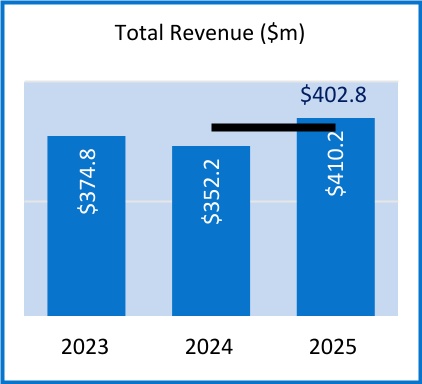
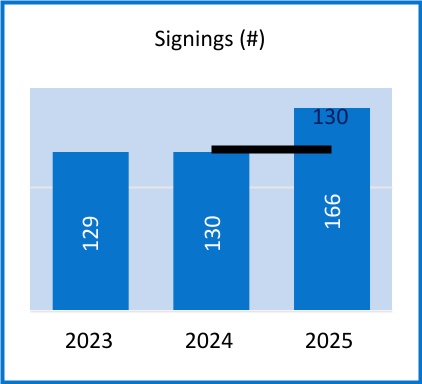
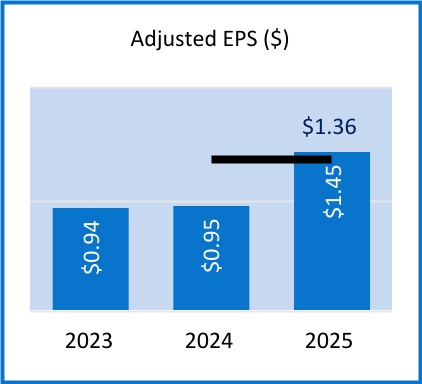
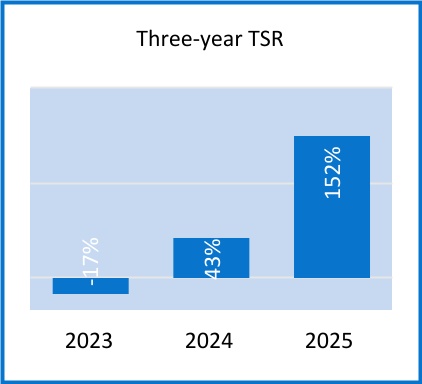
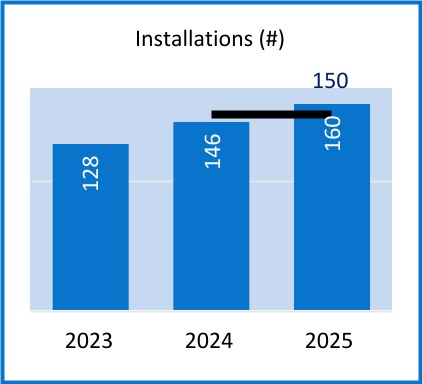
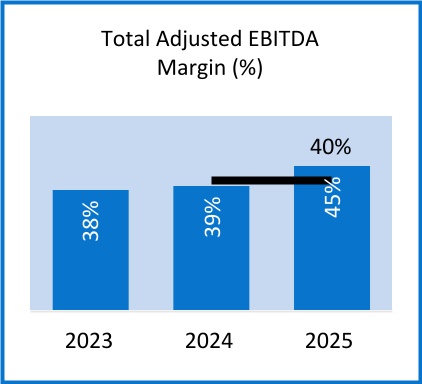
n Fiscal year actual performance — 2025 annual bonus target | ||
(1)Adjusted EPS and Total Adjusted EBITDA Margin are non-GAAP financial measures. Please see “Non-GAAP Financial Measures” on page 76 for a reconciliation of all non-GAAP measures to the most directly comparable GAAP measures and a description of how the non-GAAP numbers are calculated from our audited financial statements.
As a result of our 2025 performance, NEOs’ annual short-term incentive bonuses were earned at between 119% - 158% of target, and 2023 – 2025 PSUs vested at 165% of target. Please see “2025 NEO Compensation—Outcomes” for more information.
Shareholder Engagement | ||
To be effective in discharging its duties, it is important for the Compensation Committee to understand the views of our shareholders. To support this, our management team maintains active dialogue with shareholders, including through quarterly earnings calls, conferences, and individual meetings. In connection with the annual meeting, specific proactive outreach is
(29)
undertaken, where feedback is sought on ballot items including executive compensation. This provides shareholders with an opportunity to speak with members of our Board, including members of the Compensation Committee.
Active year-round engagement by management and annual outreach, including Compensation Committee participation, to collect shareholder views on topics including executive compensation. | 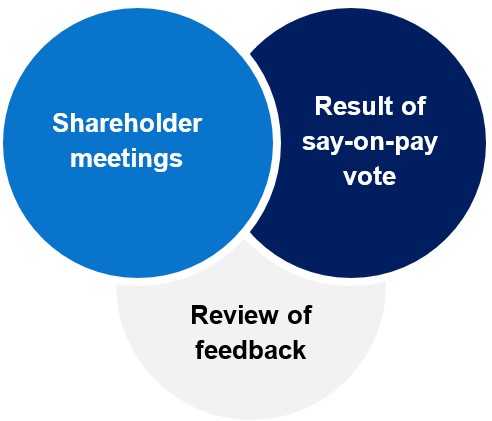 | Provides an opportunity for shareholders to vote annually on an advisory basis on our executive compensation arrangements. | ||||||||||||
The Compensation Committee actively considers the results of the annual say-on-pay vote and feedback from shareholders as part of its broader review of executive compensation. | ||||||||||||||
During our March – April 2025 shareholder outreach, we contacted the holders of approximately 67% of our outstanding shares and engaged in active discussions with investors who accepted meetings, representing approximately 32% of our outstanding shares. All shareholders who engaged were generally supportive of our executive compensation program. Those investors that did not accept the meetings did not express any concerns to share with us regarding our executive compensation program. Where suggestions were provided, they related to specific performance metric preferences for our incentive compensation elements and were not reflective of any systemic issues with respect to our overall executive compensation program. For example, EPS and EBIT were suggested as additional performance metrics. In response, we incorporated Adjusted EPS as a quantitative performance metric in the executive bonus scorecard. We also conducted a round of detailed shareholder outreach in March – April 2026, where shareholders continued to express broad support for the structure of our program, and will report on that round of engagement in next year’s proxy statement.
This feedback was reinforced at our 2025 Annual General Meeting of Shareholders, where 95% of shares cast voted in favor of the say-on-pay advisory vote on executive compensation.
While there were no significant changes to our overall compensation framework in 2025 or 2026, the Company entered into a third amendment of Mr. Gelfond’s employment agreement during the year, which became effective January 1, 2026. In negotiating Mr. Gelfond’s agreement terms, the Compensation Committee and the Board considered feedback received during shareholder engagement to inform its decisions. For example, the Board is aware that legacy provisions in Mr. Gelfond’s agreement provide for certain payments upon a change in control of the Company. However, the views most commonly expressed by active participants in our shareholder engagement have been: (a) acknowledgement that renegotiating these legacy terms would likely result in changed compensation terms that are ultimately highly costly to shareholders, and (b) satisfaction that these existing provisions align closely to shareholder value creation. In Mr. Gelfond’s other employment terms regarding separation, the Compensation Committee sought to align them to typical market practice, including “double-trigger” payments upon a change in control. For more information Mr. Gelfond’s employment agreement, please see “—Additional Information” on page 40.
IMAX’s Pay for Performance Philosophy | ||
Our Compensation Philosophy and How We Apply It
IMAX is a leading provider of premium theatrical technology and experiences, supporting filmmakers, studios, and exhibitors in delivering differentiated moviegoing to audiences worldwide. Our strategy focuses on expanding the scale and profitability of The IMAX Experience® through disciplined network growth, strong studio relationships, and consistent execution of our commercial and technology roadmap, with the objective of generating sustainable long-term value for shareholders.
Execution of this strategy depends on the experience, expertise, and leadership of our employees, including our executive team. Our executives bring deep industry knowledge and established relationships that support IMAX’s ability to secure premium content, grow our global footprint, and maintain the strength of the IMAX brand. Our compensation philosophy is designed to align executive pay with performance by linking compensation outcomes to the achievement of strategic, operational, and financial objectives that drive long-term shareholder value.
(30)
To drive the behaviors required to execute our strategy and deliver long-term shareholder value, our company‑wide compensation philosophy is grounded in a commitment to pay for performance and in attracting and retaining highly qualified talent. Compensation programs are designed to align rewards with the achievement of strategic, operational, and financial objectives. For our NEOs, this philosophy is reflected through the following core principles and program design decisions.
Compensation Principles and Program Design
Principle | How we achieve it | ||||
Pay for performance aligned with the achievement of our strategic objectives | • Deliver a majority of target compensation in variable, performance-based pay. • Link incentive payouts to performance outcomes and individual contributions that directly support our strategic priorities and reinforce accountability for business unit results, with an emphasis on objective, quantitative measures. • Provide meaningful upside opportunities for superior performance and commensurate downside risk in the event of underperformance. | ||||
Attract and retain highly qualified talent with relevant experience and industry relationships | • Establish compensation levels informed by competitive market data across a relevant peer group of media, technology, and entertainment companies. • Deliver long term incentives through a balanced mix of performance based and time based equity awards. | ||||
Encourage decision making that balances near term execution with long term value creation | • Deliver a majority of target total compensation in equity to align executives with long term shareholder interests. • Set performance goals and payout ranges consistent with Board approved expectations. • Require meaningful executive share ownership to further align interests with shareholders. • Recognize individual contributions that support sustained performance and long-term growth. | ||||
Designing incentives that align with our strategic priorities and financial performance
Consistent with our compensation principles, the performance metrics used in our incentive plans are designed to align executive rewards with the achievement of our strategic objectives and financial results. Our incentive frameworks incorporate a balanced set of performance measures, combining lagging indicators that reflect financial outcomes and operational execution with leading indicators that support sustained growth, profitability, and long‑term value creation.
This balanced approach, together with the evaluation of business unit and individual performance and contributions, reinforces accountability, supports disciplined decision‑making, and strengthens the alignment between pay outcomes and performance. In 2025, our incentive plans used the following corporate performance metrics with the associated weights differentiated for the CEO relative to the other NEOs to reflect modestly different areas of highest impact and accountability:
Short-term (80% for CEO and 50% for other NEOs) | Long-term (PSUs) | ||||||||||
Outcomes | Outcomes and strategic drivers | Outcomes | |||||||||
Total Revenue (22% — 25%) | Installations (16% — 18.75%) | Total Adjusted EBITDA Growth (60%) | |||||||||
Total Adjusted EBITDA Margin (22% — 25%) | Signings (18% — 18.75%) | Relative TSR (40%) | |||||||||
Adjusted EPS (12.5% — 22%) | |||||||||||
Total Revenue, Total Adjusted EBITDA Margin, and Adjusted EPS are key financial measures used by management and investors to assess our revenue growth, operating efficiency, profitability, and overall financial performance. Installations and Signings metrics reflect our progress in expanding the IMAX platform globally and monetizing our technology through the deployment of new systems and the execution of commercial agreements that support future revenue growth. Relative TSR is used in our long‑term incentive program to align NEO compensation outcomes with shareholder returns, measuring IMAX’s performance relative to a defined peer group and reflecting the investment experience of our shareholders compared to alternative opportunities.
(31)
Assessing the alignment of pay with performance
A central tenet of our compensation philosophy is a pay-for-performance culture that rewards superior performance. The following chart compares IMAX’s CEO three-year realizable compensation and TSR performance to our compensation peer group, as illustrated in the table below.
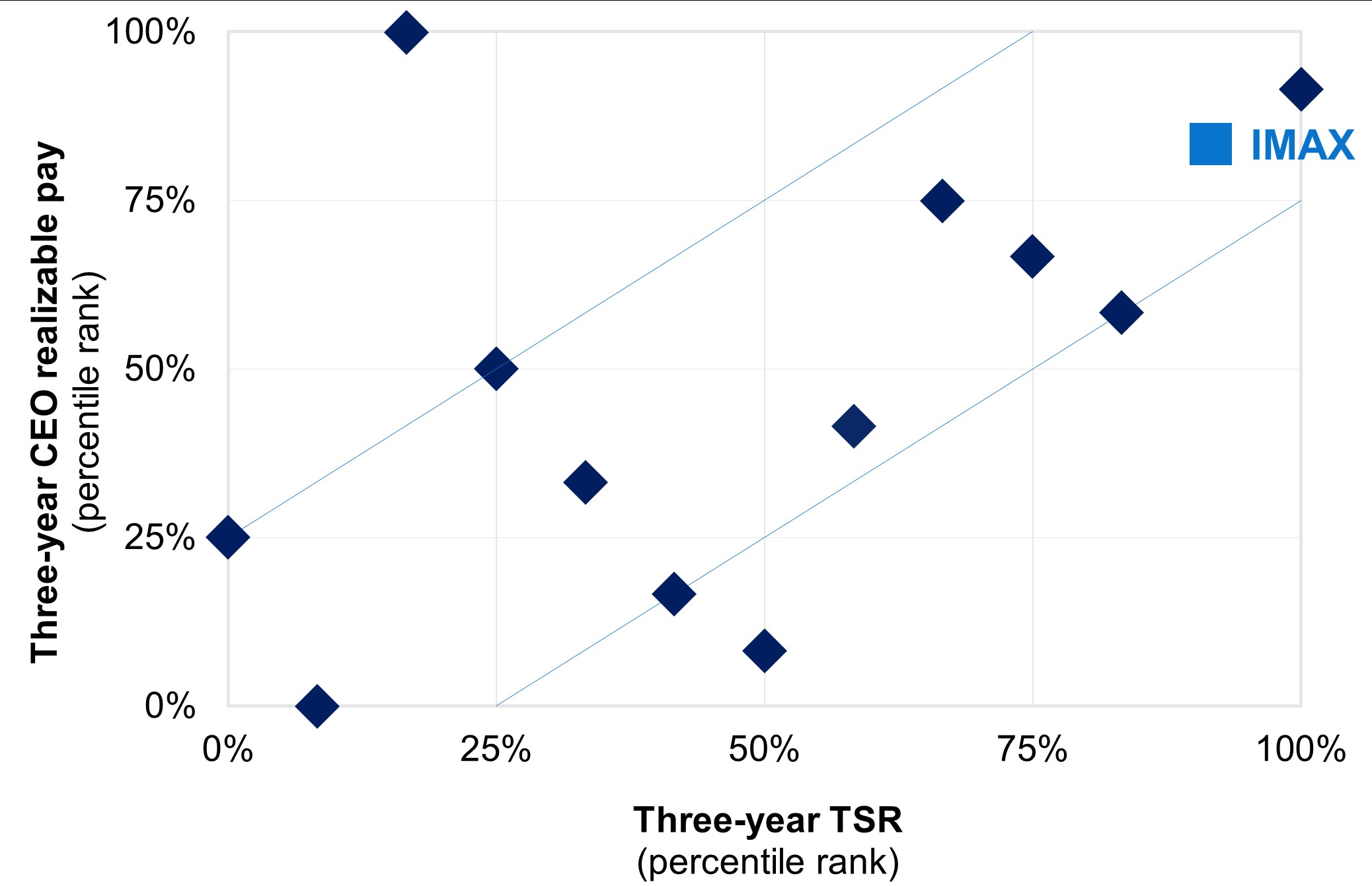
Realizable pay reflects actual cash compensation earned and the intrinsic value of equity grants from the three most recent fiscal years for which the data was available, which for most of our peers reflects fiscal years 2022-2024. Total Shareholder Return represents the three-year compound annual growth rate in dividend-adjusted close price, using the close price on the last day of the period for which pay was collected. Financial data was sourced from S&P’s Capital IQ financial database and compensation data was sourced from applicable proxy filings.
IMAX has consistently used this approach to assess pay for performance alignment, and the Compensation Committee is confident that this data demonstrates the alignment of pay and performance in keeping with our compensation philosophy.
(32)
Compensation Governance | ||
Compensation Committee oversight
The Compensation Committee, which is composed entirely of independent directors, is responsible for overseeing IMAX’s compensation policies and programs, including equity and incentive compensation. This involves:
•Reviewing and approving the compensation of the CEO, with consideration to his performance;
•Reviewing any employment arrangements applicable to the CEO, such as any employment or severance agreements;
•Reviewing and approving the CEO’s recommendations regarding the compensation of other executive officers;
•Reviewing shareholder and proxy advisor feedback, and participating in shareholder engagement efforts;
•Reviewing the CD&A and approving required disclosures including the Compensation Committee Report;
•Assessing the Compensation Committee’s effectiveness and Charter;
•Evaluating and making recommendations to the Board on incentive compensation, inclusive of our equity plans; and
•Performing the required functions under the equity incentive plans, such as approving grants to employees.
None of the NEOs had any role in approving their own compensation. However, the Compensation Committee does consider the recommendations of our CEO and of our Chief People Officer in setting compensation levels for (non-CEO) NEOs. The Compensation Committee has the authority to retain outside consultants to provide independent advice. The Committee engaged Willis Towers Watson to provide market data and advice in connection with the negotiation of the amendment to the CEO’s employment agreement during 2025. The Compensation Committee did not engage a consultant for any other purposes in 2025. As discussed on page 29, the Compensation Committee also considers feedback received from our shareholders and the results of our advisory annual say-on-pay vote when reviewing and approving executive compensation annually.
Using compensation peer group data to inform decisions
Decisions on NEO compensation consider a range of factors including an individual’s experience, skills, and relationships; his/her actual and relative contributions; internal relativities; and retention risk and role criticality. These largely qualitative factors are augmented by external market data on pay practices at other companies, sourced from public filings or published surveys.
Defining a relevant peer group for IMAX is challenging, given our diverse and unique business, the necessity for strong relationships within the worldwide entertainment industry – particularly Hollywood, and our global footprint, which includes a ~71% ownership stake in IMAX China listed on the Hong Kong Stock Exchange. In assessing potential peers, consideration was given to the following:
•Industry representation given our market-leading role at the intersection of entertainment and technology, with a need for executive talent that can credibly interact with Hollywood and international studios and filmmakers.
•Financial indicators including revenues within a 0.5 – 3-times range of IMAX, market capitalization, and gross margin.
•Geographic footprint to include companies that compete for executives with multi-national experience (IMAX’s global footprint encompasses over 90 countries).
•Other subjective factors such as brand prominence and presence in expanding areas of strategic growth.
No specific position is targeted relative to external market data when setting target pay levels, given the need for informed judgment and knowledge of our business to make appropriate decisions.
The Compensation Committee approved the following peer group for 2025, which remains unchanged from the prior year (other than the removal of companies that have undergone transaction activity in the intervening period):
Peer companies (1) | ||||||||
Ambarella, Inc. (AMBA) | Dolby Laboratories, Inc. (DLB) | Lionsgate Studios (LION)(2) | ||||||
Cinemark Holdings, Inc. (CNK) | fuboTV Inc. (FUBO) | The Marcus Corporation (MCS) | ||||||
Cineplex, Inc. (TSX: GC) | Harmonic, Inc. (HLIT) | WildBrain Ltd. (WILD) | ||||||
Corsair Gaming, Inc. (CRSR) | Knowles Corporation (KN) | Xperi Holding Corporation(3) | ||||||
(1)Since initial approval of the peer group in 2022, the following companies have been removed due to transaction activities: Avid Technology, Inc. and World Wrestling Entertainment, Inc.
(2)Following the split of Lions Gate Entertainment Corp. in 2025, the studio business was retained in the peer group given its continuing relevance.
(3)In 2022, Xperi Holding Corporation separated into two independent publicly traded companies, one comprising its intellectual property licensing business and one comprising its product business. For our peer group purposes, we used Xperi Inc., the surviving product business entity of Xperi Holding Corporation.
(33)
Managing compensation risk
The Compensation Committee has determined, based on an assessment of the Company’s executive compensation programs completed by management, that our compensation policies and programs do not give rise to inappropriate risk taking or risks that are reasonably likely to have a material adverse effect on the Company. Central to that assessment is the fact that our compensation plans balance short-term and long-term incentives with the use of both cash and equity. This exposure to variable pay and the long-term sustainability of our share price aligns our NEOs’ interests with those of our shareholders.
This is supported by policies and practices that factor in the best interests of our shareholders, reflect high governance standards, support the management of potential risk, and promote sustainable long-term decision-making behaviors from our NEOs.
Share ownership guidelines
The Company maintains guidelines that require certain individuals to accumulate a significant ownership stake in IMAX, so they are incentivized to maximize sustainable long-term returns for our shareholders. Covered individuals have four years to achieve compliance with their respective guideline, with annual pro-rated milestones of increasing increments of 25%. If an individual does not comply with the ownership guideline within the required time frame, the Company retains the ability to require 100% retention by the individual of awards granted under the equity programs or a reduction in incentive awards. Compliance is assessed annually on April 1 based on a two-year average stock price. As of April 1, 2026, all NEOs were in compliance with the applicable guidelines.
Officer | Guideline (% of salary) | Pro-rata guideline (% of salary) | Current ownership (% of salary) | ||||||||
Richard L. Gelfond | 500 | % | 500 | % | 1,882 | % | |||||
Natasha Fernandes | 100 | % | 100 | % | 336 | % | |||||
Anne Globe(1) | 100 | % | 50 | % | 94 | % | |||||
Robert D. Lister | 100 | % | 100 | % | 699 | % | |||||
Mark Welton | 100 | % | 100 | % | 786 | % | |||||
(1)Ms. Globe became subject to the share ownership guidelines in 2024 and is currently required to hold 50% of her salary in the equivalent of shares. She will be required to hold at least 100% of her salary in the equivalent of shares in 2028.
Compensation recoupment
The Company maintains a clawback policy to comply with the requirements of Section 954 of the Dodd-Frank Act and the related rules and regulations promulgated by the SEC and NYSE (the “Clawback Policy”). The Clawback Policy applies to current and former executive officers and requires the Company to clawback certain awards of cash and equity incentive compensation earned, granted, or vested based on the attainment of a financial reporting measure (which includes TSR) when such payment was made as a result of achieving financial metrics that were subsequently amended due to a financial accounting restatement. A copy of the policy is filed as exhibit 97.1 to the 2025 Form 10-K. No clawback-related actions pursuant to the policy were required or pursued in 2025.
Mr. Gelfond’s employment agreement (as described in more detail on page 56) also contains provisions that enable the Company to clawback incentive payments if such amounts are paid to Mr. Gelfond as a result of financial metrics that are subsequently materially adversely restated, regardless of fault.
Hedging and pledging of company securities
The Company maintains an Insider Trading Policy which prohibits hedging and pledging of Company securities. Hedging includes trading in publicly-traded options, puts, calls, or other derivative instruments that are designed to hedge or offset decreases and increases in the value of Company securities, including, without limitation, prepaid variable forward contracts, equity swaps, collars, and exchange funds. Pledging includes pledging Company securities as collateral for a loan, including using margin accounts with a broker. For more information on our Insider Trading Policy, please see the section titled “Code of Business Conduct and Ethics and Insider Trading Policy” on page 73.
(34)
2025 NEO Compensation | ||
Base salary
Base salaries are reviewed annually with consideration to the impact on total compensation, taking into account factors including the NEO’s role, scope, and responsibilities; an incumbent’s experience, prior roles, capability, and contributions; relevant market data; and the terms of the relevant employment agreements, where applicable.
Officer | Currency | 2024 | 2025 | Change | ||||||||||
Richard L. Gelfond | USD | 1,200,000 | 1,200,000 | 0.0% | ||||||||||
Natasha Fernandes(1) | CAD | 550,000 | 605,000 | 10.0% | ||||||||||
Anne Globe (2) | USD | 725,000 | 746,750 | 3.0% | ||||||||||
Robert D. Lister | USD | 775,816 | 775,816 | 0.0% | ||||||||||
Mark Welton | CAD | 800,000 | 800,000 | 0.0% | ||||||||||
(1)Ms. Fernandes’ increase was effective April 1, 2025, and reflects continued adjustments to more competitively position her salary versus market, supported by her growth in experience as Chief Financial Officer since being promoted, as well as her contributions in 2025.
(2)Ms. Globe’s increase was effective April 1, 2025, which reflects a merit-based adjustment based on the annual review by the Compensation Committee.
Annual cash bonus
We provide our NEOs with an annual cash bonus opportunity that can be earned based on an assessment of pre-established quantitative goals and a qualitative assessment of their strategic accomplishments and individual performance during the year. No changes were made to NEO target bonus opportunities during the year. For 2025, annual cash bonus determinations were based on a combination of corporate performance, business unit performance and individual performance.
Officer | Target (% of salary) | Quantitative performance weighting | Individual performance weighting(1) | ||||||||
Richard L. Gelfond | 100 | % | 80 | % | 20 | % | |||||
Natasha Fernandes | 60 | % | 50 | % | 50 | % | |||||
Anne Globe | 50 | % | 50 | % | 50 | % | |||||
Robert D. Lister | 60 | % | 50 | % | 50 | % | |||||
Mark Welton | 70 | % | 50 | % | 50 | % | |||||
(1)With the exception of Mr. Gelfond, individual performance weighting includes a business unit performance factor, which accounts for 10% of the individual performance component of the scorecard.
Quantitative performance
Each year the Compensation Committee reviews the quantitative performance metrics to ensure they align with the Company’s current financial and strategic goals. Financial metrics account for a majority of this element, which align outcomes with our success at meeting financial expectations during the year. This is complemented by quantitative strategic objectives that represent meaningful leading indicators of future financial performance and our success in expanding the IMAX network globally. For 2025, the Compensation Committee approved the following metric changes to best align with the Company’s strategic priorities and drivers of shareholder value:
•Total Adjusted EBITDA Margin replaced Total Adjusted EBITDA (as reflected in dollars) to place greater emphasis on operating efficiency and margin discipline as the Company continues to scale. The Compensation Committee believes this metric better aligns executive incentives with sustainable profitability and long-term value creation.
•Adjusted EPS replaced Free Cash Flow, which more directly reflects underlying operating performance and profitability and is a key metric used to assess the Company’s financial results. While Free Cash Flow remains an important internal measure, it can be influenced by the timing of investments and other factors that may not consistently reflect annual operating performance.
•The Streaming Technology Booking metric was removed as a standalone goal. As that business transitions beyond its initial acquisition phase, the Compensation Committee determined that its performance is now more appropriately reflected within the Company’s broader financial results. Eliminating this goal further simplifies the incentive framework and focuses executive attention on its key enterprise-wide priorities and value creation.
(35)
For 2025, the weightings of each metric varied between the CEO and other NEOs to best align with influence and accountability. The maximum potential payout in respect of each metric was capped at 120% of target for our NEOs other than the CEO and 200% for our CEO.
The table below summarizes the metrics and their relevant weightings; threshold, target, and maximum goals; and actual results in respect of the 2025 performance metrics applicable to annual bonuses. These metrics applied consistently to all eligible plan participants, including the NEOs. The threshold performance goals for 2025 were set at 85% of target performance goal. Consistent with 2024, achieving the threshold performance level results in payouts of 50% of the target bonus. Payouts increase to 100% upon achieving the target performance goal, and up to 200% upon achieving the maximum performance goal. This design reinforces the Company’s pay-for-performance philosophy by maintaining a direct relationship between performance and payout, while providing for meaningful differentiation in outcomes across varying levels of performance.
| Weight for | Performance goals | Quantitative Performance Element Payout Prior to Cap(1) (% target) | |||||||||||||||||||||
CEO | other NEOs | Threshold | Target | Maximum | Actual | ||||||||||||||||||
Total Revenue (m) | 25.00% | 22.00% | $342.4 | $402.80 | $483.4 | $410.2 | 109.2% | ||||||||||||||||
Total Adjusted EBITDA Margin (%) | 25.00% | 22.00% | 34.0% | 40.0% | 48.0% | 45.1% | 163.8% | ||||||||||||||||
Adjusted EPS | 12.50% | 22.00% | $1.16 | $1.36 | $1.63 | $1.45 | 133.1% | ||||||||||||||||
Signings (count) | 18.75% | 18.00% | 111 | 130 | 156 | 166 | 200.0% | ||||||||||||||||
Installations (count) | 18.75% | 16.00% | 128 | 150 | 180 | 160 | 133.3% | ||||||||||||||||
Associated payout (% of target opportunity) | 50% | 100% | Up to 200% | ||||||||||||||||||||
(1)Payouts by metric are calculated independently and interpolated on a straight-line basis between threshold, target and maximum. For performance below threshold, no bonus is earned. For NEOs other than the CEO, in the event the calculated payout factor exceeds 120% of target, the payout is capped at 120%.
Outcomes by metric consistently exceeded target but only once exceeded maximum despite a record performance year, evidencing the rigor in the goal-setting process and reinforcing our culture of aligning pay to performance. Our goals are established through a disciplined, data-driven process that incorporates historical performance, external market conditions, internal forecasts, and Compensation Committee oversight to ensure they are both challenging and achievable. This approach is designed to appropriately calibrate and incentivize the achievement of stretch goals without encouraging undue risk-taking, while maintaining strong alignment with our strategic priorities. The overall quantitative performance factor was 147.4% of target for the CEO and 117.6% for the other NEOs.
Individual performance
Business unit performance
Beginning in 2025, a business unit performance component was introduced as part of the annual cash bonus, comprising 10% of the individual performance portion. This component represents a defined portion of the annual cash bonus opportunity and reflects performance against pre-established financial and strategic objectives applicable to each executive’s area of responsibility. The business unit component reinforces accountability for operating results and strategic execution at the segment level and further aligns compensation outcomes with the areas executives directly influence.
For 2025, performance considerations included progress in strengthening IMAX’s proprietary technology platform and end‑to‑end ecosystem to deliver consistent premium quality at global scale, including support for continued Filmed For IMAX adoption. The Compensation Committee also considered the effectiveness of leadership in sustaining IMAX’s specialized engineering and technical capabilities, deepening strategic partnerships with filmmakers, studios, exhibitors, and other global partners, and reinforcing IMAX’s premium brand positioning and growing fan base. Additional factors included execution against a diversified and flexible global content portfolio across Hollywood, local‑language, and alternative content, leveraging localization to support regional performance, and disciplined expansion of IMAX’s sales engine to drive installations, renewals, and partner value. For Ms. Fernandes and Mr. Lister, qualitative assessments reflected their respective leadership in enabling these outcomes through the finance, legal, and human resources functions.
Qualitative performance
The Compensation Committee believes it is important to retain some discretion in determining annual cash bonuses to ensure the alignment of pay and performance. The objective of the qualitative performance element of the bonus is to incentivize and reward individual NEO performance and outcomes in areas that are not necessarily quantifiable but are integral to our continued success.
(36)
Areas considered generally reflect key strategic achievements that are leading indicators of our future performance. In respect of the CEO, the Compensation Committee assesses and scores Mr. Gelfond’s performance. For other NEOs, the CEO evaluates their performance and recommends scores which the Compensation Committee reviews and approves.
The table below shows the payout as a percentage of target for the individual performance portion of the annual bonus (20% for the CEO and 50% for the other NEOs), although the Compensation Committee and CEO also give consideration to the overall total value when approving outcomes.
INDIVIDUAL PERFORMANCE PORTION OF THE ANNUAL CASH BONUS (20% for the CEO and 50% for the other NEOs) | ||||||||
Officer | Key achievements considered in assessing individual performance | Individual Performance Element Payout (% of target) | ||||||
Richard L. Gelfond | •Overall leadership and contributions that continues to strengthen IMAX within the entertainment industry, reflected in above target achievements across the quantitative scorecard •Enhanced studio and filmmaker relationships that help drive IMAX’s success at the box office through increased IMAX-centric marketing, scheduling accommodations for tentpole films, and public endorsements from top directors which in turn has contributed to the procurement of film pipeline that provides visibility into future operational results •Reorganized the Entertainment division with tactical appointments and restructuring that enabled an enhanced analytical, data-driven approach to capture, programming and distribution, which increased our agility in driving global box office performance through strategic mix decisions •Delivered on commitments to transform camera technology driving cornerstone directors of the most anticipated movies to film in IMAX •Strengthened the leadership team and develop internal successors with greater internal and external exposure | 200 | % | |||||
Natasha Fernandes | •Demonstrated disciplined financial leadership and strong execution across the Company’s financial, capital markets, and investor relations activities •Oversaw outstanding operating results, including strong profitability, margin expansion, and free cash flow generation, reflecting the scalability of the Company’s business model and effective cost management •Successfully led significant capital structure initiatives, including the expansion of the Company’s revolving credit facility and the issuance of convertible notes which were well received by the market •Strengthened the investor relations strategy, enhanced financial reporting processes, and built depth and capability within the finance organization, and increased collaboration across the senior leadership team | 147 | % | |||||
Anne Globe | •Contributed significantly to the Company’s brand, marketing execution, and studio and exhibition partner relationships •Drove strong box office results and increased market share through well-executed global marketing campaigns, with improved consistency and execution across regions •Strengthened the Company’s positioning with studios through best in class, IMAX-centric campaigns and enhanced collaboration with the sales organization •Continued to build and develop a high performing, engaged marketing organization, reflected in improved employee engagement, higher in office presence, and reduced turnover •Advanced the Company’s digital and analytics capabilities, laying important groundwork for future direct to consumer engagement and data driven marketing initiatives | 120 | % | |||||
(37)
INDIVIDUAL PERFORMANCE PORTION OF THE ANNUAL CASH BONUS (20% for the CEO and 50% for the other NEOs) | ||||||||
Robert D. Lister | •Delivered critical leadership across legal, governance, strategic, and Board-related matters •Successfully negotiated and renewed major studio agreements, including certain Filmed For IMAX agreements, and led complex executive and Board processes •Effectively managed significant legal and regulatory matters, while maintaining cost discipline and supporting key operational and organizational initiatives •Oversaw successful negotiation and completion of 3-year renewal of CEO’s employment agreement, promoting leadership continuity | 125 | % | |||||
Mark Welton | •Drove meaningful revenue growth and operational execution across the Company’s global sales and theater operations, exceeding key revenue and signing targets •Successfully structured and renegotiated several major exhibitor agreements, managing complex commercial and technical negotiations •Successfully led a broad range of global operational initiatives to support the Company’s next-generation technology and transformation efforts, including its film camera development | 129 | % | |||||
Outcomes
The above performance resulted in the Compensation Committee approving the following annual cash bonuses for the NEOs in respect of 2025 performance.
Officer | Currency | Target bonus(1) | Actual bonus | Actual bonus as % of target | ||||||||||
Richard L. Gelfond | USD | 1,200,000 | 1,898,841 | 158.2 | % | |||||||||
Natasha Fernandes | CAD | 354,750 | 500,000 | 140.9 | % | |||||||||
Anne Globe | USD | 370,656 | 442,615 | 119.4 | % | |||||||||
Robert D. Lister | USD | 465,490 | 575,904 | 123.7 | % | |||||||||
Mark Welton | CAD | 560,000 | 708,120 | 126.5 | % | |||||||||
(1)Calculated based on eligible earnings and the applicable target bonus opportunity for the year.
Long-term incentives
Equity-based long-term incentive awards account for the highest proportion of each NEO’s target compensation mix and provide direct alignment with the interests of our shareholders given exposure to movements in IMAX’s share price. Awards recognize the scope of a role’s responsibility, reward demonstrated performance, and encourage retention of talent and continuity in executive leadership. The level of value realized is designed to reflect leadership contributions to the successful execution of our strategy and our ability to deliver long-term sustainable growth.
Long-term Incentive Awards granted in 2025
In 2025, NEOs received target long-term incentive awards in an equally weighted mix of PSUs and RSUs. There were no material changes to the PSU or RSU designs in 2025 relative to 2024.
In determining target award values, the Compensation Committee considers several factors including individual and company performance, role scope and responsibility, the NEO’s aggregate compensation opportunity, internal relativities, the availability of equity, market practices among peers and, if relevant, the terms set out in a NEO’s employment agreement. The Compensation Committee approved an increase in Ms. Fernandes’ target grant value from $600,000 to $850,000 for 2025 to reflect her growth in experience as Chief Financial Officer since being promoted, with all other target grant values unchanged in 2025 versus 2024.
Officer | Target grant value (USD)(1) | ||||
Richard L. Gelfond | 5,500,000 | ||||
Natasha Fernandes | 850,000 | ||||
Anne Globe | 825,000 | ||||
Robert D. Lister | 1,450,000 | ||||
Mark Welton | 1,450,000 | ||||
(1)The number of PSUs and RSUs awarded is determined by dividing the approved target values by the grant date fair market value of our Common Shares.
(38)
Performance stock units awarded in 2025
2025 PSUs can be earned between 0% - 165% of the target value, based on IMAX’s average annual Total Adjusted EBITDA growth (weighted at 60%) and TSR relative to a custom peer group (weighted at 40%). The peer group used for relative TSR purposes is consistent with our compensation peer group as this reflects relevant industry companies against which to assess our investment return performance. Both measures are assessed over a three-year performance period which will conclude on December 31, 2027.
Metric(1) | Threshold | Threshold - Target | Target | Maximum | |||||||||||||
Average Annual Total Adjusted EBITDA Growth | Goals | 5.0% | 10.0% | 12.5% | ≥ 20% | ||||||||||||
Vesting (% of target) | 50% | 75% | 100% | 175% | |||||||||||||
Relative TSR Percentile Rank(2) | Goals | 25th | - | 50th | ≥ 90th | ||||||||||||
Vesting (% of target) | 30% | - | 100% | 150% | |||||||||||||
(1)Payouts by metric are calculated independently and interpolated on a straight-line basis between threshold, threshold-target (as applicable), target and maximum. For performance below threshold, no PSUs will vest.
(2)The 2025 relative TSR peer group comprises Ambarella, Inc., Cinemark Holdings, Inc., Cineplex, Inc., Corsair Gaming, Inc., Dolby Laboratories, Inc., fuboTV Inc., Harmonic, Inc., Knowles Corporation, The Marcus Corporation, WildBrain Ltd., and Xperi Inc. Following the split of Lions Gate Entertainment Corp., the studio business was retained in the peer group given its continuing relevance.
Restricted share units awarded in 2025
RSUs are generally earned based on continued service and vest in three tranches on the first (33%), second (33%), and third (34%) anniversaries of the date of grant.
Assessment of 2023 performance stock unit vesting
At the conclusion of 2025, the three-year performance period ended for PSUs granted in 2023. Awards were subject to goals based on Attributable Adjusted EBITDA growth (60%) and TSR relative to our peer group (40%). The Company achieved a maximum payout of 175% and 150% for Attributable Adjusted EBITDA and TSR portions, respectively, underscoring strong multi-year performance. Total achievement for the 2023 PSUs was at 165% of target.
Metric(1) | Threshold | Threshold - Target | Target | Target - Maximum | Maximum | Actual | |||||||||||||||||
Average Annual Attributable Adjusted EBITDA Growth | Goals | 5.0% | 10.0% | 12.5% | 17.5% | ≥ 20% | 27% | ||||||||||||||||
Vesting (% of target) | 50% | 75% | 100% | 150% | 175% | 175% | |||||||||||||||||
Relative TSR Percentile Rank | Goals | 25th | - | 50th | - | ≥ 90th | 98th | ||||||||||||||||
Vesting (% of target) | 30% | - | 100% | -% | 150% | 152% | |||||||||||||||||
(1)Payouts by metric were calculated independently and interpolated on a straight-line basis between threshold, threshold-target (as applicable), target, target – maximum (as appropriate) and maximum. For performance below threshold, no PSUs would have vested.
Beginning with the Adjusted EBITDA-based PSUs granted in 2024, performance is measured based on the Company’s Total Adjusted EBITDA growth rather than Attributable Adjusted EBITDA growth. Total Adjusted EBITDA includes the non-controlling interests of the Company’s subsidiaries. This change was implemented to better align PSU performance conditions with how management evaluates the Company’s business and overall performance.
Other elements of compensation
Retirement and pension plans
All employees are offered the opportunity to participate in at least one capital accumulation plan, to aid them in preparation for their future retirement. The plans for which an employee is eligible, including our NEOs, vary based on their country of residence and level of seniority.
NEOs participate in local market defined contribution-style tax-advantaged retirement savings plans, which are offered on consistent terms to all eligible employees.
Mr. Gelfond is also eligible to receive benefits under a Supplemental Executive Retirement Plan (“SERP”) which was established in 2000, and a post-retirement medical benefits plan. These benefits contribute to a competitive overall total compensation package.
•The SERP is an unfunded defined benefit arrangement with a fixed value of $20.3 million. Mr. Gelfond is 100% vested in the benefits and in the event of his termination of employment, other than by the Company for cause, is entitled to receive the benefits as a lump sum.
(39)
•The post-retirement medical benefits plan is an unfunded arrangement that covers Mr. Gelfond and his dependents. Mr. Gelfond is fully vested in the plan, which provides that the Company will maintain retiree health benefits until Mr. Gelfond becomes eligible for Medicare at which time the Company will provide Medicare supplemental coverage, as selected by Mr. Gelfond. If such supplemental coverage is not permitted, Mr. Gelfond will be entitled to an annual cash payment equal to the value of such coverage.
Other benefits
The Company provides certain additional benefits and limited perquisites to eligible senior executives, including the NEOs, as part of its broader Total Rewards program. These benefits are intended to support sustained performance and leadership effectiveness within a competitive executive compensation framework. In 2025, the NEOs were eligible to receive all or a portion of the following benefits, which are also footnoted under the Summary Compensation Table:
•Participation in an Executive Supplemental Health Plan for eligible senior executives based in the United States, which provides expanded coverage and reimbursement of services not covered by our medical, dental and vision plans.
•An executive wellness allowance, which provides for reimbursement of up to approximately $2,500 in qualifying wellness costs annually.
•A death-in-service benefit which provides for a lump sum payment to an eligible executive’s beneficiaries, equal to two-times base salary (subject to absolute caps) in the event of the executive’s death prior to actual retirement at age 65.
•Reimbursement of qualifying expenses related to life insurance premiums.
•Reimbursement of qualifying expenses related to tax, financial and estate planning services, charitable giving, business club memberships and other incidentals.
Certain NEOs are entitled to additional benefits under their respective employment agreement as discussed in “Potential Payments upon Termination or Change-in-Control.” on page 52.
Additional Information | ||
Employment and change-in-control agreements
The Company has written employment agreements or offer letters with each NEO, which are described in detail in the “Potential Payments upon Termination or Change-in-Control” on page 52. These agreements are critical to attract and retain experienced talent within our industry, and to motivate and properly incentivize our NEOs, while still allowing the Compensation Committee requisite discretion to determine overall compensation. The agreements specify details on the terms applicable to salary, bonus, equity awards, and the restrictive covenants the NEO is subject to (which include non-competition and non-solicitation provisions). Generally, the agreements are established at the time of hire and are amended from time to time to extend or modify the terms of employment, including to reflect compensation decisions resulting from a promotion or other change in job responsibility.
Each NEO’s employment arrangement requires that we make certain payments to the relevant NEO in the event of a termination of employment for various reasons, including in connection with a change-in-control. The provisions are designed to promote stability and continuity of senior management in the event of a transaction involving a change in control. No NEO has a “single-trigger” change-in-control benefit (other than Mr. Gelfond—see below); meaning all such change-in-control provisions for NEOs other than the CEO require a qualifying termination of employment following a change-in-control event in order to receive benefits.
Mr. Gelfond’s Agreement
On July 17, 2025, IMAX entered into a third amendment to Mr. Gelfond’s existing employment agreement, which became effective as of January 1, 2026 and extends the term of his existing employment agreement to December 31, 2028. In negotiating Mr. Gelfond’s agreement terms, the Compensation Committee considered feedback received during shareholder outreach and engaged Willis Towers Watson to provide independent market data to inform its decisions. A summary of the key features and changes, as applicable, are summarized below. Copies of Mr. Gelfond’s employment agreement and its amendments are filed as exhibits to the 2025 Form 10-K.
(40)
Key Feature | Summary | ||||
Target Cash Compensation | •Cash compensation has not been increased •Mr. Gelfond’s salary will remain $ 1.2 million and his target bonus opportunity will remain at 100% of base salary (capped at 200%) | ||||
Target annual equity grant | •Mr. Gelfond’s target annual equity grant value has increased from $5.5 million to $7.0 million •Equity will continue be granted in an equal mix of RSUs and PSUs subject to Total Adjusted EBITDA and relative TSR based vesting conditions •The Board and the Compensation Committee determined that this grant value increase was warranted given Mr. Gelfond’s performance in role, his influential industry relationships and the value they bring to the Company, the time since his last adjustment, movements in market data and the competitive talent landscape •The increase was purposefully delivered only in Mr. Gelfond’s long-term incentive to ensure the eventual value is tied to company performance through exposure to stock price, and in the case of PSUs, additional vesting conditions •The resulting impact is an increase to Mr. Gelfond's target compensation of 19.0% (3.5% on an annualized basis since his last adjustment in 2020) •In addition, the maximum payout opportunity for Mr. Gelfond’s PSUs is increasing from 165% of target to 200% of target to better align with market; this change is being made for all PSU participants | ||||
Service Factor(1) Consideration | •Mr. Gelfond’s agreement has been updated so that he is covered by the Service Factor provision applicable to all other Long-Term Incentive Plan participants •This change means that subject to meeting the Service Factor provisions, upon termination without cause, resignation, retirement or non-renewal, Mr. Gelfond’s outstanding equity awards will vest in accordance with their original schedules, and in the case of PSUs, subject to the original performance goals, without any time pro-rating for service •The Board and the Compensation Committee determined that this change was appropriate to ensure competitiveness with market and consistent with the treatment of other employees, and that it reflected good governance given there would be no award acceleration on separation, thus supporting alignment during and following leadership transitions | ||||
(1)The Service Factor definition is as follows: (i) attaining the age of at least 55 and (ii) continuous service with the Company or any of its subsidiaries and affiliates for at least 10 years, or such other criteria that are deemed by the Compensation Committee to be an achievement of the Service Factor; provided, however, that, in the case of a resignation, the participant must provide the Company with a written notice of intent to resign at least six (6) months prior to the final day of employment with the Company.
In negotiating Mr. Gelfond’s amendment, the Board was cognizant of certain legacy change in control provisions in Mr. Gelfond’s agreement.
These provisions were originally negotiated in connection with Mr. Gelfond’s role as an equity-holder pursuant to a shareholders agreement entered as part of the acquisition of IMAX in 1994 by Mr. Gelfond and the Company’s former co-CEO and Chairman, Bradley J. Wechsler, as well as an incentive bonus granted in 2006. These legacy provisions provide Mr. Gelfond with the opportunity to earn payments on a change-in-control, based on the value of the Company as shown in the “Potential Payments upon Termination or Change-in-Control” section starting on page 52. The Board and Compensation Committee reaffirmed its position that renegotiating legacy agreements with Mr. Gelfond (and/or Mr. Wechsler who retains his rights to similar payments even though his employment with the Company ended in 2009) that are 20-30 years old would be both impractical for the Company and damaging to shareholders. The Compensation Committee continues to believe that these legacy provisions align with shareholders’ interests, while not creating undue risk. The Compensation Committee also noted that the views most commonly expressed by active participants in the shareholder outreach were (a) acknowledgement that renegotiating these legacy terms would likely be highly costly to shareholders, and (b) satisfaction that these existing provisions align closely to shareholder value creation.
Appointment of Interim PEO
On April 16, 2026, the Board appointed Mr. Lister, the Company’s Chief Legal Officer and Senior Executive Vice President, to serve as the Company’s interim PEO in addition to his current duties until May 1, 2026, following which Mr. Gelfond will resume the role of PEO. Mr. Lister will not receive any additional compensation in connection with his temporary interim appointment.
Tax and accounting considerations
To the extent that any compensation paid to the NEOs constitutes a deferral of compensation within the meaning of Section 409A of the Internal Revenue Code of 1986 (the “Code”), we intend to cause the compensation to comply with the requirements of Section 409A and to avoid the imposition of penalty taxes and interest upon the participant receiving the award. In determining the form and amount of compensation awarded we look mainly to the compensation principles and objectives outlined above while also considering the impact of Financial Accounting Standards Board Accounting Standards Codification Topic 718 “Compensation – Stock Compensation”.
(41)
Section 162(m) of the Code limits the deductibility of compensation paid to certain top executives to $1.0 million per taxable year. Prior to the enactment of the Tax Cuts and Jobs Act of 2017 (the “Tax Act”), there was an exemption from this $1.0 million deduction limit for compensation payments that qualified as “performance-based” under applicable regulations. The enactment of the Tax Act eliminated the performance-based compensation exemption, except with respect to certain grandfathered arrangements. While the Compensation Committee considers the tax implications of its decisions when determining the compensation of our officers, it reserves the discretion, in its judgment, to authorize compensation payments that are not deductible when it believes that such payments are appropriate to attract and retain executive talent.
COMPENSATION COMMITTEE REPORT
The members of the Compensation Committee hereby state that they have reviewed and discussed the Compensation Discussion and Analysis for the year ended December 31, 2025, with management. Based on this review and discussion, the Compensation Committee recommended to the Board of Directors that the Compensation Discussion and Analysis be included in this Circular.
April 24, 2026 | Respectfully submitted, | ||||
| Kevin Douglas (Chair) | |||||
Gail Berman Steve Pamon Dana Settle | |||||
(42)
2025 SUMMARY COMPENSATION TABLE
The table below sets forth the compensation earned by the NEOs during the last three completed fiscal years.
| Name and Principal Position | Year | Salary ($) | Bonus ($) | Stock Awards ($)(1) | Non-equity Incentive Plan Compensation ($) | Change in Pension Value and Nonqualified Deferred Compensation Earnings ($) | All Other Compensation ($) | Total ($) | ||||||||||||||||||||||||||||||
| Richard L. Gelfond | 2025 | 1,200,000 | — | 5,499,951 | (2) | 1,898,841 | — | (3) | 57,137 | (4) | 8,655,929 | |||||||||||||||||||||||||||
| Chief Executive Officer | 2024 | 1,200,000 | — | 5,499,983 | 1,196,391 | — | 85,437 | 7,981,811 | ||||||||||||||||||||||||||||||
| and Director | 2023 | 1,200,000 | — | 5,499,992 | 1,954,521 | — | 74,122 | 8,728,635 | ||||||||||||||||||||||||||||||
Natasha Fernandes(5) | 2025 | 431,376 | — | 850,000 | (6) | 364,800 | — | 50,605 | (7) | 1,696,781 | ||||||||||||||||||||||||||||
| Chief Financial Officer and | 2024 | 373,562 | — | 799,972 | 243,250 | — | 41,034 | 1,457,818 | ||||||||||||||||||||||||||||||
| Executive Vice President | 2023 | 370,513 | — | 774,964 | 300,000 | — | 44,041 | 1,489,518 | ||||||||||||||||||||||||||||||
| Anne Globe | 2025 | 741,312 | — | 824,993 | (8) | 442,615 | — | 55,771 | (9) | 2,064,691 | ||||||||||||||||||||||||||||
| Chief Marketing Officer | 2024 | 672,135 | — | 824,977 | 327,027 | — | 54,908 | 1,879,047 | ||||||||||||||||||||||||||||||
| 2023 | — | — | — | — | — | — | — | |||||||||||||||||||||||||||||||
| Robert D. Lister | 2025 | 775,816 | — | 1,449,989 | (10) | 575,904 | — | 106,137 | (11) | 2,907,846 | ||||||||||||||||||||||||||||
| Chief Legal Officer and | 2024 | 775,816 | — | 1,449,972 | 452,968 | — | 95,712 | 2,774,468 | ||||||||||||||||||||||||||||||
| Senior Executive Vice President | 2023 | 772,013 | — | 1,449,951 | 644,322 | — | 136,911 | 3,003,197 | ||||||||||||||||||||||||||||||
Mark Welton(12) | 2025 | 583,680 | — | 1,449,989 | (13) | 516,644 | — | 66,051 | (14) | 2,616,364 | ||||||||||||||||||||||||||||
| President, IMAX Global Theatres | 2024 | 556,000 | — | 1,449,972 | 378,731 | — | 66,628 | 2,451,331 | ||||||||||||||||||||||||||||||
| 2023 | 599,817 | — | 1,449,951 | 600,000 | — | 71,389 | 2,721,157 | |||||||||||||||||||||||||||||||
(1)As required by SEC rules, the “Stock Awards” columns in this Summary Compensation Table reflect the aggregate grant date fair values of PSUs and RSUs, respectively, computed in accordance with Financial Accounting Standards Board (“FASB”) Accounting Standards Codification (“ASC”) Topic 718 (with no reductions for forfeitures). See “Capital Stock — Share-Based Compensation” in Note 16 of Notes to Consolidated Financial Statements in Item 8 of the 2025 Form 10-K, for the assumptions used to calculate the fair value of the PSUs and RSUs. Whether, and to what extent, an NEO realizes value with respect to PSU, or RSU awards will depend on, as applicable, our actual operating performance, share price fluctuations relative to a peer group and the NEO’s continued employment through the applicable vesting date.
(2)This amount represents the grant date fair value of 109,518 RSUs and 104,869 PSUs granted on January 2, 2025 pursuant to Mr. Gelfond’s employment agreement. The grant date fair value of the PSU awards granted to Mr. Gelfond in 2025, assuming the highest level of performance conditions associated with these PSUs occurs (capped at 175% and 150% of target of the initial Total Adjusted EBITDA award and the initial TSR awards, respectively) is $4,537,400.
(3)The carrying value of Mr. Gelfond’s benefits under the SERP decreased due to changes in actuarial assumptions that are unrelated to the value Mr. Gelfond will derive under the SERP. Pursuant to the terms of an amendment to his employment agreement, effective January 1, 2020, Mr. Gelfond is entitled to a fixed value of $20.3 million under the SERP. See “Employers Pension and Postretirement Benefits — Defined Benefit Plan” in Note 22 of Notes to Consolidated Financial Statements in Item 8 of the 2025 Form 10-K, for more information related to the SERP.
(4)This amount reflects: (i) $8,750 for contributions to his 401(k) retirement plan; (ii) $12,156 for the supplemental health reimbursement premiums; (iii) $27,596 for allowance for personal automobile use; (iv) $2,500 reimbursement under the Executive Wellness Plan; and (v) $6,135 for reimbursements for personal expenses incurred on business travel and/or events.
(5)Ms. Fernandes’ salary, bonus, non-equity incentive plan compensation, and all other compensation are paid in Canadian dollars. Exchange rates of US$1.00 = CAD$1.3706 in 2025, US$1.00 = CAD$1.4389 in 2024, and US$1.00 = CAD$1.3226 in 2023 have been applied to convert such amounts from Canadian dollars to U.S. dollars. The exchange rates were as of the last trading date in the relevant year.
(6)This amount represents the grant date fair value of 17,000 RSUs and 16,006 PSUs granted on March 7, 2025 pursuant to Ms. Fernandes’ employment agreement. The grant date fair value of the PSU awards granted to Ms. Fernandes in 2025, assuming the highest level of performance conditions associated with these PSUs occurs (capped at 175% and 150% of target of the initial Total Adjusted EBITDA award and the initial TSR awards, respectively) is $701,250.
(7)This amount reflects: (i) $21,569 for contributions to her retirement plan; (ii) $22,367 for fixed annual executive allowance; (iii) $3,321 reimbursement for the Executive Wellness Plan; (iv) $785 for tax preparation related to business travel; and (v) $2,563 for reimbursement for personal expenses.
(8)This amount represents the grant date fair value of 16,500 RSUs and 15,535 PSUs granted on March 7, 2025 pursuant to Ms. Globe’s employment agreement. The grant date fair value of the PSU awards granted to Ms. Globe in 2025, assuming the highest level of performance conditions associated with these PSUs occurs (capped at 175% and 150% of target of the initial Total Adjusted EBITDA award and the initial TSR Award, respectively) is $680,600.
(9)This amount reflects: (i) $12,156 for the supplemental health reimbursement premiums; (ii) $28,813 for a fixed annual executive allowance; (iii) $8,750 for contributions to her 401(k) retirement plan; (iv) $4,792 in reimbursement for the Executive Wellness Plan; and (v) $1,260 for reimbursement for personal expenses.
(43)
(10)This amount represents the grant date fair value of 29,000 RSUs and 27,304 PSUs granted on March 7, 2025 pursuant to Mr. Lister’s employment agreement. The grant date fair value of the PSU awards granted to Mr. Lister in 2025, assuming the highest level of performance conditions associated with these PSUs occurs (capped at 175% and 150% of target of the initial Total Adjusted EBITDA award and the initial TSR awards, respectively) is $1,196,234.
(11)This amount reflects: (i) $19,680 for the supplemental health reimbursement premiums; (ii) $36,382 for allowance for personal automobile use; (iii) $8,750 for contributions to his 401(k) retirement plan; (iv) $34,075 for a taxable benefit in relation to the achievement of the Service Factor; (v) $4,750 for tax preparation; and (vi) $2,500 reimbursement for the Executive Wellness Plan.
(12)Mr. Welton’s salary, bonus, non-equity incentive plan compensation and all other compensation are paid in Canadian dollars. Exchange rates of US$1.00 = CAD$1.3706 in 2025, US$1.00 = CAD$1.4389 in 2024, and US$1.00 = CAD$1.3226 in 2023 have been applied to convert such amounts from Canadian dollars to U.S. dollars. The exchange rates were as of the last trading date in the relevant year.
(13)This amount reflects the grant date fair value of 29,000 RSUs and 27,304 PSUs granted on March 7, 2025 pursuant to Mr. Welton’s employment agreement. The grant date fair value of the PSU awards granted to Mr. Welton in 2025, assuming the highest level of performance conditions associated with these PSUs occurs (capped at 175% and 150% of target of the initial Total Adjusted EBITDA award and the initial TSR awards, respectively) is $1,196,234.
(14)This amount reflects: (i) $31,487 for contributions to his retirement plan including the non-registered Plan; (ii) $16,808 for a fixed executive allowance; (iii) $6,274 for life insurance payments; (iv) $2,189 reimbursement for the Executive Wellness Plan; and (v) $9,293 for reimbursement for personal expenses.
The material terms of the NEOs’ employment agreements are described below in “Potential Payments upon Termination or Change-in-Control” and such summaries are qualified in their entirety by the full text of such agreement.
(44)
2025 GRANTS OF PLAN-BASED AWARDS
The following table sets forth information relating to grants of plan-based awards made to NEOs during the fiscal year ended December 31, 2025 under any plan, including awards that subsequently have been transferred.
Estimated Future Payouts under Non-Equity Incentive Plan Awards(1) | Estimated Future Payouts under Equity Incentive Plan Awards (2) | |||||||||||||||||||||||||||||||||||||
| Name | Grant Date | Threshold ($) | Target ($) | Maximum ($) | Threshold (#)(3) | Target (#)(4) | Maximum (#)(5) | All Other Stock Awards: Number of Shares or Stock or Units (6) (#) | Grant Date Fair Value of Stock and Option Awards (7) ($) | |||||||||||||||||||||||||||||
| Richard L. Gelfond | - | 1,200,000 | 2,400,000 | (8) | - | - | - | - | - | |||||||||||||||||||||||||||||
| Jan 2, 2025 | - | - | - | 44,602 | 104,869 | 173,730 | - | 2,749,954 | ||||||||||||||||||||||||||||||
| Jan 2, 2025 | - | - | - | - | - | - | 109,518 | (9) | 2,749,997 | |||||||||||||||||||||||||||||
Natasha Fernandes(10) | - | 258,826 | - | - | - | - | - | - | ||||||||||||||||||||||||||||||
| Mar 7, 2025 | - | - | 6,841 | 16,006 | 26,559 | - | 425,000 | |||||||||||||||||||||||||||||||
| Mar 7, 2025 | - | - | - | - | - | - | 17,000 | (11) | 425,000 | |||||||||||||||||||||||||||||
| Anne Globe | - | 370,656 | - | - | - | - | - | - | ||||||||||||||||||||||||||||||
| Mar 7, 2025 | - | - | - | 6,640 | 15,535 | 25,777 | - | 412,493 | ||||||||||||||||||||||||||||||
| Mar 7, 2025 | - | - | - | - | - | - | 16,500 | (12) | 412,500 | |||||||||||||||||||||||||||||
| Robert D. Lister | - | 465,490 | - | - | - | - | - | - | ||||||||||||||||||||||||||||||
| Mar 7, 2025 | - | - | - | 11,671 | 27,304 | 45,306 | - | 724,989 | ||||||||||||||||||||||||||||||
| Mar 7, 2025 | - | - | - | - | - | - | 29,000 | (13) | 725,000 | |||||||||||||||||||||||||||||
Mark Welton(14) | - | 408,576 | - | - | - | - | - | - | ||||||||||||||||||||||||||||||
| Mar 7, 2025 | - | - | - | 9,812 | 27,304 | 45,306 | - | 724,989 | ||||||||||||||||||||||||||||||
| Mar 7, 2025 | - | - | - | - | - | - | 29,000 | (15) | 725,000 | |||||||||||||||||||||||||||||
(1)Represents annual cash bonus awards. The Target column reflects the awards granted had we achieved all of our 2025 performance measures at target, and are based on eligible earnings and the applicable target bonus for the year. See “Compensation Discussion and Analysis — 2025 NEO Compensation — Annual cash bonus” on page 35. Actual payouts are reported in the “Non-Equity Incentive Plan Compensation” column of the “Summary Compensation Table.”
(2)Each PSU represents a contingent right to receive one Common Share. The number of PSUs that ultimately vest can range from 0% to a maximum vesting opportunity of 175% of the initial Total Adjusted EBITDA award and 150% of the initial TSR award, depending upon actual performance versus the established Total Adjusted EBITDA and TSR targets. All PSUs were awarded under the IMAX Corporation Second Amended and Restated Long-Term Incentive Plan (the “IMAX LTIP” or “LTIP”).
(3)This amount represents the minimum vesting opportunity available for the PSUs granted in 2025, which will be evaluated at the conclusion of the three-year performance period depending upon actual performance versus the established Total Adjusted EBITDA and TSR targets.
(4)This amount represents the PSUs granted in 2025, which were awarded under the IMAX LTIP.
(5)This amount represents the maximum vesting opportunity available for the PSUs granted in 2025, which will be evaluated at the conclusion of the three-year performance period depending upon actual performance versus the established Total Adjusted EBITDA and TSR targets.
(6)Each RSU represents a contingent right to receive one Common Share. All RSUs were awarded under the IMAX LTIP.
(7)This amount represents the aggregate grant date fair values computed in accordance with FASB ASC Topic 718 (with no reductions for expected forfeitures). See “Capital Stock — Share-Based Compensation” in Note 16 of Notes to Consolidated Financial Statements in Item 8 of the 2025 Form 10-K, for the assumptions used to calculate the fair value of the RSUs and PSUs. Whether, and to what extent, an NEO realizes value with respect to RSU or PSU awards will depend, as applicable, on our actual operating performance, stock price fluctuations, and the NEO’s continued employment.
(8)Mr. Gelfond has a maximum annual bonus opportunity pursuant to his employment agreement of 200% of his base salary.
(9)These RSUs represent 109,518 RSUs granted on January 2, 2025 pursuant to Mr. Gelfond’s employment agreement. These RSUs will vest and convert to Common Shares in three installments: 36,506 on each of January 2, 2026, January 2, 2027 and January 2, 2028.
(10)Ms. Fernandes’ estimated future payouts under non-equity incentive plan awards are paid in Canadian dollars. An exchange rate of US$1.00= CAD$1.3706 in 2025 has been applied to convert such amounts from Canadian dollars to U.S. dollars.
(11)These RSUs represent 17,000 RSUs granted on March 7, 2025 pursuant to Ms. Fernandes’ employment agreement. The RSUs will vest and convert to Common Shares in three installments: 5,666 on each of March 7, 2026 and March 7, 2027 and 5,668 on March 7, 2028.
(12)These RSUs represent 16,500 RSUs granted on March 7, 2025 pursuant to Ms. Globe’s employment agreement. The RSUs will vest and convert to Common Shares in three installments: 5,500 on each of March 7, 2026, March 7, 2027 and March 7, 2028.
(13)These RSUs represent 29,000 RSUs granted on March 7, 2025 pursuant to Mr. Lister’s employment agreement. These RSUs vest and will convert to Common Shares in three installments: 9,666 on each of March 7, 2026, March 7, 2027 and 9,668 on March 7, 2028.
(14)Mr. Welton’s estimated future payouts under non-equity incentive plan awards are paid in Canadian dollars. An exchange rate of US$1.00= CAD$1.3706 in 2025 has been applied to convert such amounts from Canadian dollars to U.S. dollars.
(45)
(15)These RSUs represent 29,000 RSUs granted on March 7, 2025 pursuant to Mr. Welton’s employment agreement. These RSUs will vest and convert to Common Shares in three installments: 9,666 on each of March 7, 2026, March 7, 2027 and 9,668 on March 7, 2028.
Additional terms and conditions of the PSUs and RSUs granted detailed above are described below in “Potential Payments upon Termination or Change-in-Control” and such summaries are qualified in their entirety by the full text of such agreement.
(46)
OUTSTANDING EQUITY AWARDS AT 2025 FISCAL YEAR-END
The following table sets forth information relating to unexercised equity awards for each NEO outstanding as of December 31, 2025.
| Option Awards | Stock Awards | |||||||||||||||||||||||||||||||||||||
| Name | Number of Securities Underlying Unexercised Options (#) Exercisable | Number of Securities Underlying Unexercised Options (#) Unexercisable | Option Exercise Price ($) | Option Expiration Date | Number of Shares or Units of Stock That Have Not Vested (#) | Market Value of Shares or Units of Stock that Have Not Vested ($) | Equity Incentive Plan Awards: Number of Unearned Shares, Units or other Rights That Have Not Vested (#) | Equity Incentive Plan Awards: Market or Payout Value of Unearned Shares, Units or Other Rights That Have Not Vested ($) | ||||||||||||||||||||||||||||||
| Richard L. Gelfond | 486,284 | — | 31.40 | June 7, 2026 | — | — | — | — | ||||||||||||||||||||||||||||||
| 356,757 | — | 31.90 | January 3, 2027 | — | — | — | — | |||||||||||||||||||||||||||||||
| 452,675 | — | 23.20 | January 2, 2028 | — | — | — | — | |||||||||||||||||||||||||||||||
| 522,979 | — | 18.75 | January 2, 2029 | — | — | — | — | |||||||||||||||||||||||||||||||
| — | — | — | — | 62,529 | (1) | 2,311,072 | (4) | — | — | |||||||||||||||||||||||||||||
| — | — | — | — | 122,386 | (2) | 4,523,387 | (4) | — | — | |||||||||||||||||||||||||||||
| — | — | — | — | 109,518 | (3) | 4,047,785 | (4) | — | — | |||||||||||||||||||||||||||||
| — | — | — | — | — | — | 91,768 | (5) | 3,391,745 | (4) | |||||||||||||||||||||||||||||
| — | — | — | — | — | — | 196,964 | (6) | 7,279,789 | (4) | |||||||||||||||||||||||||||||
| — | — | — | — | — | — | 63,731 | (7) | 2,355,498 | (4) | |||||||||||||||||||||||||||||
| — | — | — | — | — | — | 110,146 | (8) | 4,070,996 | (4) | |||||||||||||||||||||||||||||
| — | — | — | — | — | — | 39,159 | (9) | 1,447,317 | (4) | |||||||||||||||||||||||||||||
| — | — | — | — | — | — | 65,710 | (10) | 2,428,642 | (4) | |||||||||||||||||||||||||||||
| Natasha Fernandes | — | — | — | — | 6,927 | (11) | 256,022 | (4) | — | — | ||||||||||||||||||||||||||||
| — | — | — | — | 15,807 | (12) | 584,227 | (4) | — | — | |||||||||||||||||||||||||||||
| — | — | — | — | 17,000 | (13) | 628,320 | (4) | — | — | |||||||||||||||||||||||||||||
| — | — | — | — | — | — | 10,072 | (5) | 372,261 | (4) | |||||||||||||||||||||||||||||
| — | — | — | — | — | — | 21,815 | (6) | 806,282 | (4) | |||||||||||||||||||||||||||||
| — | — | — | — | — | — | 7,703 | (7) | 284,703 | (4) | |||||||||||||||||||||||||||||
| — | — | — | — | — | — | 14,226 | (8) | 525,793 | (4) | |||||||||||||||||||||||||||||
| — | — | — | — | — | — | 5,806 | (9) | 214,590 | (4) | |||||||||||||||||||||||||||||
| — | — | — | — | — | — | 10,200 | (10) | 376,992 | (4) | |||||||||||||||||||||||||||||
| Anne Globe | — | — | — | — | 24,452 | (14) | 903,746 | (4) | — | — | ||||||||||||||||||||||||||||
| — | — | — | — | 16,500 | (15) | 609,840 | (4) | — | — | |||||||||||||||||||||||||||||
| — | — | — | — | — | — | 12,225 | (8) | 451,836 | (4) | |||||||||||||||||||||||||||||
| — | — | — | — | — | — | 5,635 | (9) | 208,270 | (4) | |||||||||||||||||||||||||||||
| — | — | — | — | — | — | 9,900 | (10) | 365,904 | (4) | |||||||||||||||||||||||||||||
| Robert D. Lister | — | — | — | — | 12,959 | (16) | 478,965 | (4) | — | — | ||||||||||||||||||||||||||||
| — | — | — | — | 28,650 | (17) | 1,058,904 | (4) | — | — | |||||||||||||||||||||||||||||
| — | — | — | — | 29,000 | (18) | 1,071,840 | (4) | — | — | |||||||||||||||||||||||||||||
| — | — | — | — | — | — | 18,846 | (5) | 696,548 | (4) | |||||||||||||||||||||||||||||
| — | — | — | — | — | — | 40,817 | (6) | 1,508,596 | (4) | |||||||||||||||||||||||||||||
| — | — | — | — | — | — | 13,962 | (7) | 516,036 | (4) | |||||||||||||||||||||||||||||
| — | — | — | — | — | — | 25,785 | (8) | 953,014 | (4) | |||||||||||||||||||||||||||||
| — | — | — | — | — | — | 9,904 | (9) | 366,052 | (4) | |||||||||||||||||||||||||||||
| — | — | — | — | — | — | 17,400 | (10) | 643,104 | (4) | |||||||||||||||||||||||||||||
| Mark Welton | — | — | — | — | 12,959 | (16) | 478,965 | (4) | — | — | ||||||||||||||||||||||||||||
| — | — | — | — | 28,650 | (17) | 1,058,904 | (4) | — | — | |||||||||||||||||||||||||||||
| — | — | — | — | 29,000 | (18) | 1,071,840 | (4) | — | — | |||||||||||||||||||||||||||||
| — | — | — | — | — | — | 18,846 | (5) | 696,548 | (4) | |||||||||||||||||||||||||||||
| — | — | — | — | — | — | 40,817 | (6) | 1,508,596 | (4) | |||||||||||||||||||||||||||||
| — | — | — | — | — | — | 13,962 | (7) | 516,036 | (4) | |||||||||||||||||||||||||||||
| — | — | — | — | — | — | 25,785 | (8) | 953,014 | (4) | |||||||||||||||||||||||||||||
| — | — | — | — | — | — | 9,904 | (9) | 366,052 | (4) | |||||||||||||||||||||||||||||
| — | — | — | — | — | — | 17,400 | (10) | 643,104 | (4) | |||||||||||||||||||||||||||||
(1)62,529 of the RSUs will vest and convert to Common Shares on January 2, 2026.
(2)61,193 of the RSUs will vest and convert to Common Shares on January 2, 2026 and January 2, 2027.
(3)36,506 of the RSUs will vest and convert to Common Shares on each of January 2, 2026, January 2, 2027 and January 2, 2028.
(4)Market value is based on the closing price of the Common Shares on the NYSE on December 31, 2025 ($36.96). These amounts assume
(47)
achievement of performance at target.
(5)This amount represents PSUs vested and converted to Common Shares on March 7, 2026 based on achievement of the maximum performance target at the conclusion of the three-year performance period on December 31, 2025. The Company achieved a maximum payout of 150% of the initial award.
(6)This amount represents PSUs vested and converted to Common Shares on March 7, 2026 based on achievement of the maximum performance target at the conclusion of the three-year performance period on December 31, 2025. The Company achieved a maximum payout of 175% of the initial award.
(7)This amount represents initial award of PSUs. These PSUs will vest and convert to Common Shares in the first quarter of 2027. At the conclusion of the three-year performance period on December 31, 2026, the number of PSUs that ultimately vest can range from 0% to a maximum vesting opportunity of 150% of the initial award, depending upon actual performance vs. the established TSR target.
(8)This amount represents initial award of PSUs. These PSUs will vest and convert to Common Shares in the first quarter of 2027. At the conclusion of the three-year performance period on December 31, 2026, the number of PSUs that ultimately vest can range from 0% to a maximum vesting opportunity of 175% of the initial award, depending upon actual performance vs. the established Total Adjusted EBITDA target.
(9)This amount represents initial award of PSUs. These PSUs will vest and convert to Common Shares in the first quarter of 2028. At the conclusion of the three-year performance period on December 31, 2027, the number of PSUs that ultimately vest can range from 0% to a maximum vesting opportunity of 150% of the initial award, depending upon actual performance vs. the established TSR target.
(10)This amount represents initial award of PSUs. These PSUs will vest and convert to Common Shares in the first quarter of 2029. At the conclusion of the three-year performance period on December 31, 2027, the number of PSUs that ultimately vest can range from 0% to a maximum vesting opportunity of 175% of the initial award, depending upon actual performance vs. the established Total Adjusted EBITDA target.
(11)6,927 of the RSUs will vest and convert into common shares on March 7, 2026.
(12)7,903 of the RSUs will vest and convert into common shares on March 7, 2026 and 7,904 on March 7, 2027.
(13)5,666 of the RSUs will vest and convert into common shares on each of March 7, 2026 and March 7, 2027 and 5,668 on March 7, 2028.
(14)12,225 of the RSUs will vest and convert into common shares on March 7, 2026 and 12,227 on March 7, 2027.
(15)5,500 of the RSUs will vest and convert to common shares on each of March 7, 2026, March 7, 2027 and March 7, 2028.
(16)12,959 of the RSUs will vest and convert into common shares on March 7, 2026.
(17)14,325 of the RSUs will vest and convert into common shares on each of March 7, 2026 and March 7, 2027.
(18)9,666 of the RSUs will vest and convert into common shares on March 7, 2026 and March 7, 2027 and 9,668 on March 7, 2028.
All stock options and RSUs in the “Outstanding Equity Awards at 2025 Fiscal Year-End” table were granted under the Stock Option Plan or the IMAX LTIP as described above in “Compensation Discussion and Analysis.”
(48)
OPTION EXERCISES AND STOCK VESTED FOR FISCAL 2025
The following table sets forth all stock awards that vested and the value realized upon vesting during the fiscal year ended December 31, 2025 for each of the NEOs on an aggregated basis.
| Name | Number of Shares Acquired on Exercise of Options (#) | Value Realized on Option Exercise ($) | Number of Shares Acquired on Vesting (#) | Value Realized on Vesting ($)(1) | ||||||||||||||||
| Richard L. Gelfond | — | — | 401,279 | (2) | 10,110,042 | |||||||||||||||
| Natasha Fernandes | 2,652 | 36,221 | (3) | 35,238 | (4) | 890,112 | ||||||||||||||
Anne Globe | — | — | 12,225 | (5) | 308,804 | |||||||||||||||
| Robert D. Lister | 50,143 | 610,501 | (6) | 90,405 | (7) | 2,283,630 | ||||||||||||||
| Mark Welton | 49,504 | 630,582 | (8) | 90,405 | (9) | 2,283,630 | ||||||||||||||
(1)Represents the aggregate dollar amount realized upon the vesting of stock award based on the closing price of Common Shares on the NYSE on the respective vesting date.
(2)Represents (i) 175,103 RSUs vested and converted into 175,103 Common Shares on January 2, 2025 and (ii) 226,176 PSUs vested and converted into 226,176 Common Shares on March 7, 2025.
(3)These options were exercised on November 24, 2025. The options were issued in 2019 and set to expire on March 7, 2026. The transaction was driven solely by the upcoming expiration of the options and the Company’s fourth quarter trading blackout period that commenced on December 18, 2025.
(4)Represents (i) 22,250 RSUs vested and converted into 22,250 Common Shares and (ii) 12,988 PSUs vested and converted into 12,988 Common Shares on March 7, 2025.
(5)Represents (i) 12,225 RSUs vested and converted into 12,225 Common Shares on March 7, 2025.
(6)These options were exercised on November 7, 2025 pursuant to a 10b5-1 Plan dated June 11, 2025. The options were issued in 2019 and set to expire on March 7, 2026.
(7)Represents (i) 39,241 RSUs vested and converted into 39,241 Common Shares and (ii) 51,164 PSUs vested and converted into 51,164 Common Shares on March 7, 2025.
(8)These options were exercised on November 10, 2025. The options were issued in 2019 and set to expire on March 7, 2026. The transaction was driven solely by the upcoming expiration of the options and the Company’s fourth quarter trading blackout period that commenced on December 18, 2025.
(9)Represents (i) 39,241 RSUs vested and converted into 39,241 Common Shares and (ii) 51,164 PSUs vested and converted into 51,164 Common Shares on March 7, 2025.
(49)
2025 PENSION BENEFITS
The following table sets forth information relating to each defined benefit pension plan that provides for payments or other benefits at, following, or in connection with retirement, as of December 31, 2025.
| Number of Years | Present Value of | Payments During | |||||||||||||||
Name and Principal Position of Named Executive Officer | Plan Name | of Credited Service (#) | Accumulated Benefits(1) ($) | Last Fiscal Year ($) | |||||||||||||
| Richard L. Gelfond | Supplemental Executive Retirement Plan | 24.5 | 17,515,000 | (2) | — | ||||||||||||
| Post-Retirement Medical Benefits | — | 251,000 | — | ||||||||||||||
(1)See “Employers Pension and Postretirement Benefits — Defined Benefit Plan and Postretirement Benefits - Executives” in Note 22 of Notes to Consolidated Financial Statements in Item 8 of the 2025 Form 10-K, for certain assumptions used to calculate the present value of accumulated benefits.
(2)This amount represents the result of actuarial assumptions regarding the carrying value of Mr. Gelfond’s benefits under the SERP that are unrelated to the value Mr. Gelfond will derive under the SERP. Pursuant to the terms of an amendment to Mr. Gelfond’s employment agreement, effective January 1, 2020, Mr. Gelfond is entitled to a fixed value of $20.3 million under the SERP. See “Employers Pension and Postretirement Benefits— Defined Benefit Plan” in Note 22 of the Notes to Consolidated Financial Statements in Item 8 of the 2025 Form 10-K, for more information related to the SERP.
We have an unfunded U.S. defined benefit pension plan, the SERP, covering Mr. Gelfond, which was established in 2000. The SERP provides for a lifetime retirement benefit from age 55. Under the terms of the SERP, if Mr. Gelfond’s employment is terminated other than for Cause (as defined in his employment agreement), he is entitled to receive SERP benefits in the form of a lump sum payment. SERP benefit payments to Mr. Gelfond are subject to a deferral for six months after the termination of his employment, at which time Mr. Gelfond will be entitled to receive interest on the deferred amount credited at the applicable federal rate for short-term obligations. The vesting percentage increased on a straight-line basis from inception until age 55. Mr. Gelfond’s SERP benefits became 100% vested on July 10, 2010. Under the terms of his employment agreement, the total amount of benefit payable to Mr. Gelfond under the SERP has been fixed at $20.3 million. For more information regarding changes in the SERP value, see the “2025 Summary Compensation Table” on page 43. We are required to assume a retirement date of December 31, 2025 for Mr. Gelfond for purposes of the "2025 Pension Benefits" table, even though Mr. Gelfond’s employment agreement runs through December 31, 2028.
The value of Mr. Gelfond’s pension benefits under the SERP decreased compared to December 31, 2024 value. See “Employers Pension and Postretirement Benefits — Defined Benefit Plan” in Note 22 of Notes to Consolidated Financial Statements in Item 8 of the 2025 Form 10-K for more information related to this calculation.
We also maintain an unfunded post-retirement medical benefits plan covering Mr. Gelfond. This plan provides that we will maintain retiree health benefits for Mr. Gelfond until he becomes eligible for Medicare and, thereafter, we will provide Medicare supplemental coverage as selected by Mr. Gelfond. If the foregoing coverage is not permitted, Mr. Gelfond will be entitled to an annual cash payment equal to the value of such coverage. Mr. Gelfond is fully vested in this plan.
Further descriptions of the SERP, the unfunded post-retirement medical benefits plan and our defined contribution plans are summarized above in “Compensation Discussion and Analysis – Retirement and Pension Plans” on page 39.
(50)
PAY RATIO DISCLOSURE
The Dodd-Frank Act requires us to disclose the ratio of the CEO’s annual total compensation to that of the Company’s global median employee (excluding the CEO).
As permitted by the SEC rules, we used the same median employee selected for fiscal year 2024 because there have been no changes to our employee population or our median employee compensation arrangements that we believe would significantly impact the compensation of our median employee or our pay ratio disclosure in fiscal year 2025.
To determine the median employee, we prepared a list of our global employee population as of our December 31, 2024 determination date, including all employees, whether employed on a full-time, part-time, or seasonal basis. Based on this methodology, the total number of global employees was 793 as of December 31, 2024.
We established a consistently applied compensation measure of target total cash compensation (base salary plus the target annual incentive value), with amounts paid in foreign currencies converted to US dollars based on the U.S. Treasury rates as of December 31, 2024. We annualized compensation for employees newly hired in 2024. We applied a valid statistical sampling technique to identify the population of employees with compensation within five percent of the median and selected an employee that was from within that range as our median employee. We then determined that employee’s annual total compensation was $95,312 for 2025. The CEO’s annual total compensation was $8,655,919 for 2025, resulting in an estimated ratio of 91:1 for CEO pay to median employee pay.
The ratio is a reasonable estimate calculated in a manner consistent with Item 402(u) of SEC Regulation S-K. Given the rule’s flexibility, the method the Company used to determine the median employee may be different from its peers, so the ratios may not be comparable.
(51)
POTENTIAL PAYMENTS UPON TERMINATION OR CHANGE-IN-CONTROL
While we have no formal severance plans, we have entered into written employment agreements or offer letters with certain of our executive officers, including each of the NEOs, which require us to make payments to the NEOs in the event of the termination of their employment in various circumstances, including in the event of a change-in-control, as further described below. These employment agreement provisions are intended to attract, retain, and motivate our senior executives, provide stability and continuity among our senior executives, and ensure that our executive officers are able to devote their full time and attention to our operations in the event of an actual or potential change-in-control.
Equity Provisions. In addition to the contractual rights of the NEOs described below, all of the NEOs hold equity awards granted under our equity compensation plans, including the IMAX LTIP, which describe the impact of certain separation events on equity awards granted. These generally applicable termination-related provisions are as follows:
•Termination generally: The Compensation Committee will determine the disposition of an award, including the acceleration of vesting, exercisability or settlement of, elimination of restrictions or conditions applicable to, or extension of exercise period, in the event of a participant’s termination of employment.
•Termination in connection with a change-in-control: A change-in-control of the Company in and of itself will have no effect; however, all outstanding unvested equity awards will immediately vest and become fully exercisable in the event that the participant’s employment is terminated by the Company without cause or by the participant for good reason within 24 months of the change-in-control. In addition, all outstanding unvested equity awards granted under the IMAX LTIP will immediately vest and become fully exercisable in the event that, following a change-in-control, the successor entity does not assume or provide a substitute for such equity awards on substantially the same terms and conditions.
For purposes of the IMAX LTIP, the following are considered to be a change-in-control: (i) any person becoming the beneficial owner of 35% or more of the Company’s securities; (ii) a change in the majority of the Board of Directors; (iii) completing certain reorganization, merger, or consolidation transactions or a sale of all or substantially all of the Company’s assets; or (iv) the complete liquidation or dissolution of the Company.
•Service Factor: If after achieving the “Service Factor” an IMAX LTIP participant resigns or is terminated without cause, his or her outstanding equity awards will continue to vest in accordance with the applicable vesting schedule of the equity award and retain the other terms of the award. The “Service Factor” is defined as (i) attaining the age of at least 55 and (ii) continuous service with the Company or any of its subsidiaries and affiliates for at least 10 years, or such other criteria that are deemed by the Compensation Committee to be an achievement of the Service Factor; provided, however, that, in the case of a resignation, the participant must provide the Company with a written notice of intent to resign at least six (6) months prior to the final day of employment with the Company.
In certain cases, an NEO’s equity awards are controlled by the terms of his or her employment agreement; in the event of a conflict between such employment agreement and the terms of our equity compensation plans, the terms of the employment agreement will prevail.
Employment Agreement Provisions
The narrative description below reflects potential payments to each of the NEOs in various termination and change-in-control scenarios based on employment agreements and arrangements, compensation, benefits, and equity levels in effect on December 31, 2025.
Payments upon Termination Generally
Regardless of the termination scenario, each NEO will receive earned but unpaid base salary through the employment termination date, along with any other accrued or vested payments or benefits owed under any of our plans or agreements covering them as governed by the terms of those plans or agreements, including perquisites and business expenses (such payments, “Accrued Obligations”). Additionally, Mr. Gelfond would also be entitled to his benefits under the SERP (except in the event he is terminated for cause) and his retiree health benefits. Mr. Lister, Ms. Fernandes, and Mr. Welton would also be entitled to a prorated target bonus for the year of termination. Mr. Welton and Ms. Fernandes may also be entitled to certain compensation under applicable Canadian law.
(52)
Payments upon Termination due to Death or Disability
In the event Mr. Gelfond’s employment is terminated due to death or disability, 100% of his outstanding unvested equity awards will vest immediately, and all vested options will remain exercisable until the shorter of (x) their original term and (y) 2 years from termination. In addition, Mr. Gelfond will be entitled to receive his target bonus, which is equal to 100% of his base salary.
If Messrs. Lister and Welton and Mses. Fernandes and Globe are terminated due to death or disability, each would be entitled to accelerated vesting for a portion of their outstanding RSUs that, when combined with those already vested, would total an aggregate of 50% of all of their RSUs granted. In addition, (i) for Mr. Welton and Ms. Globe, each would be entitled to vesting of a portion of their PSUs that, when combined with those already vested, would total an aggregate of 50% of their PSUs granted; and (ii) for Mr. Lister and Ms. Fernandes, each would be entitled to vesting of a portion of their PSUs that, when combined with those already vested, would total an aggregate of 50% of their PSUs granted, subject to the achievement of the original performance conditions. For Ms. Fernandes and Mr. Lister, any vested options would continue to be exercisable for a period of 180 days. In addition, Mr. Lister would be entitled to a prorated achieved bonus for the year of his death or disability.
Payment upon Termination without Cause or Resignation for Good Reason
In the event that Mr. Gelfond’s employment is terminated by the Company without cause or by him for good reason, Mr. Gelfond would be entitled to (i) 200% of his base salary for each remaining year or partial year of the term remaining under his employment agreement but not to exceed 24 months. In addition, Mr. Gelfond’s (i) unvested equity awards will, pursuant to the Service Factor under the LTIP, continue to vest in accordance with their original vesting schedules (in the case of PSUs, subject to the achievement of their original performance conditions) and (ii) outstanding stock options shall remain exercisable for the duration of the original terms (provided that, in the case of a resignation by Mr. Gelfond without good reason and pursuant to the LTIP, Mr. Gelfond provides the Company with a written notice of intent to resign at least six months prior to Mr. Gelfond’s final day of employment with the Company).
In the event that Ms. Globe’s employment is terminated by the Company without cause or by her for good reason, Ms. Globe would be entitled to a severance pay equal to one month of base salary and target bonus for every year of service (prorated for partial years); provided that the minimum severance period will be six months, and the maximum severance period will be 12 months. For example, if Ms. Globe is terminated after six years of service, she will be entitled to six months of base salary and the prorated target bonus for six months.
In the event that Mr. Lister’s employment is terminated by the Company without cause or by him for good reason, Mr. Lister would be entitled to receive (i) his base salary, automobile allowance, and continued participation under the Company’s group medical plan for the greater of (x) the remainder of his employment term and (y) 18 months, (ii) a cash payment equal to a prorated target bonus for the year in which Mr. Lister’s employment is terminated, and (iii) a cash payment equal to the target bonus for each full year remaining during the term. In the event Mr. Lister were not permitted to continue his participation in our medical plans, Mr. Lister would be entitled to a cash payment equal to the value of the benefit continuation for the severance period, payable in three semi-annual installments. Mr. Lister also would be entitled to the accelerated vesting of all granted but unvested equity awards (in the case of PSUs, subject to the achievement of the original performance conditions).
In the event that Mr. Welton’s or Ms. Fernandes’ employment is terminated by the Company without cause, Mr. Welton or Ms. Fernandes, as applicable, would be entitled to the prorated target bonus for the year of the termination. Mr. Welton or Ms. Fernandes, as applicable, would also be entitled to (i) one month’s salary for each year of service up to a maximum of 24 months, target bonus, and fixed cash allowance and (ii) continued healthcare benefits for the duration of the salary continuation period (or earlier, upon obtainment of new employment). In addition, for Mr. Welton, all equity that remains unvested as of the date of the termination will, pursuant to the Service Factor, continue to vest in accordance with the original vesting schedule (in the case of PSUs, subject to the achievement of the original performance conditions). For Ms. Fernandes, (i) all of her outstanding equity as of the date of the termination will continue to vest in accordance with the original vesting schedule during the salary continuation period and (ii) all vested options will remain exercisable until the earlier of (x) six months beyond the end of the salary continuation period and (y) the expiration of the remaining terms of the vested options.
Payment upon a Change-in-Control
In the event that the Company experiences a change-in-control, Mr. Gelfond would be entitled to a cash bonus (the “Sale Bonus”) in an amount equal to the product of (a) 0.375% and (b) the amount by which the sale or liquidation transaction imputes an equity value in excess of CAD$150,000,000 to the Common Shares originally issued by the Company (on a fully diluted basis but excluding the Common Shares issued upon the conversion of the Class B convertible preferred shares of the Company formerly outstanding that were converted into Common Shares on June 16, 1994 and the Common Shares issuable upon the exercise of warrants previously owned by Mr. Gelfond and the Company’s former co-CEO and Chairman, Bradley J. Wechsler). The Sale Bonus provisions
(53)
date back to a shareholders agreement entered into by Mr. Gelfond and Mr. Wechsler in connection with their 1994 acquisition of the Company and would be paid as a result of the Company’s having reached an imputed equity value in excess of CAD$150,000,000. Mr. Gelfond would also be entitled to a cash incentive bonus (the “Incentive Bonus”) equal to the product of (a) 225,000 and (b) the difference between the closing price of the Common Shares upon such change-in-control and the closing price of the Common Shares on March 10, 2006, which was $10.67. The Incentive Bonus provision dates back to the extension of Mr. Gelfond’s employment pursuant to a March 8, 2006 amendment agreement, entered into when the Company did not have a sufficient number of shares to grant under its LTIP plan. In the event that the change-in-control is by way of a stock-for-stock merger, all of Mr. Gelfond’s outstanding unvested stock options will vest and be converted at the stock merger conversion ratio into stock options of the acquiring company (if it is public) or be cashed out (if the acquiring company is not public). Mr. Gelfond did not have any unvested, in-the-money stock options as of December 31, 2025. Additionally, in the event that Mr. Gelfond’s employment is terminated by the Company without cause or by him for good reason within 24 months following a change-in-control, Mr. Gelfond would also be entitled to his severance payments and benefits detailed under “Payment upon Termination without Cause or Resignation for Good Reason.” Also, all of Mr. Gelfond’s unvested RSUs will vest immediately, and he will be entitled to the continued vesting and settlement of unvested PSUs equal to the greater of (x) the Company’s performance as of the last trading day before the change-in-control event or (y) to the extent the performance conditions remain applicable, actual performance as of the end of the applicable performance period in accordance with the original vesting schedule. In the event the termination of Mr. Gelfond’s employment with the Company constitutes a “change in control event” under Section 409A of the Code, the unvested PSUs will vest immediately subject to the conditions set forth above. Upon a change-in-control, Mr. Gelfond’s benefits under the SERP would be accelerated and become payable.
In the event that Mses. Fernandes' and Globe’s and Mr. Welton’s employment is terminated by the Company without cause in connection with a change-in-control, each would be entitled to the same severance payments and benefits as detailed under “Payment upon Termination without Cause or Resignation for Good Reason.” In addition, Mr. Welton’s and Mses. Fernandes' and Globe’s outstanding options and RSUs, as applicable, will accelerate and vest immediately. Mr. Welton and Ms. Fernandes will also be entitled to the vesting and settlement of unvested PSUs equal to the greater of (x) the Company’s performance as of the last trading day before the change-in-control event or (y) to the extent the performance conditions remain applicable, actual performance as of the end of the applicable performance period. Ms. Globe will be entitled to the immediate vesting and settlement of unvested PSUs at the specified target level of performance. For Ms. Globe, if the change-in-control event does not constitute a “change-in-ownership” event under Section 409A of the Code, her unvested equity will vest in accordance with the original vesting schedule.
In the event that Mr. Lister’s employment is terminated by the Company without cause or by him for good reason within 24 months following a change-in-control, he would be entitled to receive his severance payments and benefits detailed under “Payments upon Termination without Cause or Resignation for Good Reason.” Mr. Lister would also be entitled to the accelerated vesting of his unvested RSUs, and the continued vesting of unvested PSUs equal to the greater of (x) the Company’s performance on the last trading day before the change-in-control event or (y) to the extent that the performance conditions remain applicable, actual performance as of the end of the applicable performance period in accordance with the original vesting schedule. Mr. Lister would also be entitled to an incentive payment of $107,500. Any requirement for continued service for his unvested PSUs will be waived.
The table below reflects potential payments to each of the NEOs in various termination and change-in-control scenarios based on compensation, benefits and equity levels in effect on December 31, 2025. The amounts shown assume that the termination or change-in-control event was effective as of December 31, 2025 and all Accrued Obligations up to this date have been paid. We caution that the actual amounts that would be paid upon an NEO’s termination of employment can be determined only at the time of such individual’s separation from the Company, and in certain cases would be determined under arrangements put in place after December 31, 2025. To the extent that the calculated amounts relate to awards of stock options, RSUs, or PSUs, we have assumed that the price per share is the fair market value of our Common Shares at December 31, 2025, which was $36.96, the closing price on the NYSE on the last trading date of the year. The table below excludes any amounts payable to the NEOs to the extent that these amounts are available generally to all salaried employees and do not discriminate in favor of our NEOs. In addition to the amounts reflected below, Mr. Gelfond would be entitled to benefits under the SERP (except in the event his employment is terminated for cause) and retiree health benefits. For more information on these benefits, see “2025 Pension Benefits” on page 50.
(54)
| Name | Triggering Event | Cash Payments (1) ($) | Value of Vesting of Equity Awards (2) ($) | Total ($) | ||||||||||||||||
| Richard L. Gelfond | Death/Disability | 1,200,000 | (3) | 27,605,757 | 28,805,757 | |||||||||||||||
| Termination Without Cause or Resignation for Good Reason | 6,748,161 | (4) | 35,880,540 | 42,628,701 | ||||||||||||||||
| Termination Without Cause following a Change-in-Control | 18,001,422 | (5) | 35,880,540 | (6) | 53,881,962 | |||||||||||||||
Natasha Fernandes (7) | Death/Disability | — | 2,035,897 | 2,035,897 | ||||||||||||||||
| Termination Without Cause or Resignation for Good Reason | 1,504,243 | (8) | 3,432,620 | 4,936,863 | ||||||||||||||||
| Involuntary Termination Within Two Years of Change-in-Control | 1,504,243 | (8) | 4,619,911 | 6,124,154 | ||||||||||||||||
| Anne Globe | Death/Disability | — | 1,043,880 | 1,043,880 | ||||||||||||||||
| Termination Without Cause or Resignation for Good Reason | 1,002,678 | (9) | — | 1,002,678 | ||||||||||||||||
| Involuntary Termination Within Two Years of Change-in-Control | 1,002,678 | (9) | 2,539,596 | (10) | 3,542,274 | |||||||||||||||
| Robert D. Lister | Death/Disability | 575,904 | (11) | 3,638,912 | 4,214,816 | |||||||||||||||
| Termination Without Cause or Resignation for Good Reason | 2,289,940 | (12) | 8,286,240 | 10,576,180 | ||||||||||||||||
| Involuntary Termination Within Two Years of Change-in-Control | 2,397,440 | (13) | 8,286,240 | 10,683,680 | ||||||||||||||||
Mark Welton (14) | Death/Disability | — | 2,702,959 | 2,702,959 | ||||||||||||||||
| Termination Without Cause or Resignation for Good Reason | 2,638,768 | (15) | 8,286,240 | 10,925,008 | ||||||||||||||||
| Involuntary Termination Within Two Years of Change-in-Control | 2,638,768 | (15) | 8,286,240 | 10,925,008 | ||||||||||||||||
(1)This value represents the estimated severance payments to each NEO.
(2)The amounts represent the intrinsic value of the vesting of the NEO’s outstanding and unvested stock options, RSUs, and PSUs calculated using the closing price of our Common Shares of $36.96 and performance conditions, as applicable, as of December 31, 2025.
(3)This value includes Mr. Gelfond’s target bonus of $1,200,000.
(4)This value includes Mr. Gelfond’s (i) severance payment of $4,849,320 and (ii) bonus of $1,898,841 earned in 2025 and paid in 2026.
(5)This value includes Mr. Gelfond’s (i) severance payment of $4,849,320, (ii) bonus of $1,898,841 earned in 2025 and paid in 2026, (iii) the Incentive Bonus of $5,915,250 based on the closing price of our Common Shares on December 31, 2025 of $36.96, and (iv) $5,338,011, which is the average of a Sale Bonus that ranges from $3,553,705 to $7,122,316, depending on the equity assumptions used.
(6)This amount is based on the assumption that the change-in-control event constitutes a “change in control event” under Section 409A of the Code.
(7)Ms. Fernandes’ compensation is paid in Canadian dollars. An exchange rate of US$1.00=CAD$1.3706 has been applied to convert such amounts from Canadian dollars to U.S. dollars.
(8)This value represents Ms. Fernandes’ severance payments of $1,504,243, which reflects a severance period of 18 months and includes bonus of $364,800 earned in 2025 and paid in 2026.
(9)This value represents Ms. Globe’s severance payments of $1,002,678, which is six months of base salary and bonus and includes bonus of $442,615 earned in 2025 and paid in 2026.
(10)The amount in this row is based on the assumption that the successor corporation does not assume or provide a substitute for the outstanding awards, and that the change-in-control event constitutes a “change-in-control” event under Section 409A of the Code.
(11)This value represents Mr. Lister’s bonus of $575,904 earned in 2025 and paid in 2026.
(12)This value represents Mr. Lister’s severance payments of $2,289,940, which includes bonus of $575,904 earned in 2025 and paid in 2026.
(13)This value represents Mr. Lister’s severance payments of $2,289,940 and an incentive payment of $107,500. This value is based on the assumption that Mr. Lister was not entitled to an increase of his target bonus to 100% of his base salary in exchange for his contribution to the change of control transaction pursuant to his employment agreement.
(14)Mr. Welton’s compensation is paid in Canadian dollars. An exchange rate of US$1.00= CAD$1.3706 has been applied to convert such amounts from Canadian dollars to U.S. dollars.
(15)This value represents Mr. Welton’s severance payments of $2,638,768, which reflects a severance period of 24 months and includes bonus of $516,644 earned in 2025 and paid in 2026.
Summary of other employment agreement terms.
The summary below describes, for each of the NEOs, the material terms of their employment agreements other than with respect to the potential payments upon termination or change-in-control. In addition to the terms set forth below, the NEOs are subject to customary non-solicitation and non-competition provisions. Unless otherwise indicated, all dollar amounts below are expressed in U.S. Dollars.
(55)
Richard L. Gelfond, Chief Executive Officer and Director.
On July 17, 2025, the Company and Richard L. Gelfond entered into a third amendment to Mr. Gelfond’s existing employment agreement with the Company dated November 8, 2016, previously amended effective January 1, 2020 (as amended, the “Gelfond Agreement”) and January 1, 2023. The Gelfond Agreement expires on December 31, 2028.
Under the Gelfond Agreement, Mr. Gelfond’s annual base salary is $1,200,000, subject to increases at the discretion of the Board of Directors, and he is eligible to receive an annual cash bonus with a target equal to his base salary and a maximum equal to two times his base salary. The Compensation Committee reviews the annual cash bonus for Mr. Gelfond in the context of both Company and individual performance. Pursuant to the Gelfond Agreement, in January of each of 2026, 2027 and 2028, Mr. Gelfond was or will be, as applicable, granted RSUs having a grant date value of $3.5 million that vest in three equal installments on the first three anniversaries of the date of grant and PSUs having a grant date value of $3.5 million, that vest over a three-year performance period, subject to Mr. Gelfond’s continued employment. For more information, please see the “Compensation Discussion and Analysis” section above.
The Gelfond Agreement contains: (i) a provision requiring Mr. Gelfond to provide us with consulting services following the expiration of his employment; and (ii) a clawback provision in the event of material financial restatements.
If, following the expiration of the Mr. Gelfond’s employment term, we do not offer Mr. Gelfond continued employment on terms substantially similar to his employment agreement, or if Mr. Gelfond elects to retire at the end of the term, Mr. Gelfond will be entitled to a prorated bonus. Mr. Gelfond’s (A) unvested equity awards will, pursuant to the Service Factor provision in the LTIP, continue to vest in accordance with their original vesting schedules (in the case of PSUs, subject to the achievement of their original performance conditions) and (B) outstanding stock options shall remain exercisable until the shorter of (1) their original term and (2) two years from the termination of the employment. In addition, his outstanding options will be exercisable until the shorter of (x) their original term and (y) two years from Mr. Gelfond’s separation from service. In addition, for a period of 12 months from the date of non‐renewal or retirement, we have agreed to provide Mr. Gelfond with office space, a full‐time assistant and continued automobile benefits.
In 2000, we created a defined benefit pension plan, the SERP, to provide benefits for Mr. Gelfond upon his retirement, voluntary resignation or termination or employment other than with cause, and non-renewal of his employment agreement. Mr. Gelfond is fully vested in his benefits under the SERP. The Gelfond Agreement fixes the total amount of benefit payable to Mr. Gelfond under the SERP at $20,298,168. Mr. Gelfond is also entitled to retiree health benefits for himself and his eligible dependents until he becomes eligible for Medicare and, thereafter, Medicare supplemental coverage selected by Mr. Gelfond, or if such coverage is not permitted, an annual cash payment equal to the value of such coverage. See “Retirement and Pension Plans” on page 39 for a description of the SERP.
Natasha Fernandes, Chief Financial Officer and Executive Vice President
The details of Ms. Fernandes’ employment terms are set forth in an employment agreement, dated as of April 25, 2022 (the “Fernandes Agreement”), which became effective as of May 1, 2022. Ms. Fernandes’ employment term continues indefinitely until a termination of employment by the Company or resignation by Ms. Fernandes. Pursuant to the Fernandes Agreement, Ms. Fernandes’ initial annual base salary was CAD$460,161.37, which was increased to CAD$500,000 effective April 1, 2023 and CAD$550,000 effective April 1, 2024. Under the Fernandes Agreement, Ms. Fernandes was eligible for (i) a target bonus of 50% of her base salary, which was increased to 55% for the 2023 performance year and 60% for the subsequent performance years and (ii) an annual equity award with a minimum aggregate grant date fair value equal to $600,000, which was increased to $850,000 for the 2025 performance year. The annual equity award will be comprised a mix of RSUs and PSUs consistent with grants given to other senior executives.
Anne Globe, Chief Marketing Officer
The details of Ms. Globe’s employment terms are set forth in an employment agreement, dated as of January 12, 2024 (the “Globe Agreement”), which became effective as of January 29, 2024. Ms. Globe’s employment term continues indefinitely until a termination of employment by the Company or resignation by Ms. Globe. Pursuant to the Globe Agreement, Ms. Globe’s annual base salary was USD$725,000, subject to annual review. Ms. Globe is eligible for a target bonus of 50% of her base salary, and an annual equity award with a minimum aggregate grant date fair value equal to USD$825,000, which will be comprised a mix of RSUs and PSUs consistent with grants given to other senior executives.
(56)
Robert D. Lister, Chief Legal Officer & Senior Executive Vice President.
On October 20, 2023, the Company and Robert D. Lister entered into a second amendment to Mr. Lister’s existing employment agreement with the Company dated December 18, 2017, first amended effective March 11, 2020 (the “Lister Agreement”). Mr. Lister’s employment term extends through December 31, 2026. Under the terms of the Lister Agreement, Mr. Lister’s annual base salary is $775,816.08, subject to annual review, and he is eligible to receive an annual cash incentive bonus with a target amount equal to 60% of his base salary. In the event of a Change of Control (as defined therein) transaction to which Mr. Lister has meaningfully contributed, Mr. Lister’s target cash bonus for that year will be increased to 100% of his base salary. Subject to the approval of the Compensation Committee in its sole discretion, the total cash bonus for that year may be up to 200% of his base salary.
Mr. Lister is entitled to an annual equity award with an aggregate grant date fair market value of $1,450,000.
If, following the expiration of Mr. Lister’s employment term, we do not offer Mr. Lister continued employment on terms substantially similar to the Lister Agreement and Mr. Lister incurs a separation from service, then for the non‐renewal period described below, Mr. Lister would be entitled to receive: (i) base salary, automobile allowance, and benefits continuation in the Company’s group health plans during the non-renewal period; and (ii) a cash payment equal to Mr. Lister’s prorated target bonus for the length of the non‐renewal period. In the event Mr. Lister were not permitted to continue his participation in our medical plans, Mr. Lister would be entitled to a cash payment equal to the value of the benefit continuation, payable in three semi‐annual installments. The non‐renewal period is equal to 12 months, except if the non‐renewal occurs within 24 months following a change‐in‐control, then the non‐renewal period will be equal to 18 months. In addition, following a non‐renewal, any unvested equity as of December 31, 2026, will continue to vest in accordance with the original vesting schedule pursuant to the Service Factor provision in the IMAX LTIP.
The Board appointed Mr. Lister to serve as the Company’s interim PEO in addition to his duties as the Company’s Chief Legal Officer and Senior Executive Vice President from April 16, 2026 to May 1, 2026, following which Mr. Gelfond will resume the role of PEO. Mr. Lister will not receive any additional compensation in connection with his temporary interim appointment.
Mark Welton, President, IMAX Global Theatres.
Under the terms of his employment arrangement with the Company in 2020, Mr. Welton was entitled to receive an annual base salary of CAD$750,750, which is subject to annual review, and he is eligible to receive cash bonuses with a target amount equal to 70% of his base salary. Mr. Welton is also eligible for an equity award with an aggregate grant date fair market value of at least $1,450,000, which will be comprised a mix of RSUs and PSUs consistent with grants given to other senior executives. Upon a termination of employment without cause, Mr. Welton’s unvested equity awards will continue to vest in accordance with the original vesting schedule (in the case of PSUs, subject to the achievement of the original performance conditions), pursuant to the Service Factor provision in the IMAX LTIP.
The terms of equity awards received by the NEOs are described in the “Compensation Discussion and Analysis” section on page 27. The NEOs’ equity awards outstanding as of December 31, 2025 and their respective exercise prices and expiration dates are set forth in the “Outstanding Equity Awards at 2025 Fiscal Year-End” on page 47.
(57)
PAY VERSUS PERFORMANCE
The following table summarizes compensation values reported in the Summary Compensation Table for our Chief Executive Officer, also known as our principal executive officer (“PEO”), and the average of our other NEOs as compared to “compensation actually paid” during the preceding five fiscal years. In determining the “compensation actually paid” to our NEOs, we are required to make various adjustments to amounts that have been previously reported in the Summary Compensation Table in previous years, as the SEC’s valuation methods for this section differ from those that are required to be applied in the Summary Compensation Table. The “compensation actually paid” amounts do not reflect the amounts of compensation actually earned, realized, or received by our NEOs during the applicable fiscal year.
| Year | Summary Compensation Table Total for PEO(1) | Compensation Actually Paid ("CAP") to PEO(2) | Average Summary Compensation Table Total for Non-PEO NEOs(1) | Average Compensation Actually Paid to Non-PEO NEOs(2) | Value of Initial Fixed $100 Investment Based On: | Net Income (Loss) (millions)(4) | Total Adjusted EBITDA (millions)(5) | |||||||||||||||||||
| TSR | Peer Group TSR(3) | |||||||||||||||||||||||||
| 2025 | $ | $ | $ | $ | $ | $ | $ | $ | ||||||||||||||||||
| 2024 | $ | $ | $ | $ | $ | $ | $ | $ | ||||||||||||||||||
| 2023 | $ | $ | $ | $ | $ | $ | $ | $ | ||||||||||||||||||
| 2022 | $ | $ | $ | $ | $ | $ | $( | $ | ||||||||||||||||||
| 2021 | $ | $ | $ | $ | $ | $ | $( | $ | ||||||||||||||||||
(1) The PEO for the covered years is Richard L. Gelfond . Our non-PEO NEOs for the covered years are as follows:
| 2021 | 2022 | 2023 | 2024 | 2025 | ||||||||||
| Patrick McClymont | Natasha Fernandes | Natasha Fernandes | Natasha Fernandes | Natasha Fernandes | ||||||||||
| Joseph Sparacio | Joseph Sparacio | Daniel Manwaring | Anne Globe | Anne Globe | ||||||||||
| Megan Colligan | Megan Colligan | Robert D. Lister | Robert D. Lister | Robert D. Lister | ||||||||||
| Robert D. Lister | Robert D. Lister | Mark Welton | Mark Welton | Mark Welton | ||||||||||
| Mark Welton | ||||||||||||||
(2) The following adjustments relating to equity awards were made to total compensation for each year to determine CAP:
| Year | Value of Equity Awards Disclosed in the Summary Compensation Table | Year End Value of Equity Awards Granted During the Covered Year | Change in Fair Value of Outstanding and Unvested Equity Awards | Change in Fair Value of Awards Granted in Prior Years Vesting During the Covered Year | Value of Awards Granted in Prior Years that Fail to Meet Applicable Vesting Conditions During the Covered Year | Total Equity Award Adjustments | ||||||||||||||
| 2025 | ||||||||||||||||||||
| PEO | $( | $ | $ | $( | $ | $ | ||||||||||||||
Average non-PEO NEO | $( | $ | $ | $( | $ | $ | ||||||||||||||
Fair values of equity awards set forth in the table above are computed in accordance with FASB ASC Topic 718 as of the end of the respective fiscal year, other than fair values of equity awards that vest in the covered year, which are valued as of the applicable vesting date. The amounts in the “Year End Value of Equity Awards Granted During the Covered Year” and “Change in Fair Value of Outstanding and Unvested Equity Awards” reflect the 44.4% increase in the Company’s total shareholder return in 2025.
(3) Represents the total cumulative shareholder return for $100 invested on December 31, 2020 (assuming that all dividends were reinvested) in common shares of the Company against the cumulative total return of the IMAX Peer Group to the end of the most recently completed fiscal year. The 2025 IMAX Peer Group consists of Ambarella, Inc., Cinemark Holdings, Inc., Cineplex Inc., Corsair Gaming, Inc., Dolby Laboratories, Inc., fuboTV Inc., Harmonic Inc., Knowles Corporation, The Marcus Corporation, WildBrain Ltd., and Xperi Inc. (the “2025 Peer Group”). IMAX’s 2024 peer group consists of Ambarella, Inc., Cinemark Holdings, Inc., Cineplex Inc., Corsair Gaming Inc., Dolby Laboratories, Inc., fuboTV Inc, Harmonic Inc., Knowles Corporation, Lions Gate Entertainment Corp., The Marcus Corporation, WildBrain Ltd., and Xperi Holding Corporation (the “2024 Peer Group”), which is consistent from the peer group used in 2023. IMAX’s 2022 peer group consisted of Ambarella, Inc., Avid Technologies, Inc., Cinemark Holdings, Inc., Cineplex Inc., Dolby Laboratories, Inc., Harmonic Inc., Lions Gate Entertainment Corp., The Marcus Corporation, and World Wrestling Entertainment, Inc. (the “2022 Peer Group”). IMAX’s 2021 peer group consisted of the 2022 Peer Group and Zynga Inc. Avid Technologies, Inc. and World Wrestling Entertainment, Inc. were excluded starting 2023 due to their acquisitions.
(4) The dollar amounts reported represent the amount of net income attributable to common shareholders reflected in the Company’s audited financial statements for the applicable year (GAAP Net Income).
(58)
(5) Based on the Company assessment, Total Adjusted EBITDA is the financial performance measure most closely linked to the calculation of CAP. Total Adjusted EBITDA is a non-GAAP Financial Measure. See “Non-GAAP Financial Measures” on page 76 for a reconciliation of all non-GAAP measurements to the most directly comparable GAAP measure and a description of how the non-GAAP numbers are calculated from our audited financial statements.
Analysis of Relationship Between Compensation Actually Paid and Performance Measures
The following graphs depict the relationship between CAP and IMAX TSR, Peer Group TSR, Total Adjusted EBITDA(1), and Net Income.
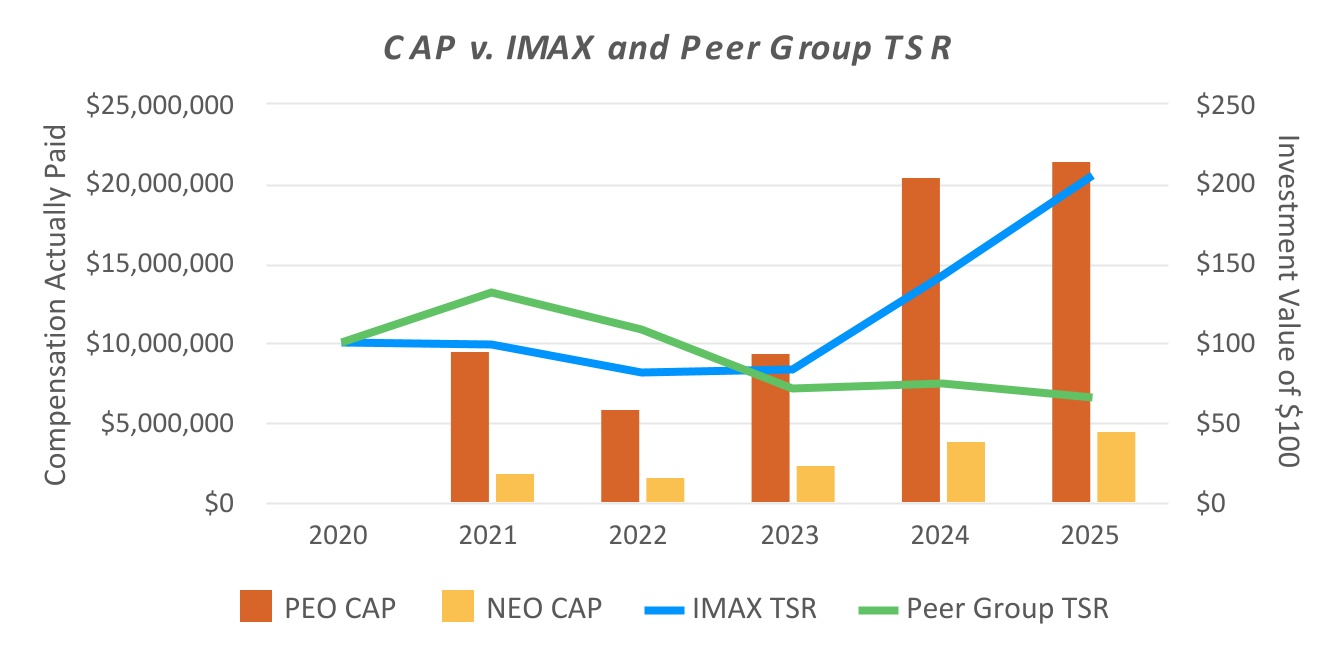
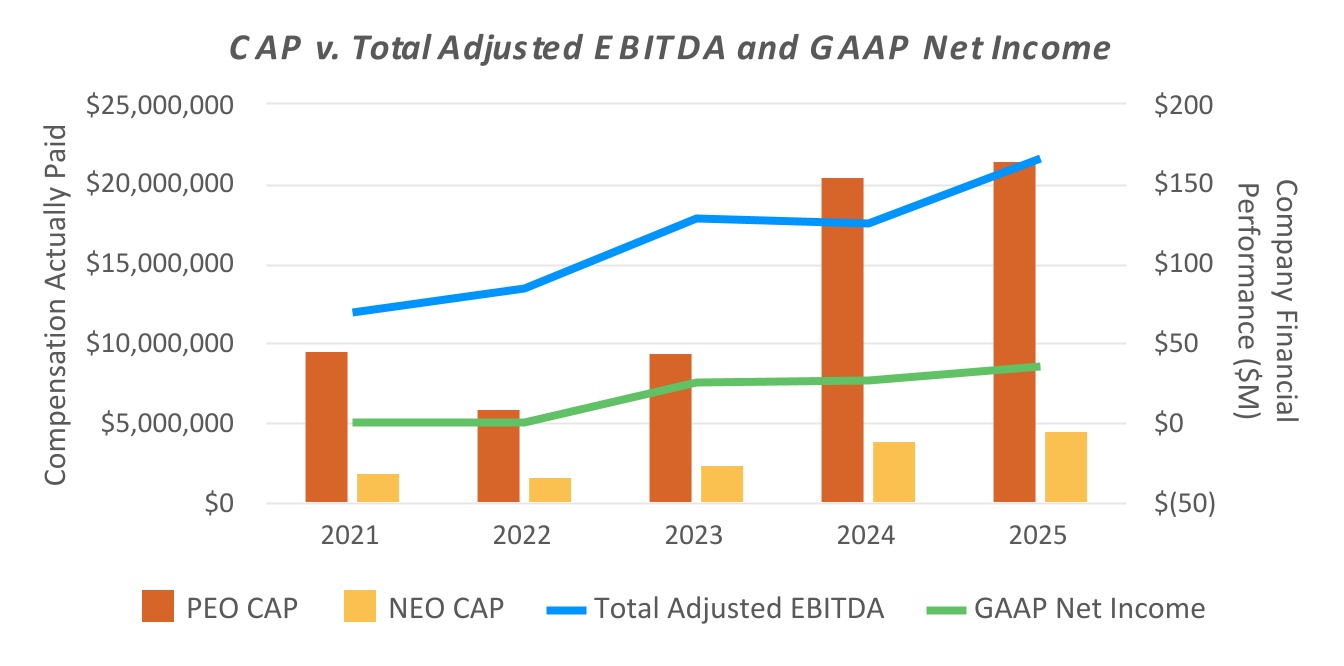
(59)
List of Most Important Performance Measures for Fiscal Year 2025
The following list sets forth the performance measures (listed in alphabetical order) that the Company views as the “most important” measures for linking our NEOs’ compensation to the Company’s performance:
•Installations
•Signings
•Total Adjusted EBITDA Growth
•Total Adjusted EBITDA Margin
•Total Revenue
Further details on how these measures are used can be found in the “Compensation Discussion & Analysis” section beginning on page 27.
(60)
COMPENSATION OF DIRECTORS
Directors who are also employees of the Company receive no additional fees for service on the Board of Directors.
Our independent directors receive an annual retainer of $50,000. The Chairman of the Board of Directors receives an annual retainer of $62,500. In addition, Committee Chairs receive the following annual retainers: the Audit Committee Chair receives $15,000 and the Compensation Committee Chair and the Governance Committee Chair each receive $10,000, respectively. Committee members also receive the following yearly retainers: Audit Committee members receive $10,000; Compensation Committee members receive $7,500; and Governance Committee members receive $5,000. Committee retainers are in addition to any applicable retainer for being a Committee Chair.
Each year, independent directors are granted an annual grant of RSUs with a value of $125,000 on the date of grant, and the Chairman of the Board is granted an annual grant of RSUs with a value of $170,000 on the date of grant. These grants are made following the election of our independent directors at our annual general meeting of shareholders. The grants made in 2025 vested on the date of grant.
Directors are reimbursed for expenses incurred in attending meetings of the Board of Directors and Committees of the Board of Directors. The Governance Committee reviews director compensation and benefits on a periodic basis.
The following table sets forth information relating to compensation of our non-executive directors for the fiscal year ended December 31, 2025.
| Name | Fees Earned or Paid in Cash ($) | Stock Awards ($) (1) | All Other Compensation ($) | Total ($) | ||||||||||||||||
| Gail Berman | 57,500 | 124,980 | (2) | — | 182,480 | |||||||||||||||
| Eric A. Demirian | 75,000 | 124,980 | (2) | — | 199,980 | |||||||||||||||
| Kevin Douglas | 67,500 | 124,980 | (2) | — | 192,480 | |||||||||||||||
| David W. Leebron | 75,000 | 124,980 | (2) | — | 199,980 | |||||||||||||||
| Michael MacMillan | 65,000 | 124,980 | (2) | — | 189,980 | |||||||||||||||
| Steve Pamon | 62,500 | 124,980 | (2) | — | 187,480 | |||||||||||||||
| Dana Settle | 62,500 | 124,980 | (2) | — | 187,480 | |||||||||||||||
Darren Throop (Board Chair) | 112,500 | 169,977 | (3) | — | 282,477 | |||||||||||||||
| Jennifer Wong | 60,000 | 124,980 | (2) | — | 184,980 | |||||||||||||||
(1)As required by SEC rules, the “Stock Awards” column in this table reflect the aggregate grant date fair values of the RSU awards computed in accordance with FASB ASC Topic 718 (with no reductions for expected forfeitures). See “Capital Stock — Share-Based Compensation” in Note 16 of Notes to Consolidated Financial Statements in Item 8 of the 2025 Form 10-K, for the assumptions used to calculate the fair value of the RSUs.
(2)The director received a grant of 4,558 RSUs on June 12, 2025. The RSUs vested on June 12, 2025. None of our non-executive directors held outstanding awards as of December 31, 2025.
(3)Mr. Throop received a grant of 6,199 RSUs on June 12, 2025 in recognition of his position as Chairman of the Board. The RSUs vested on June 12, 2025.
(61)
2025 EQUITY COMPENSATION PLAN INFORMATION
The following table sets forth information regarding our Equity Compensation Plans as of December 31, 2025.
| Plan Category | Number of Securities to be Issued Upon Exercise of Outstanding Options, Warrants and Rights (a) | Weighted Average Exercise Price of Outstanding Options, Warrants and Rights (1) (b) | Number of Securities Remaining Available for Future Issuance Under Equity Compensation Plans (Excluding Securities Reflected in Column (a)) (c) | ||||||||
| Equity compensation plans approved by security holders | 4,203,883 | 25.82 | 3,427,292 | ||||||||
| Equity compensation plans not approved by security holders | — | — | — | ||||||||
Total(2) | 4,203,883 | 25.82 | 3,427,292 | ||||||||
(1)The weighted average exercise price is calculated based solely on outstanding stock options and does not take into account common shares that are subject to outstanding RSUs and PSUs, which do not have an exercise price.
(2)The number of securities to be issued upon exercise of outstanding options, warrants, and rights excludes 774,406 common shares that may be issued with respect to outstanding PSUs, assuming full achievement of the Total Adjusted EBITDA and TSR targets.
(62)
CORPORATE GOVERNANCE
The Board of Directors believes that good corporate governance is fundamental to our overall success. The Board has adopted the following key corporate policies and practices:
•Nine out of ten director nominees are independent.
•Annual election of all directors and mandatory retirement.
•Annual Board and committee self-evaluations.
•Board “overboarding” limits and approval required before directors accept another public company directorship.
•Regular executive sessions of independent directors, and ability of directors to meet “in camera” without management present at each scheduled quarterly meeting.
•The Board and its Committees hire outside advisors independently of management.
•One class of common stock, with each share carrying equal voting rights (a “one-share, one-vote” standard).
•Independent Board chair, independent committee chairs, and independent committee membership.
•Clawback policy that applies to all executive officers.
•Anti-hedging and anti-pledging provisions in our Insider Trading Policy.
•No poison pill.
•Advance notice bylaw that allows any shareholder to nominate a director.
•Corporate Governance Guidelines and Code of Business Conduct and Ethics.
•Share ownership requirements for directors and executives.
In addition, the Governance Committee of the Board of Directors, which is currently composed of Messrs. Leebron (Chair), MacMillan and Pamon, and Ms. Settle, all of whom are independent directors, reviews our corporate governance practices from time to time, as further described in “Corporate Governance Guidelines.”
Corporate Governance Guidelines
The Board of Directors has adopted the Company’s Corporate Governance Guidelines, which outline the Board of Directors’ authority, responsibilities, composition, and procedures.
The role of the Board of Directors is to supervise the management of the business and affairs of the Company, including:
•overseeing the strategic and business planning processes and reviewing, approving, and monitoring the annual and long-term operating plans, including fundamental financial and business strategies and objectives;
•reviewing and approving the Company’s annual and quarterly financial statements;
•reviewing and assessing the major risks the Company faces and reviewing, approving, and monitoring its approach to addressing such risks;
•developing and reviewing the CEO’s corporate objectives, annually evaluating the performance of the CEO against these objectives, determining the CEO’s performance-based compensation annually, providing input into the CEO's evaluation of the performance of principal senior executives, and developing appropriate succession plans, from time to time; and
(63)
•reviewing and monitoring the Company’s controls and procedures, including its disclosure controls and procedures to maintain its integrity, its internal controls and procedures for financial reporting, and its compliance with the Code of Business Conduct and Ethics (the “Code of Ethics”), as well as satisfying itself as to the integrity of the CEO and other executive officers and their fostering of a culture of integrity throughout the Company.
A current copy of the Corporate Governance Guidelines, the text of which is incorporated by reference into this Circular, is available, without charge, at https://imaxcorporation.gcs-web.com/governance/.
Director Independence
Nine of the Company’s ten directors are independent as defined under applicable legal, regulatory, and stock exchange requirements. Section 303A of the NYSE Listed Company Manual provides that no director qualifies as “independent” unless the Board of Directors affirmatively determines that such director has no material relationship with the Company, and Section 1.2 of Canadian National Instrument 58-101 provides that an independent director is a person other than an officer or employee of the Company, or an individual having a material relationship with the Company that in the opinion of the Board of Directors could reasonably interfere with the exercise of independent judgment in carrying out the responsibilities of the director. The NYSE Listed Company Manual and Canadian National Instrument 58-101 set forth specific categories of relationships that disqualify a director from being independent.
The Board of Directors has reviewed the independence of each director and considered whether any director has a material relationship with the Company. As a result of this review, the Board of Directors affirmatively determined that each of the following directors, representing nine of our ten directors, is independent within the meaning of the NYSE, Canadian securities regulations, and SEC director independence standards, as currently in effect:
•Gail Berman | •David W. Leebron | •Dana Settle | ||||||
•Eric A. Demirian | •Michael MacMillan | •Darren Throop | ||||||
•Kevin Douglas | •Steve R. Pamon | •Jennifer Wong | ||||||
Our Board of Directors’ independence determination was based on information provided by the directors and discussions among the officers and directors.
In making the foregoing independence determination, the Board of Directors considered that Mr. Douglas is our largest individual shareholder, holding approximately 15.23% of our Common Shares as of April 13, 2026. The Board determined that, notwithstanding Mr. Douglas’ shareholdings, he has neither a direct nor indirect material interest in any transactions with the Company.
By virtue of Mr. Gelfond’s current role as CEO, IMAX Corporation, he is not an independent director.
All members of the Compensation Committee, Audit Committee, and Governance Committee are “independent” pursuant to the relevant SEC and Canadian regulations and NYSE rules. In the event any transaction or agreement is proposed in respect of which a director has a material interest, the director will be recused from voting on that matter and removed from the meeting while the transaction at issue is being considered by the Board of Directors.
Board Leadership Structure
Under our Corporate Governance Guidelines, the Board of Directors has the flexibility to determine the appropriate Board of Directors leadership structure. In making this determination, the Board of Directors considers many factors, including the needs of the business at the time, the assessment of its leadership needs, and the best interests of shareholders. When the Chair is not an independent director, the independent directors will appoint a lead independent director.
Mr. Throop, an independent director, currently serves as the Chair of the Board. An independent Chair contributes to the Board’s oversight role and assessment of the CEO and management generally. The Board appointed Mr. Throop to serve as Chair of the Board due to his many years as a valuable member of our Board, as well as his extensive operational and leadership experience. The CEO is responsible for setting our strategic direction and the day-to-day leadership of our business, while the Chair, along with the rest of our independent directors, ensures that the Board’s time and attention are focused on oversight of the Company’s most critical matters.
The Board of Directors routinely assesses its Board leadership structure with careful consideration of the feedback obtained through shareholder engagement.
(64)
Risk Oversight
The Board of Directors is responsible for understanding the material risks that we face over the short, intermediate, and long terms and overseeing management of those risks. The Board of Directors recognizes that the risks we face vary in likelihood, magnitude, and timeline and that purposeful and appropriate risk-taking is integral to achieving the Company’s strategic objectives and long-term success. The Board of Directors regularly engages in discussion of financial, legal, business, technology, economic, political, and other risks. Because overseeing risk is an ongoing process and inherent in our strategic decisions, the Board of Directors also discusses risk in relation to specific proposed matters.
The Board of Directors implements its risk oversight function both as a whole and through its committees. Each of the board committees is authorized by its charter to engage, at its discretion, independent consultants in carrying out its responsibilities. As part of our enterprise risk management (“ERM”) program, management monitors and assesses material risks faced by the Company and provides regular reports on the risk portfolio and mitigation efforts thereto to the committees, which in turn report to the full Board. The Board believes that its leadership structure and the delegation of responsibilities to its committees are appropriate and effective in facilitating board-level risk oversight.
| RISK OVERSIGHT BY THE COMMITTEES OF THE BOARD | ||||||||||||||
| AUDIT COMMITTEE | COMPENSATION COMMITTEE | GOVERNANCE COMMITTEE | ||||||||||||
| Responsible for overseeing the ERM; risks related to financial statements, financial reporting, accounting, cybersecurity and data privacy and other information technology, and legal matters; internal control and audit function; and Whistleblower Program. Meets separately with our CEO and representatives of our independent auditors a minimum of four times per year. | Responsible for overseeing risks associated with our compensation policies and practices, including the incorporation of features that mitigate risks without diminishing the incentive nature of compensation. | Responsible for overseeing risks related to the Company’s governance structure and other corporate governance matters, including succession planning, the composition and effectiveness of the Board of Directors and its committees, compliance with the Code of Ethics, conflicts of interests and related party transactions, stakeholder engagement, and adequacy of the Corporate Governance Guidelines, and ESG matters. | ||||||||||||
While the Board of Directors is responsible for reviewing and assessing the major risks that we face and for reviewing, approving and monitoring our approach to addressing such risks, our management is charged with managing risk. We have robust internal processes and a strong internal control environment to identify and manage risks and to communicate with the Board of Directors through senior management. The ERM program is designed to identify, assess, prioritize, and mitigate risks across the Company. Under the ERM program, management assesses enterprise risks by collecting and reviewing information from various internal functions and develops mitigation responses for identified risks. Management provides regular reports on the risk assessment and mitigation efforts to the Board and its committees as appropriate. The risks identified are incorporated into the Board and management’s decision-making processes. In addition to the ERM program, the Company has also implemented the following policies and practices to help monitor the risks the Company faces:
•regular management disclosure committee meetings;
•the Code of Ethics;
•a Whistleblower Program;
•an Anti-Bribery and Anti-Corruption Policy;
•an Insider Trading Policy;
•a Clawback Policy;
•rigorous product quality standards and processes; and
(65)
•comprehensive internal and external audit processes.
Board & Management Succession Planning
The Board of Directors recognizes that effective succession planning is important to the long-term success of the Company and the continuity of its leadership. The Board, with support from the Governance Committee and senior management, oversees an ongoing process for the identification and development of executive talent.
During 2024, the Board reviewed succession plans for the Company’s named executive officers and other key senior leadership positions. This review included, among other things, the development and refinement of role profiles for critical positions (including the Chief Executive Officer, Chief Financial Officer, President of Global Theatres, Chief Legal Officer, and President of Entertainment), evaluation of internal candidates, consideration of external candidates, and review of short-term contingency plans and longer-term succession scenarios. The Board also reviewed leadership development plans designed to support the readiness of potential successors. In 2025, the Company focused on actively developing those individual within the Company who have been identified as potential successors.
Succession planning is an ongoing process, and the Board regularly reviews the Company’s leadership pipeline and development initiatives. The Company intends to continue to expand its succession planning efforts to include additional senior management roles to support leadership continuity. In light of Mr. Gelfond’s temporary medical leave of absence, the Board considered business needs and reviewed the contingency plan for an interim PEO. On April 16, 2026, the Board appointed Mr. Lister, the Company’s Chief Legal Officer and Senior Executive Vice President, to serve as the Company’s interim PEO in addition to his current duties until May 1, 2026, following which Mr. Gelfond will resume the role of PEO.
Nomination Process
The Governance Committee is responsible for identifying and recommending candidates for election or re-election to the Board of Directors. Such candidates are then nominated for election by a majority of our independent directors. The Governance Committee does not set forth specific, minimum qualifications that nominees must possess, but rather believes that each nominee should be evaluated in light of opportunities and risks facing the Company and the competencies, skills, and personal qualities that are desirable to contribute to our effective governance. The Governance Committee seeks individuals from different backgrounds with varying perspectives, professional experience, education, and skills. In evaluating potential nominees for election and re-election as members of the Board of Directors, the Governance Committee seeks nominees that:
•manifest the highest integrity and possess the highest personal and professional ethics and values;
•have significant business experience or other organizational leadership experience that will allow the nominee to contribute significantly to the Company as a member of the Board of Directors;
•have the willingness and an ability to make the necessary time commitment to actively participate as a member of the Board of Directors;
•exhibit sound business judgment;
•are committed to effectively representing the interests of our shareholders; and
•for re-elections, have participated in and contributed to the activities of the Board and have devoted sufficient time and attention to being a director.
Candidates are identified from a number of sources including recommendations from directors, management, shareholders, and others. The Governance Committee will consider any nominee recommended by a shareholder under the same criteria as any other potential nominee. Please see “Procedures for Considering Shareholder Proposals and Director Nominations for Our 2027 Annual General Meeting” on page 7 for information on how shareholders may nominate a director.
(66)
Board Composition
Our Corporate Governance Guidelines provide that the Board of Directors may be comprised a minimum of one and a maximum of 15 directors, with the actual number determined from time to time by resolution of the Board of Directors. As of the date of this Circular, the size of the Board of Directors has been set at ten directors.
The Board of Directors recognizes that one of its key responsibilities is to evaluate and determine its optimal governance structure so as to provide independent oversight of management. The Board of Directors has determined that there is no single, generally accepted approach to providing governance and that the right governance structure for the Board of Directors may vary as circumstances warrant. Consistent with this understanding, the independent directors consider the Board of Directors’ size and composition on an annual basis in connection with its annual self-evaluation.
In considering its governance structure, the Board of Directors has taken a number of factors into consideration. The Board of Directors, with nine of its ten directors being independent, exercises strong, independent oversight. This oversight function is enhanced by the fact that all of the Board Committees and their respective chairpersons are comprised entirely of independent directors. A number of processes and procedures of the Board of Directors and of the Committees provide independent oversight of the CEO’s performance:
•regular executive sessions of the independent directors;
•the ability of independent directors to contact one another, the CEO, and other executive officers at any time; and
•the annual evaluations of the performance of the CEO against predetermined metrics and qualitative contributions.
The Board of Directors recognizes the importance of periodically refreshing the Board and aims to strike a balance between the knowledge and experience that comes from longer tenures on the Board of Directors with the fresh ideas and perspectives that can come from adding new members.
In addition to identifying and recommending candidates for directorship, the Governance Committee is responsible for reviewing the Board’s composition on a periodic basis. In accordance with the Governance Committee Charter, the Governance Committee considers independence, diversity, age, competencies, skills, experiences, availability of service to the Company, and tenure of the directors, and the Board’s anticipated needs in reviewing the current Board composition. The Governance Committee also considers succession planning in light of anticipated retirements, and for Board and Committee Chair roles, to maintain relevant expertise and depth of experience.
When a vacancy on the Board of Directors occurs, the Governance Committee is responsible for identifying and recommending to the Board potential candidates for consideration based on the various experience and skills required as a result of such vacancy. In addition, the Governance Committee oversees an annual assessment of the effectiveness of the Board of Directors and Board Committees and self-assessments completed by the directors evaluating their individual performance and contributions to the Board of Directors.
Pursuant to the requirements of the CBCA, the Company has evaluated the number of (i) women; (ii) members of visible minorities; (iii) aboriginal persons; and (iv) persons with disabilities (collectively, the “Designated Groups”) represented on the Board of Directors and in senior management positions. As of the date of this Circular, 40% of our Board of Directors is represented by the Designated Groups, with three female directors (30%) and two directors who identify as members of a visible minority group (20%). One director falls under both categories. We currently have seven female members on our management team of 15 (47%) and two members of our management team who identifies as a member of a visible minority group (13%). The Company has not independently verified the responses of those who have self-identified as members of the Designated Groups. We do not have a policy or targets on the representation of Designated Groups on the Board of Directors or on our management team, as the Board of Directors does not believe that quotas result in the identification or selection of the best candidates. Rather, the Governance Committee takes into account the competencies, skills, and personal qualities described above.
Director Term Limits
The Board of Directors has not established any term limits for directors but has adopted a mandatory retirement age of 80. It does not believe there to be a correlation between term of service and effective board performance.
(67)
Meetings of the Board of Directors and its Committees
During the fiscal year ended December 31, 2025, the Board of Directors held seven meetings, the Audit Committee held six meetings, the Compensation Committee held one meeting and the Governance Committee held one meeting. Each incumbent director attended at least 75% of the aggregate meetings of the Board of Directors and Committees of the Board on which such director served in 2025. The independent directors are given the opportunity to hold executive sessions (where members of management are not in attendance) at all regularly scheduled Board of Directors meetings. Six such executive sessions of the Board of Directors were held during 2025.
Our Board of Directors does not include a single director chosen to preside over the regularly scheduled (quarterly) executive sessions. Executive sessions that follow Board of Directors meetings are usually informal discussions, which are often led by the Chair of the Board or a chair of one of the Board Committees, depending on the subjects to be discussed. The Chair of the Board reviews the matters to be discussed in executive sessions and determines which director is best placed to preside over the executive session. This process facilitates open and candid discussions among the independent directors.
The following incumbent directors attended the following number of Board of Directors meetings during the fiscal year ended December 31, 2025:
| Richard L. Gelfond | 7/7 | Kevin Douglas | 7/7 | Dana Settle | 6/7 | ||||||||||||
| Darren Throop | 7/7 | David W. Leebron | 7/7 | Jennifer Wong | 6/7 | ||||||||||||
Gail Berman | 6/7 | Michael MacMillan | 7/7 | ||||||||||||||
| Eric A. Demirian | 7/7 | Steve R. Pamon | 7/7 | ||||||||||||||
All of the members of the Audit Committee are independent directors and hold in camera sessions where members of management are not in attendance at least once each fiscal quarter. A total of four such in camera sessions were held during 2025.
While we encourage directors to attend our Annual General Meeting of Shareholders, there is no formal policy concerning such attendance. All of the directors attended last year’s Annual General Meeting of Shareholders.
Committees of the Board of Directors
To assist it in discharging its duties effectively, the Board of Directors has delegated some of its duties to three committees of the Board: the Audit Committee, the Compensation Committee, and the Governance Committee. Each of these committees and their respective chairs are appointed annually by the Board of Directors. Each committee has a written charter that sets out its principal duties and responsibilities. The Chair of each committee is responsible for reporting on the activities of that committee to the full Board of Directors on a periodic basis. Each committee has the authority to retain special legal, accounting, or other advisors. The following table shows the composition of each of our Board Committees on April 24, 2026.
| Name | Independent Director | Audit Committee | Governance Committee | Compensation Committee | ||||||||||
| Gail Berman | ü | ü | ||||||||||||
| Eric A. Demirian | ü | ü(Chair) | ||||||||||||
| Kevin Douglas | ü | ü(Chair) | ||||||||||||
| David W. Leebron | ü | ü | ü(Chair) | |||||||||||
| Michael MacMillan | ü | ü | ü | |||||||||||
| Steve R. Pamon | ü | ü | ü | |||||||||||
| Dana Settle | ü | ü | ü | |||||||||||
| Darren Throop | ü | |||||||||||||
| Jennifer Wong | ü | ü | ||||||||||||
Audit Committee
The Audit Committee is currently composed of Messrs. Demirian (Chair), Leebron and MacMillan, and Ms. Wong, each of whom is an independent director who meets the independence and other requirements of the NYSE and Canadian National Instrument 52-110 - Audit Committees standards applicable to Audit Committee members, and each of whom is also financially literate under NYSE listing standards. The Board of Directors has established the Audit Committee for the purpose of overseeing:
(68)
•The quality and integrity of our financial statements and related disclosure.
The committee reviews and discusses with management and the independent auditor the annual audited and quarterly unaudited financial statements, the Company’s disclosures under “Management’s Discussion and Analysis of Financial Condition and Results of Operations” (MD&A) in its annual report on the Form 10-K, and earnings press releases before they are issued. The committee also discusses critical accounting policies, alternative treatments of financial information, and other material communications between the independent auditor and management.
•Our compliance with legal and regulatory requirements.
The committee monitors the Company’s compliance with applicable legal and regulatory requirements, including by overseeing the Company’s Whistleblower Program, reviewing with management and counsel any material legal matters, reviewing the adequacy and effectiveness of the Company’s procedures to meet its compliance responsibilities, being consulted by management on the appointment or dismissal of the Chief Legal Officer, and obtaining reports from management on compliance with applicable legal and regulatory requirements.
•The independent auditors’ qualifications, independence, and performance.
The committee is directly responsible for the appointment, compensation, retention, and oversight of the Company’s independent auditor, including pre-approving all audit and permissible non-audit services to be provided; evaluating the independent auditor’s qualifications, performance and independence on an annual basis; and reviewing the independent auditor’s internal quality control procedures and overseeing the required rotation of the lead audit partner.
•The effectiveness of our internal controls and procedures, including the risk management program.
The committee reviews with management and the independent auditor the scope, planning and staffing of the proposed audit for the upcoming year; the quality, adequacy and effectiveness of the Company’s internal controls and procedures, including with respect to financial reporting; the Company’s policies on risk assessment and risk management; and the Company’s cybersecurity and other information technology risks, controls, and procedures.
•The performance of our internal audit function.
The committee annually reviews the Company’s internal audit plan and internal audit charter.
Each Audit Committee member has experience with various businesses and professions relevant to their understanding of the accounting principles used by the Company in preparing its financial statements and to their understanding of the general applications of such accounting principles in connection with the accounting for estimates, accruals, and reserves. These experiences have been with companies, businesses, and professional organizations presenting a breadth and level of complexity of accounting issues generally comparable to those reasonably expected to be raised by our financial statements, and have provided them with an understanding of internal controls and procedures for financial reporting. For more information on the education and experience of each Audit Committee member, see “Item No. 1 - Election of Directors” on page 9. The Board of Directors has determined that Mr. Demirian qualifies as an “audit committee financial expert” as that term is defined in Item 407(d)(5)(ii) of Regulation S-K as a result of Mr. Demirian’s qualifications as a Chartered Professional Accountant. Mr. Demirian serves as the Chair of the Audit Committee.
The Audit Committee meets with our external auditors, both with and without management present, to review and discuss our accounting policies, our quarterly and year-end financial statements and their presentation, and significant financial issues which may arise for our Company. The Audit Committee operates under the Audit Committee Charter, a copy of which is available, without charge, at https://imaxcorporation.gcs-web.com/governance/ or upon written request to the Company at IMAX Corporation, 902 Broadway, 20th Floor, New York, New York 10010, Attention: Corporate Secretary.
Compensation Committee
The Compensation Committee is currently composed of Messrs. Douglas (Chair) and Pamon and Mses. Berman and Settle, each of whom is an independent director. The Compensation Committee is responsible for evaluating and making recommendations to the Board of Directors regarding our equity-based and incentive compensation plans, policies, and programs. In addition, the Compensation Committee approves or recommends to the Board of Directors the compensation package (including components, quantum and timing) for our CEO, sets his performance metrics, and assesses his performance on a periodic basis. On an annual basis, the Compensation Committee reviews and approves the components and the amount of compensation paid to our NEOs. The Compensation Committee is also responsible for performing the functions required of it under our equity award plans, including the granting of RSUs and PSUs from time to time.
The Compensation Committee has the authority to retain outside consultants to provide independent advice to the Compensation Committee, after considering the independence of an advisor under applicable legal, regulatory, and stock exchange
(69)
requirements. In 2025, the Committee engaged Willis Towers Watson to provide market data and advice in connection with the negotiation of the CEO’s employment agreement. The Compensation Committee operates under the Compensation Committee Charter, a copy of which is available, without charge, at https://imaxcorporation.gcs-web.com/governance/ or upon written request to the Company at IMAX Corporation, 902 Broadway, 20th Floor, New York, New York 10010, Attention: Corporate Secretary.
Governance Committee
The Governance Committee is currently composed of Messrs. Leebron (Chair), MacMillan and Pamon, and Ms. Settle, each of whom is an independent director. The Governance Committee is responsible for monitoring and evaluating our corporate policies and governance practices, monitoring significant developments in the law and practice of corporate governance, monitoring and evaluating our compliance with the law, our Articles of Amalgamation, By-Laws, the Code of Ethics, and other governance agreements, and monitoring the effectiveness of the Board of Directors and Board Committees in the discharge of their general oversight responsibilities. In addition, the Governance Committee oversees our policies and programs concerning corporate social responsibility, including ESG matters.
The Governance Committee is responsible for identifying and recommending candidates for election to the Board of Directors. The Governance Committee evaluates potential new candidates for the Board of Directors on an ongoing basis in light of the opportunities and risks facing us and the competencies, skills, and personal qualities that are desirable to add value and to contribute to our effective governance. The Governance Committee also has the authority to engage consultants and third-party search firms to assist in identifying qualified candidates for the Board of Directors. The Governance Committee, together with the CEO and other members of the Board of Directors and/or senior management, meet with and interview potential candidates. See “Nomination Process” and “Board Composition” above for additional information.
The Governance Committee operates under the Governance Committee Charter, a copy of which is available, without charge, at https://imaxcorporation.gcs-web.com/governance/ or upon written request to the Company at IMAX Corporation, 902 Broadway, 20th Floor, New York, New York 10010, Attention: Corporate Secretary.
Orientation and Education
We have developed and implemented orientation materials and procedures for new directors. When new directors join our Board of Directors, we provide a comprehensive onboarding package, which includes written materials on our industry, business, strategies, and policies. New directors also have access to fellow directors and senior management and are invited to attend orientation sessions as necessary.
For continued education of our directors, we provide reports, presentations, and other written materials, prepared by internal and external experts, relating to our business and on relevant topics such as industry trends, geopolitical and macroeconomic developments, and the evolving regulatory landscape on a periodic basis. Directors are also offered annual membership in the National Association of Corporate Directors, at our expense.
Board and Committee Self-Assessment
On an annual basis, each director and committee member completes a review and self-evaluation of the Board of Directors’ and Board Committees’ operating effectiveness as well as his or her own individual performance as a member of the Board of Directors. The evaluation process solicits feedback on a range of issues, including Board and committee structure and compositions, meeting dynamics, interaction with management, and other information and resources available to the Board. The input is summarized on a confidential basis and provided to the Chair of the Governance Committee. The Governance Committee reports the results of the evaluations to the Board of Directors. Any agreed upon changes are implemented as applicable.
Directors’ Share Ownership Guidelines
To support the alignment of directors’ interests with those of our shareholders, non-management directors are required, in accordance with the Company’s Share Ownership Guidelines, to achieve and maintain a minimum level of share ownership. Directors subject to the policy must satisfy the guidelines within four years of the date such director first became subject to the policy. In 2024, the Share Ownership Guidelines were updated to increase the directors’ minimum shareholder requirement from 300% of their annual retainer to 400% of their annual retainer. As of April 1, 2026, all of the non-management directors had met their share ownership guidelines within the required time frame.
(70)
| Name | Guideline (% of Annual Retainer)(1) | Current Ownership (% of Annual Retainer) | ||||||
Gail Berman(2) | 400% | 789% | ||||||
| Eric A. Demirian | 400% | 1,169% | ||||||
| Kevin Douglas | 400% | 293,427% | ||||||
| David W. Leebron | 400% | 4,024% | ||||||
| Michael MacMillan | 400% | 1,383% | ||||||
Steve Pamon | 400% | 1,215% | ||||||
| Dana Settle | 400% | 2,485% | ||||||
| Darren Throop | 400% | 757% | ||||||
Jennifer Wong(2) | 400% | 756% | ||||||
(1)Pursuant to the Company’s Share Ownership Guidelines, compliance with such guidelines is measured as of April 1st of each year.
(2)Ms. Berman and Ms. Wong each became subject to the Share Ownership Guidelines in 2023 and are currently required to hold 75% of the minimum shareholding requirement.
(71)
CORPORATE RESPONSIBILITY
The Company makes it a priority to operate its business in a responsible and sustainable manner. This effort includes, but is not limited to, conducting business in a socially responsible and ethical manner, supporting human rights, and actively monitoring our environmental impact. The Company recognizes the importance of protecting our social, financial, informational, environmental, and reputational assets.
Corporate Social Responsibility
We focus on three key pillars to drive social impact:
1.Inspiring and empowering the next generation of filmmakers.
We support unique experiences to inspire younger generations of filmmakers and further their interest in filmmaking. In 2024 and 2025, our Los Angeles office hosted a group of high school students from the LA area as part of the All-American High School Film Festival, an organization dedicated to empowering young artists to share their stories and transform their world through digital media.
IMAX also has a long history of collaboration with the University of Southern California (“USC”), covering partnerships with filmmakers and creatives, internship programs, and screenings. In 2024, we partnered with USC on workshops to immerse students in the process of filming with IMAX cameras. Building on the success of the 2024 pilot, IMAX expanded the 2025 program, in partnership with Kodak, Giant Screen Cinema Association and FotoKem, to include over 30 student filmmakers from multiple universities, offering a deeper hands-on experience with IMAX cameras. The workshop took place in the dramatic Alabama Hills of Lone Pine, California, with IMAX providing both an MSM 70mm film camera and an Alexa LF digital camera, giving students a rare opportunity to compare analog and digital formats side by side. Instruction was led by returning IMAX experts, with continued support from a member of USC’s faculty. The workshop concluded at our Los Angeles office, where students reviewed their footage on an IMAX screen.
2.Creating opportunities for underserved communities.
We are committed to supporting organizations with deep roots in our communities that are dedicated to creating a positive impact on marginalized, underserved, or otherwise disadvantaged communities. We host an annual Company-wide day of service, “IMAX Impact Day,” which is now in its fourth year and provides opportunities for employees to volunteer their time to charitable organizations and causes worldwide. Across IMAX offices in six different countries, our employees partner with 17 charitable organizations that address food insecurity, homelessness, mental illness, environmental preservation and much more. Some of the organizations we work with include Project Angel Food and Habitat for Humanity in Los Angeles, Riverwood Conservancy and Women in Film and Television in Toronto, and global organizations including Clean Coasts. In addition to employee time, IMAX contributes financially to all organizations involved.
IMAX hosted an employee donation-matching campaign for corporate staff in support of the 2025 Los Angeles Wildfire Relief, matching employee donations to a select group of registered charities throughout Los Angeles County that provided direct on-the-ground support to residents recovering from the devastating effects of the wildfires. Organizations included the American Red Cross, Best Friends Animal Society, California Community Foundation, California Wildlife Center, Pasadena Humane, LA Fire Department Foundation, and Los Angeles Regional Food Bank.
Employees at IMAX also organized in support of the Movember Foundation, creating a global campaign across IMAX offices on three different continents to raise awareness of men’s health issues and fundraise throughout the month of November 2025.
3.Preservation and enhancement of our planet for future generations.
As one of the world’s leading entertainment technology companies, we believe in making a global social impact through the use of our technology to capture the beauty and fragility of our environment and life on earth in documentaries. IMAX’s catalog of sustainability-themed films in the recent decades includes A Beautiful Planet, Born to be Wild, Pandas, To the Arctic, Island of Lemurs: Madagascar and many more. IMAX works with educators and learning centers to create educational guides for our sustainability-themed documentaries to be used by teachers in classrooms. This is an extension of the Company’s mission to educate, entertain, and inspire audiences globally. We believe in the power of film to promote awareness of and appreciation for the “big picture,” the understanding that the actions we take in our daily lives can significantly impact the future of the planet.
IMAX is partnering with Adam McKay’s Hyperobject Industries on the forthcoming original documentary Stormbound, which chronicles the dangerous world of storm chasing and extreme weather events in the United States. Featuring remarkable unseen
(72)
footage of Hurricanes Charley, Florence, Ian, Irma, and Katrina, Stormbound will showcase nature's raw power with an inspiring true story of hope and survival. The film, shot with IMAX cameras, is currently in production and is scheduled for release across the IMAX network.
Environmental Sustainability
IMAX seeks to raise awareness in environmental sustainability and to reduce our environmental footprint by implementing energy efficient measures, reducing waste, reducing use of fresh water, and limiting runoff through the storm water system in the Company’s facilities. The Company partnered with Credit Valley Conservation to build an environmentally friendly parking lot, plant trees, and develop a trail at the Company’s Sheridan Park office in Mississauga, Ontario. In 2022, IMAX was recognized with a “Friend of the Credit Conservation Award” from Credit Valley Conservation in the category of Corporate Leadership. This award recognizes the important work being done to preserve the Credit River Watershed and to adopt new and creative approaches to plan for an environmentally sustainable future. In 2024, our Sheridan Park and Los Angeles facilities implemented a new waste management practice to divert organic wastes from landfills. In addition, the Company has installed water bottle filler stations in its facilities and encourages their use to reduce the use of water bottles across its offices. The Company regularly reviews sustainability projects for its facilities, particularly the owned facilities in Ontario and California.
Human Capital
The Company recognizes that effective human capital management is essential to its success, and it seeks to cultivate a culture and employee experience that transcends the ordinary. By doing so, the Company aims to achieve higher levels of employee engagement, which positively impacts workforce retention, enhances performance, and drives greater innovation. Please see the section titled “Human Capital” in the 2025 Form 10-K for additional information regarding the Company’s employee programs and compensation practices.
CODE OF BUSINESS CONDUCT AND ETHICS AND INSIDER TRADING POLICY
Code of Business Conduct and Ethics
We have a Code of Ethics applicable to all employees, including the principal executive officer, principal financial officer, principal accounting officer or controller and all other persons performing similar functions, and all directors and contractors. Any incidents or reports made in connection with a potential violation of the Code of Ethics are reported to the Audit Committee through (i) the Whistleblower hotline or (ii) our internal audit function. The Governance Committee also monitors compliance with the Code of Ethics, including periodic review with the Chief Legal Officer of the adequacy and effectiveness of the Company’s procedures to ensure proper compliance. The Code of Ethics is distributed to applicable individuals on commencement of service and annually thereafter. Such individuals are required annually to acknowledge receipt of, read and agree to abide by the Code of Ethics. A copy of the Code of Ethics is available without charge at https://imaxcorporation.gcs-web.com/governance/ or upon written request at IMAX Corporation, 902 Broadway, 20th Floor, New York, New York 10010, Attention: Corporate Secretary. Any amendments to, or waivers of, the Code of Ethics will be disclosed to the extent required by applicable law or the rules of the NYSE at https://imaxcorporation.gcs-web.com/governance/.
Insider Trading Policy
To further align the interests of our directors, officers, and employees with those of our shareholders, we adopted our Insider Trading Policy, which governs the purchase, sale, and/or other dispositions of our securities by directors, officers, employees, contractors, and consultants who have access to material non-public information. The Insider Trading Policy is designed to promote compliance with insider trading laws, rules, and regulations as well as the listing standards of the NYSE. It is also the policy of the Company that the Company will not engage in a transaction in Company securities while aware of material nonpublic information related to the Company or Company securities. A copy of the Insider Trading Policy is filed as Exhibit 19.1 to the 2025 Form 10-K.
The Insider Trading Policy prohibits all covered individuals from engaging in any transactions involving our securities while in possession of material non-public information of the Company. They are also prohibited from engaging in activities that are designed to hedge or offset decreases or increases in the market value of our securities (including, without limitation, prepaid variable forward contracts, equity swaps, collars, and exchange funds). In addition, directors, officers, and employees may not hold our securities in a margin account or pledge our securities as collateral for a loan. The Insider Trading Policy also requires directors and officers subject to Section 16 of the Exchange Act to obtain pre-clearance for trades in our securities from our Chief Legal Officer or our Deputy General Counsel and Corporate Secretary.
(73)
POLICIES AND PRACTICES FOR GRANTING OPTION AWARDS
The Company does not currently award stock options as a part of our equity compensation programs, but Mr. Gelfond holds outstanding stock option awards that were granted under our equity-based incentive plans in prior fiscal years. We do not grant option awards in anticipation of the release of material non-public information that is likely to result in changes to the price of our Common Shares. In addition, we generally do not grant stock options (i) during trading blackout periods established under our Insider Trading Policy, or (ii) at any time during the four business days prior to or the one business day following the filing of our periodic reports or the filing or furnishing of a Form 8-K that discloses material non-public information. These restrictions do not apply to RSUs, PSUs, or other types of equity awards that do not include an exercise price related to the market price of our Common Shares on the date of grant.
During fiscal year 2025, (i) none of our NEOs were granted stock options with an effective grant date during any period beginning four business days before the filing or furnishing of a Form 10-Q, Form 10-K, or Form 8-K that disclosed material non-public information, and ending one business day after the filing or furnishing of such reports, and (ii) we did not time the disclosure of material non-public information for the purpose of affecting the value of executive compensation.
DELINQUENT SECTION 16(A) REPORTS
Section 16(a) of the Securities Exchange Act of 1934, as amended, requires our directors, officers, beneficial owners of more than ten percent of our common shares to report ownership and changes in ownership with the SEC on Forms 3, 4, and 5. We believe all of these reports were timely filed in the fiscal year ended December 31, 2025 based upon our review of the reports filed with the SEC, with the exception of the following report, which was filed late due to an administrative delay.
•Jose Zlatar, who was late in filing a Form 3 following his becoming an executive officer of the Company on April 30, 2025. His Form 3 was filed on May 27, 2025.
REVIEW, APPROVAL OR RATIFICATION OF TRANSACTIONS WITH RELATED PERSONS
On a regular basis, we require our directors, nominees for director, and executive officers to identify to the Board of Directors transactions and/or relationships that could constitute transactions with a related person as defined in Item 404(a) of Regulation S-K. For any potential transaction in which a director, executive officer, nominee for director, 5% or greater beneficial owner, any immediate family members of the foregoing, or other related person would have a material interest that is expected to exceed $120,000 in a single calendar year, such transaction is reviewed, in advance, by our Chief Legal Officer and Chief Compliance Officer to ensure compliance with our Code of Ethics and to evaluate the disclosure requirements under Item 404(a) of Regulation S-K before the transaction is considered for approval by the Board of Directors. In the course of its review and approval or ratification of a related person transaction, the Board of Directors considers:
•the approximate dollar value of the transaction;
•the related person’s interest in the transaction and the approximate dollar value of such interest without regard to any profit or loss;
•the position of the related person within the Company or relationship with the Company;
•the materiality of the transaction to the related person and the Company;
•whether the transaction was undertaken in the ordinary course of business of the Company;
•whether the transaction would impair the independence of a non-employee director;
•whether the transaction with the related person is proposed to be, or was, entered into on terms no less favorable to the Company than terms that could have been reached with an unrelated third party;
•the purpose of, and the potential benefits to the Company of, the transaction; and
•any other information regarding the transaction or the related person in the context of the transaction that would be material to investors in light of the circumstances of the particular transaction.
(74)
Currently, we do not have a formal written policy governing transactions with related persons. In the event any transaction or agreement occurs in respect of which a director has a material interest, the director will be recused from voting on that matter and will not participate in the meeting while the transaction at issue is being considered by the Board of Directors.
CERTAIN RELATIONSHIPS AND RELATED TRANSACTIONS
None of our directors or executive officers, or any security holder of record as of the date of this Circular who owned, of record or to our knowledge, more than 5% of our outstanding Common Shares, or any member of such person’s immediate family, had any material interest, direct or indirect, in any transaction during the last fiscal year, or since the commencement of the current fiscal year, in any completed or proposed transaction, except for the following:
Mr. Douglas is our largest individual shareholder, holding approximately 15.23% of our Common Shares as of April 13, 2026. However, the Board of Directors has determined that, notwithstanding Mr. Douglas’ shareholdings, he has neither a direct nor indirect material interest in any transactions with the Company.
(75)
NON-GAAP FINANCIAL MEASURES
In this Circular, the Company presents Total Adjusted EBITDA and Margin, Attributable Adjusted EBITDA and Margin, and Adjusted EPS as supplemental measures of the Company’s performance which are not recognized under GAAP.
The Company believes that these non-GAAP financial measures are important supplemental measures that allow management and users of the Company’s financial statements to view operating trends and analyze controllable operating performance on a comparable basis between periods without the after-tax impact of share-based compensation and certain unusual items included in net income attributable to common shareholders. Although share-based compensation is an important aspect of the Company’s employee and executive compensation packages, it is a non-cash expense and is excluded from certain internal business performance measures.
These non-GAAP financial measures allow a more comprehensive analysis of the Company’s operating performance. In addition, the Company believes that they present relevant and useful information widely used by analysts, investors and other interested parties in the Company’s industry to evaluate, assess and benchmark the Company’s results. These non-GAAP measures may not be comparable to similarly titled amounts reported by other companies. Additionally, the non-GAAP financial measures used by the Company should not be considered as a substitute for, or superior to, the comparable GAAP amounts.
Total Adjusted EBITDA and Margin, and Attributable Adjusted EBITDA and Margin
EBITDA is defined as reported net income or loss excluding: (i) income tax expense or benefit; (ii) interest expense, net of interest income; (iii) depreciation and amortization, including film asset amortization; and (iv) amortization of deferred financing costs. Total Adjusted EBITDA is defined as EBITDA excluding: (i) share-based and other non-cash compensation; (ii) realized and unrealized investment gains or losses; (iii) transaction related expenses; (iv) restructuring charges and other impairments; (v) write-downs, net of recoveries, including goodwill, asset impairments and credit loss expense or reversal; and (vi) induced conversion expense on settlement of convertible notes. Attributable Adjusted EBITDA is defined as Total Adjusted EBITDA less non-controlling interests of the Company’s subsidiaries.
Total Adjusted EBITDA Margin is defined as Total Adjusted EBITDA divided by Revenue. Attributable Adjusted EBITDA Margin is defined as Attributable Adjusted EBITDA divided by Revenue.
A reconciliation of Net Income and Margin, which are the most directly comparable GAAP measures to Total Adjusted EBITDA and Margin, respectively, and to Attributable Adjusted EBITDA and Margin are presented in the table below.
(76)
Years Ended | |||||||||||||||||
(in thousands of U.S. Dollars, except for Adjusted EBITDA Margin amounts) | 2025 | 2024 | 2023 | ||||||||||||||
| Reported net income | $ | 45,526 | $ | 32,702 | $ | 33,066 | |||||||||||
| Add (subtract): | |||||||||||||||||
| Income tax expense | 17,767 | 4,996 | 13,051 | ||||||||||||||
| Interest expense, net of interest income | 2,578 | 3,936 | 2,101 | ||||||||||||||
| Depreciation and amortization, including film asset amortization | 62,446 | 65,503 | 60,022 | ||||||||||||||
Amortization of deferred financing costs(1) | 1,984 | 1,969 | 2,235 | ||||||||||||||
| EBITDA | $ | 130,301 | $ | 109,106 | $ | 110,475 | |||||||||||
Share-based and other non-cash compensation | 26,824 | 23,209 | 24,230 | ||||||||||||||
| Unrealized investment losses (gains) | 867 | (127) | (465) | ||||||||||||||
Transaction-related expenses | — | — | 3,569 | ||||||||||||||
Restructuring charges and other impairments | 2,478 | 3,749 | 2,946 | ||||||||||||||
| Write-downs, including asset impairments and credit loss expense | 9,211 | 2,999 | 3,273 | ||||||||||||||
Induced conversion expense on settlement of convertible notes | 15,264 | — | — | ||||||||||||||
Total Adjusted EBITDA | $ | 184,945 | $ | 138,936 | $ | 144,028 | |||||||||||
Less: Non-Controlling Interest | $ | (19,193) | $ | (14,191) | $ | (15,869) | |||||||||||
Attributable Adjusted EBITDA | $ | 165,752 | $ | 124,745 | $ | 128,159 | |||||||||||
Revenue | 410,212 | 352,208 | 374,839 | ||||||||||||||
Net Income Margin | 11.1% | 9.3% | 8.8% | ||||||||||||||
Total Adjusted EBITDA Margin | 45.1% | 39.4% | 38.4% | ||||||||||||||
Attributable Adjusted EBITDA Margin | 40.4% | 35.4% | 34.2% | ||||||||||||||
(1)The amortization of deferred financing costs is recorded within Interest Expense in the Consolidated Statements of Operations.
Adjusted EPS
Adjusted net income or loss attributable to common shareholders and adjusted net income or loss attributable to common shareholders per basic and diluted share exclude, where applicable: (i) share-based compensation; (ii) realized and unrealized investment gains or losses; (iii) transaction related expenses, (iv) goodwill impairments, (v) restructuring charges and other impairments; (vi) employee retention credits; and (vii) induced conversion expense on settlement of convertible notes; as well as the related tax impact of these adjustments.
Reconciliations of net income attributable to common shareholders and the associated per share amounts to adjusted net income attributable to common shareholders and adjusted net income attributable to common shareholders per basic and diluted share are presented in the table below.
(77)
Years Ended | |||||||||||||||||||||||||||||||||||
| 2025 | 2024 | 2023 | |||||||||||||||||||||||||||||||||
| (In thousands of U.S. Dollars, except per diluted share amounts) | Net Income | Per Diluted Share | Net Income | Per Diluted Share | Net Income | Per Diluted Share | |||||||||||||||||||||||||||||
Net income attributable to common shareholders | $ | 34,876 | $ | 0.63 | $ | 26,059 | $ | 0.48 | $ | 25,335 | $ | 0.46 | |||||||||||||||||||||||
Adjustments(1): | |||||||||||||||||||||||||||||||||||
| Share-based compensation | 26,133 | $ | 0.47 | 22,454 | $ | 0.42 | 23,184 | $ | 0.42 | ||||||||||||||||||||||||||
Unrealized investment losses (gains) | 867 | $ | 0.02 | (127) | $ | — | (558) | $ | (0.01) | ||||||||||||||||||||||||||
| Transaction-related expenses | — | $ | — | — | $ | — | 3,361 | $ | 0.06 | ||||||||||||||||||||||||||
| Goodwill impairment | 7,000 | $ | 0.13 | — | $ | — | — | $ | — | ||||||||||||||||||||||||||
| Restructuring charges and other impairments | 2,447 | $ | 0.04 | 3,749 | $ | 0.07 | 2,688 | $ | 0.05 | ||||||||||||||||||||||||||
| Employee retention credits | (3,971) | $ | (0.07) | — | $ | — | — | $ | — | ||||||||||||||||||||||||||
| Induced conversion expense on settlement of convertible notes | 15,264 | $ | 0.27 | — | $ | — | — | $ | — | ||||||||||||||||||||||||||
| Tax impact on items listed above | (2,032) | $ | (0.04) | (1,125) | $ | (0.02) | (1,931) | $ | (0.04) | ||||||||||||||||||||||||||
Adjusted net income(1) | $ | 80,584 | $ | 1.45 | $ | 51,010 | $ | 0.95 | $ | 52,079 | $ | 0.94 | |||||||||||||||||||||||
| Weighted average shares outstanding (in thousands): | |||||||||||||||||||||||||||||||||||
| Basic | 53,636 | 52,650 | 54,310 | ||||||||||||||||||||||||||||||||
| Diluted | 55,544 | 53,864 | 55,146 | ||||||||||||||||||||||||||||||||
 (1)Reflects amounts attributable to common shareholders. | |||||||||||||||||||||||||||||||||||
(78)
AVAILABLE INFORMATION
We make available free of charge our annual reports on Form 10-K, quarterly reports on Form 10-Q and current reports on Form 8-K as soon as reasonably practicable after such filing has been made with the SEC. Reports are available at https://imaxcorporation.gcs-web.com/sec-filings/ or by calling Investor Relations at 1-212-821-0154. Additional information relating to the Company is available at www.sedarplus.ca and www.sec.gov/edgar. Financial information is provided in our comparative financial statements and MD&A for our most recently completed financial year. The text of the current copy of the Corporate Governance Guidelines is incorporated by reference into this Circular.
APPROVAL BY BOARD OF DIRECTORS
The contents and the sending of this Circular to each shareholder entitled to receive notice of the Meeting, to each director and to the auditors of the Company have been approved by the Board of Directors.
April 24, 2026
| /s/ Kenneth I. Weissman | |||||
| Kenneth I. Weissman | |||||
| Deputy General Counsel & Corporate Secretary | |||||
(79)